

In this article (10 sections)
- What is the ECGT?
- How does the ECGT differ from the Green Claims Directive?
- The 12 new blacklisted practices
- Claims not on the blacklist but assessed case by case
- New information under the Consumer Rights Directive
- Why are B2B Taiwanese suppliers also being asked?
- What about packaging already printed and stock on hand?
- What are the consequences of breaching the ECGT?
- FAQ
- Conclusion
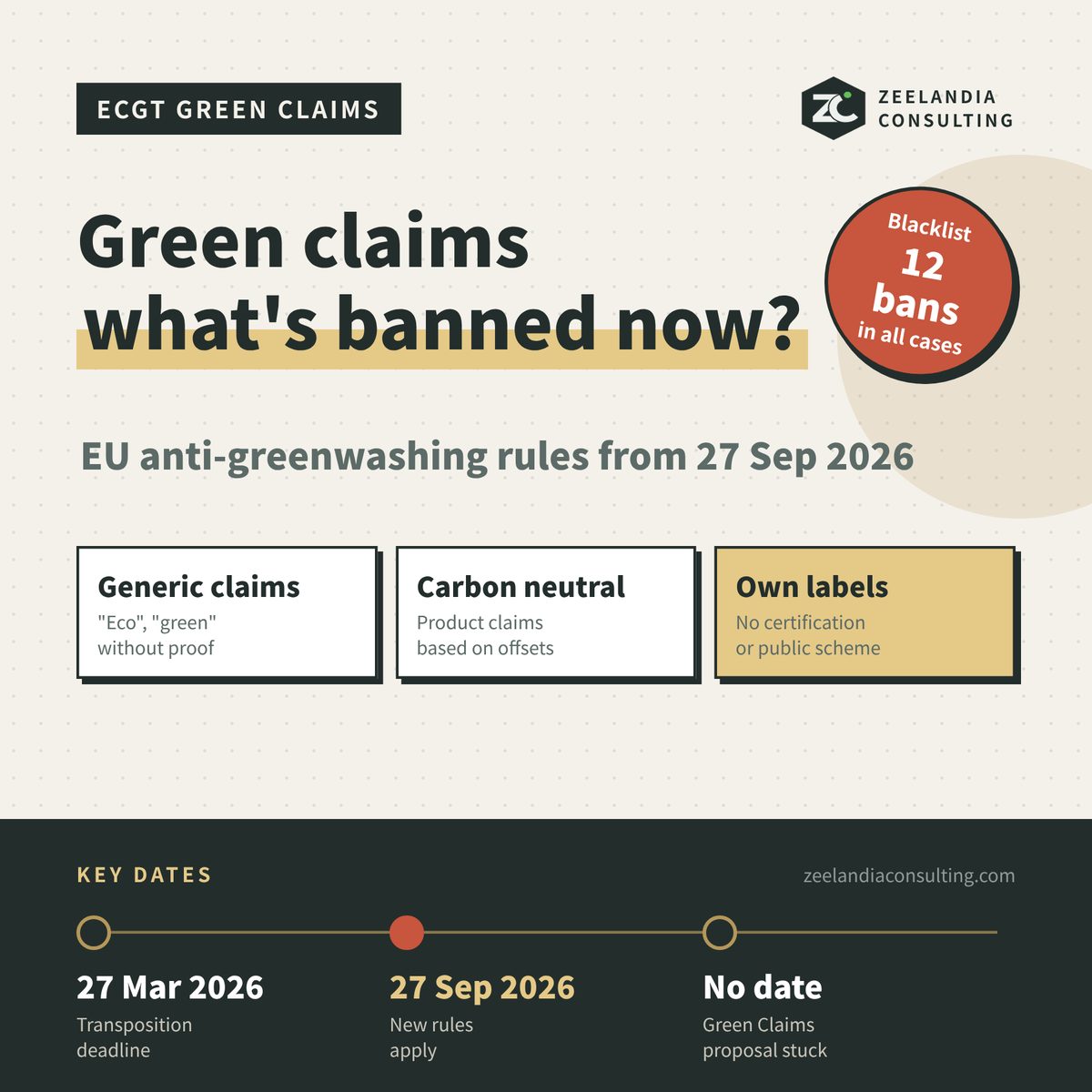
The Empowering Consumers for the Green Transition Directive (Directive (EU) 2024/825, ECGT or EmpCo) applies from 27 September 2026. It amends the Unfair Commercial Practices Directive (UCPD) and the Consumer Rights Directive (CRD), adding to the blacklist of practices banned in all circumstances generic claims such as “environmentally friendly” or “green”, product carbon neutrality claims based on offsetting, and self-made sustainability labels. Many people think “the EU green claims law has been withdrawn”, but what is stuck is a different proposal. The ECGT is already being applied.
Key takeaways
- The ECGT already applies (from 27 September 2026); what is stuck is the Green Claims Directive proposal. Confusing the two is currently the most common misunderstanding.
- 12 new practices are banned outright: generic environmental claims, product carbon neutrality claims based on offsetting, sustainability labels not based on a certification scheme or established by public authorities, presenting legal requirements as a distinctive feature, and misleading practices on durability, software updates and repair.
- Future performance claims such as “net zero by 2030” need a detailed implementation plan, regularly verified by an independent third-party expert.
- The rules cover business-to-consumer commercial practices (B2C); B2B suppliers are mostly affected indirectly, through data requests from their brand customers.
- Stock already produced and on the shelves is also covered: the Commission’s Q&A says there is no transition period beyond the application date.
What is the ECGT?
The ECGT is a directive: Member States must transpose it into national law, and national authorities enforce it. The key dates are:
| Date | Event |
|---|---|
| 26 March 2024 | Directive enters into force |
| 27 March 2026 | Transposition deadline for Member States |
| 27 September 2026 | New rules apply; the harmonised notice on the legal guarantee and the harmonised label for commercial guarantees of durability are used from the same date |
Transposition progress varies by country. The Netherlands transposed the directive through its implementing act on improving sustainability information for consumers (Stb. 2026, 152); Germany through the Third Act amending the Act against Unfair Competition, in force on 27 September 2026. In France, the bill was still before parliament in late September 2026, and the competent authority, the DGCCRF, has said it will not carry out checks under the directive until transposition is complete.
How does the ECGT differ from the Green Claims Directive?
| Item | ECGT | Green Claims Directive |
|---|---|---|
| Legal status | Adopted; applies from 27 September 2026 | Proposal (COM(2023) 166); on 20 June 2025 the Commission announced its intention to withdraw it, the trilogue was cancelled, and it is now stuck in the Council |
| Approach | A blacklist plus general principles, covering claims made to consumers | Was to set methods for substantiating claims in advance and third-party verification |
| What it means for companies | Must be complied with now | No application date |
The Green Claims Directive being stuck does not mean environmental claims can be written as before. The most common greenwashing formulations are already directly blacklisted by the ECGT.
The 12 new blacklisted practices
The ECGT adds 12 practices to Annex I of the UCPD that are “in all circumstances considered unfair”. For blacklisted practices, authorities do not need to assess case by case whether consumers were misled: doing it is enough to breach the law.
| Annex I | Banned practice | Typical wording by Taiwanese exporters |
|---|---|---|
| 2a | Displaying a sustainability label not based on a certification scheme or established by public authorities | A company’s own “green product” label, internal scoring icons |
| 4a | A generic environmental claim where recognised excellent environmental performance cannot be demonstrated | “Environmentally friendly”, “green”, “eco-friendly”, “climate friendly” |
| 4b | A claim about the entire product or the entire business when it concerns only part of it | Calling it an “eco product” because the outer carton now uses recycled paper |
| 4c | Claiming, based on offsetting, that a product has a neutral, reduced or positive impact on the environment | Labelling a “carbon neutral product” after buying carbon credits |
| 10a | Presenting requirements imposed by law as a distinctive feature of your own offer | Advertising a battery as “mercury-free” (the EU Battery Regulation already restricts mercury) |
| 23d | Withholding that a software update will negatively affect the product’s functioning | Battery life shortens after a firmware update, with no prior notice |
| 23e | Presenting a software update as necessary when it only enhances functionality | “You must update to keep using the product” when the update only adds features |
| 23f | Marketing a product with a known design feature that limits its durability | Not mentioning a component design known to shorten the product’s life |
| 23g | Claiming a product has a certain durability in terms of usage time or intensity under normal conditions when it does not | Stating “1,000 charge cycles” when this cannot be reached under normal use |
| 23h | Presenting a product as repairable when it is not | Claiming “repairable” when the product cannot be opened or no parts are available |
| 23i | Inducing consumers to replace consumables earlier than technically necessary | Filter or ink cartridge replacement prompts appearing too early |
| 23j | Withholding information on, or falsely claiming, the effect of using non-original parts or consumables on functionality | “Using non-original batteries will damage the product” when it will not |
Note what “generic” means in 4a. A claim whose specific content is clearly stated on the same medium, such as “packaging made with 80% recycled paper”, is not generic; “eco-friendly packaging” on its own is. “Recognised excellent environmental performance” also has a defined scope: compliance with the EU Ecolabel, an officially recognised type I ecolabel in a Member State (EN ISO 14024), or top environmental performance under other EU law. It is not a company’s own assessment.
Claims not on the blacklist but assessed case by case
Future environmental performance claims (UCPD Article 6(2)(d)). Claims such as “carbon neutral by 2030” or “net zero by 2040” need clear, objective, publicly available and verifiable commitments set out in a detailed and realistic implementation plan, including measurable, time-bound targets and allocated resources, regularly verified by an independent third-party expert whose findings are made available to consumers.
Benefits irrelevant to the product (point (e) of the same paragraph). Advertising benefits that are not relevant to any feature of the product or business is also misleading, for example highlighting what is already common practice in the market.
Environmental and social characteristics as “main characteristics” of the product (Article 6(1)(b)). Untrue or misleading statements about a product’s environmental and social characteristics and circularity aspects (durability, reparability, recyclability) amount to a misleading practice.
New information under the Consumer Rights Directive
Beyond claims, the ECGT also amends the Consumer Rights Directive, requiring traders to give consumers more information before they place an order:
- A harmonised notice on the legal guarantee: reminding consumers of their legal guarantee rights, in a format set by Implementing Regulation (EU) 2025/1960, applicable from 27 September 2026.
- A harmonised label for commercial guarantees of durability: used where the producer offers a commercial guarantee of durability covering the whole product for more than two years at no extra cost.
- Where the producer provides them: the minimum period for software updates, the reparability score (where applicable), and information on spare parts, repair and repair restrictions.
- For distance sales, any environmentally friendly delivery options offered.
This information is given by the trader to the consumer, but its content mostly comes from the producer.
Why are B2B Taiwanese suppliers also being asked?
The Commission’s Q&A is clear: the ECGT is strictly limited to B2C. Transactions between businesses are out of scope. Taiwanese suppliers will nevertheless encounter it in at least three situations:
- Own brands sold directly to European consumers: when selling through e-commerce platforms or your own website, you are the trader making claims to consumers, and the rules apply directly.
- Brand customers’ claims rely on your data: when a European brand states recycled content, carbon footprint or durability on its product page, the basis mostly comes from suppliers. Customers must be able to produce evidence for the authorities, so they come back to their suppliers for it.
- Text on the product and packaging ends up with consumers: packaging, manuals and on-product markings printed under contract are the brand’s claims to consumers. Packaging markings must also meet PPWR requirements, and the two are often checked together.
What about packaging already printed and stock on hand?
The Commission’s Q&A says the new rules apply to existing products, including stock produced, ordered, delivered or placed on the shelves before the application date, and that there is no transition period beyond the application date for sustainability labels. The Q&A mentions that traders can use stickers or in-store notices to deal with non-compliant claims, and that enforcement authorities will consider proportionality and whether the trader made reasonable efforts. In Germany, for example, the amendment also has no general sell-off period.
The easiest mistake is assuming “old packaging can be sold until it runs out”. The ECGT looks at when the commercial practice takes place, not when the packaging was printed.
What are the consequences of breaching the ECGT?
The ECGT itself sets no separate penalties. Member States enforce it through their transposing laws and existing unfair commercial practices rules, and authorities can order a practice to stop, require corrections and impose fines. Under Article 13 of the UCPD as amended by Directive (EU) 2019/2161, where penalties for widespread cross-border infringements are coordinated through the EU consumer protection cooperation mechanism, the maximum fine is at least 4% of annual turnover in the Member State concerned, or at least EUR 2 million where turnover information is not available. Consumers can also claim compensation, a price reduction or termination of the contract under UCPD Article 11a.
FAQ
Can “carbon neutral” still be used?
Claiming, based on offsetting, that a product is carbon neutral or has a reduced environmental impact falls under point 4c of the blacklist and is banned outright; such claims must be based on the product’s actual life cycle impact. The Commission’s Q&A explains that offset-based claims at company level fall outside point 4c, but remain subject to the general rules of the UCPD. Writing only “carbon neutral” or “climate neutral” without being able to demonstrate recognised excellent environmental performance is a generic claim under point 4a.
We are only an OEM or ODM. Does the ECGT concern us?
The ECGT does not directly regulate B2B transactions. But brand customers’ claims to consumers rely on supply chain data, so customers will usually ask you for the basis, and the packaging and markings you print also become the brand’s claims to consumers.
Will the Green Claims Directive come back?
As of October 2026, the proposal is still stuck in the Council, and the Commission’s 2026 work programme still lists it as a pending proposal, with no application date. Whether it restarts depends on later decisions by the Council and the Commission.
Are the rules the same in every EU country?
The ECGT is a directive, so national transposing laws differ in wording and enforcement authorities, and the scope may also vary slightly. The Netherlands and Germany have completed transposition; in France the bill was still before parliament in late September 2026. Which rules apply depends on the countries you sell to.
Conclusion
The ECGT puts the most common greenwashing formulations directly on the blacklist, shifting the test from “were consumers misled?” to “was it done?”. For Taiwanese exporters, the risk is mostly not on their own websites but on their brand customers’ product pages, packaging and manuals, where the basis for the claims often comes from suppliers. Start by reviewing the environmental claims on your products and packaging and what supports them, to see what needs changing and where data needs adding.
The ECGT green claims page in the ZC Regulatory Radar will keep tracking national transposition and secondary legislation.
Further reading
- The PPWR and packaging requirements for electronics
- EU Battery Regulation in practice, part 3: CE marking, DoC, labels, QR code and removable design
Need help?
ZC has an office in Amsterdam and can help you check whether the environmental claims on your products, packaging and marketing materials fall within the ECGT, and act as your EU regulatory point of contact. See other EU regulations advisory.
- Book a 30-minute online consultation: calendly.com/zc-meeting/30min
- Follow ZC on LINE: lin.ee/QKV5RTE
This article provides general information, updated to 30 October 2026, and does not constitute legal advice. Whether a specific case is affected depends on the transposing laws of each Member State and the actual selling arrangements.
Next step: have you considered these three options?
Sources · Directive (EU) 2024/825 (Empowering Consumers for the Green Transition) · Commission Implementing Regulation (EU) 2025/1960 (harmonised notice and label) · European Commission, Questions and answers on the ECGT Directive (September 2026) · European Parliament Legislative Train, Substantiating and communicating green claims · Directive (EU) 2019/2161 (penalties under the UCPD) · Ondernemersplein, Duurzaamheidsclaims moeten duidelijk en controleerbaar zijn · Taylor Wessing, Amendment to the German Unfair Competition Act (February 2026) · Gossement Avocats, La directive (UE) 2024/825 s'applique-t-elle directement à compter du 27 septembre 2026 ? (25 septembre 2026). This article is general information and not legal advice for any specific case. Obligations are defined by the Official Journal of the EU.
ECGTEmpCogreen claimsanti-greenwashinggreenwashingenvironmental claimscarbon neutralsustainability labelsDirective 2024/825


