
In this article (8 sections)
- 1. How did VSME become the VS?
- 2. What does the VS cover? Basic and Comprehensive Modules
- 3. What is the value chain cap, and what can customers still ask for?
- 4. The digital template and XBRL: are they required?
- 5. What does this mean for suppliers outside the EU?
- Three things to check now
- Common misconceptions
- FAQ
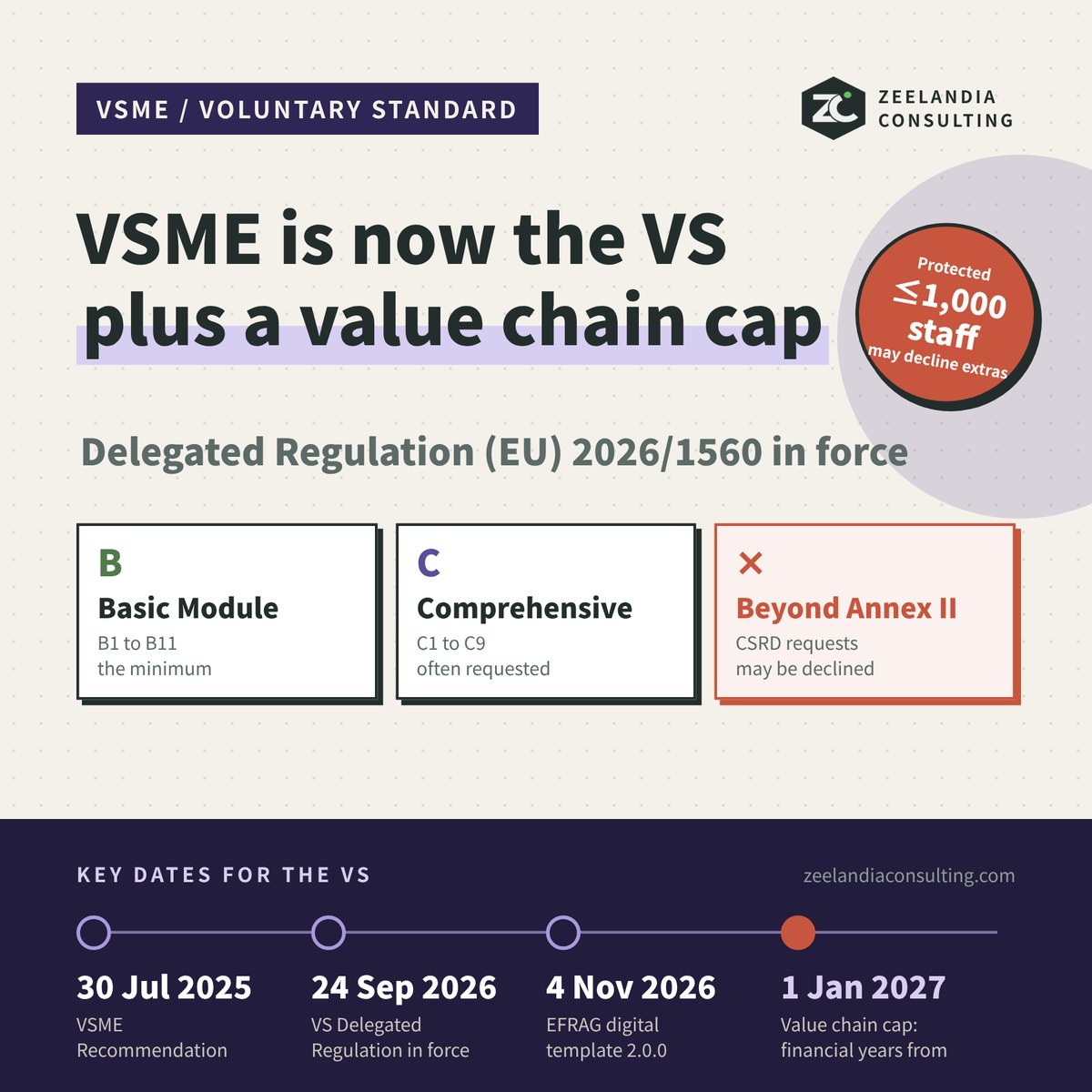
What is VSME? VSME is the EU’s voluntary sustainability reporting standard for undertakings that do not have to report under the CSRD. Since 24 September 2026 it has been in force as Commission Delegated Regulation (EU) 2026/1560, under a new name: the Voluntary Standard (VS). Reporting under the VS is not a legal obligation. But for financial years starting in 2027, the VS is also the ceiling on the sustainability information large European customers can require from suppliers with up to 1,000 employees.
Key points
- VSME has become the VS and moved from a Commission recommendation to Delegated Regulation (EU) 2026/1560; Recommendation (EU) 2025/1710 no longer has legal effect.
- The VS is voluntary. No undertaking is required to report under it.
- The VS also sets the value chain cap: for financial years beginning on or after 1 January 2027, undertakings reporting under the CSRD may not require value chain undertakings with up to 1,000 employees to provide information beyond the datapoints in Annex II, when the request is made for their own sustainability reporting.
- The cap covers only requests made for CSRD reporting. Due diligence and requests under other laws are not affected.
- On 4 November 2026 EFRAG released VS Digital Template 2.0.0 and a free XBRL converter.
1. How did VSME become the VS?
VSME was written by EFRAG for non-listed SMEs. The Omnibus I amendments narrowed the CSRD to undertakings with more than 1,000 employees and more than EUR 450 million net turnover, and required the Commission to set a voluntary standard by delegated act for undertakings outside that scope (Article 29ca of the amended Accounting Directive), based on the 2025 VSME Recommendation.
| Date | What happened | Source |
|---|---|---|
| 17 December 2024 | EFRAG delivers the VSME standard to the Commission | EFRAG Knowledge Hub |
| 30 July 2025 | The Commission recommends VSME for non-listed SMEs | Recommendation (EU) 2025/1710 |
| 26 February 2026 | Omnibus I Directive published (in force 18 March), narrowing the CSRD and creating the value chain cap | Directive (EU) 2026/470 |
| 3 July 2026 | The Commission adopts the delegated act; VSME becomes the VS | Delegated Regulation (EU) 2026/1560 |
| 21 September 2026 | Published in the Official Journal, in force on 24 September; the VSME Recommendation no longer produces legal effects | 2026/1560, Article 4 and recital 5 |
| 4 November 2026 | EFRAG releases VS Digital Template 2.0.0, the XBRL taxonomy and converter | EFRAG |
| Financial years from 1 January 2027 | The value chain cap (Article 3) applies | 2026/1560, Article 4 |
The rename is not cosmetic. The SME in VSME meant small and medium-sized enterprises; the VS is intended for undertakings with an average of no more than 1,000 employees in the preceding financial year (Annex I, paragraph 2). Mid-sized manufacturers with several hundred staff, which were never SMEs, are now in its target group.
2. What does the VS cover? Basic and Comprehensive Modules
The VS has two modules (Annex I, paragraphs 6 and 7). The Basic Module (B1 to B11) is the minimum, and the target approach for micro-undertakings. The Comprehensive Module (C1 to C9) adds what banks, investors and corporate clients are likely to ask for, and can only be applied on top of the Basic Module. The report states which option was chosen and that it complies with that option (B1).
| Code | Topic | What is disclosed |
|---|---|---|
| B1 | Basis for preparation | Module option, individual or consolidated basis, list of subsidiaries, legal form, NACE codes, total assets, turnover, employees, country of operations and site locations; sustainability certifications or labels, if any |
| B2 | Practices and policies for the transition | Practices, policies, future initiatives and targets, where they exist |
| B3 | Energy and GHG emissions | Total energy consumption (MWh); estimated Scope 1 and location-based Scope 2 emissions (tCO2e) |
| B4 | Pollution of air, water and soil | Pollutant emissions reported to authorities by law or under an environmental management system |
| B5 | Biodiversity | Sites in or near biodiversity-sensitive areas |
| B6 | Water | Total water withdrawal; water consumption for water-intensive processes |
| B7 | Resource use and waste | Whether circular economy principles are applied; total waste (hazardous and non-hazardous) and share recycled or reused; material flows for material-intensive sectors |
| B8 | Workforce | Employees by contract type, gender and, where relevant, country |
| B9 | Health and safety | Number and rate of recordable work-related accidents; fatalities |
| B10 | Pay, collective bargaining, training | Pay at or above minimum wage, collective bargaining coverage, average training hours |
| B11 | Corruption and bribery | Number of convictions and total fines, if any |
| C1 to C9 | Comprehensive Module | Business model and strategy, detail on practices and policies, GHG targets and transition plans, climate risks, employee turnover, human rights policies and complaints mechanism, human rights incidents, revenue from certain sectors, gender diversity of the governance body |
A few more rules:
- 10 employees or fewer: datapoints in square brackets are voluntary, for example energy, GHG, water and waste (Annex I, paragraph 8).
- “If applicable”: disclosures that apply only in specific circumstances (such as B4 and B5) are presumed not applicable when omitted (paragraph 15).
- Omission: trade secrets, classified information and similar may be omitted, but each omission is listed in B1 and reassessed at each reporting date (paragraph 22).
- Scope 3: disclose where appropriate for the sector and activities; manufacturing, agrifood, construction and packaging are likely to have significant Scope 3 categories (paragraphs 49 to 52).
- No assurance obligation: undertakings applying the VS are not obliged to seek assurance (recital 5).
3. What is the value chain cap, and what can customers still ask for?
For suppliers, this is the part that matters most. Omnibus I added the following to Article 19a(3) of the Accounting Directive (Article 29a(3) for groups):
- Protected undertaking: an undertaking with an average of no more than 1,000 employees in the preceding financial year that is in the value chain of a CSRD reporting undertaking.
- Reporting undertakings may rely on the supplier’s self-declaration without verifying it, unless they know or can reasonably be expected to know it is manifestly incorrect.
- For requests made for CSRD sustainability reporting, protected undertakings have the right to decline information beyond the VS.
- Reporting undertakings may not require information beyond the VS in contracts; contrary clauses are not binding, while the rest of the contract stands.
- Where a request goes beyond the VS, the reporting undertaking must inform the supplier which information exceeds it and that it may decline.
Article 3 of Delegated Regulation 2026/1560 narrows this further: the cap comprises only the datapoints listed in Annex II, with one list for undertakings with 10 employees or fewer and one for those with more.
| Disclosure | Datapoints in Annex II | 10 or fewer | More than 10 |
|---|---|---|---|
| B1 | Module option, individual or consolidated basis, general undertaking information | ✓ | ✓ |
| B3 | Total energy consumption (MWh), estimated GHG emissions | ✓ | |
| B6 | Total water withdrawal | ✓ | |
| B7 | Circular economy principles, total waste, share recycled or reused | ✓ | |
| B8 | Employees by contract type and by gender | ✓ | ✓ |
| B9 | Number and rate of recordable work-related accidents | ✓ | ✓ |
| B10 | Minimum wage, collective bargaining coverage, average training hours | ✓ | ✓ |
| C1 | Products or services, markets, main business relationships | ✓ | |
| C5 | Employee turnover rate | ✓ | |
| C6 | Code of conduct or human rights policy, complaints mechanism | ✓ | |
| C7 | Human rights incidents in own workforce and value chain | ✓ |
Anything not in this table, such as B2 practices and policies, B4 pollution, B5 biodiversity, C3 GHG targets or C4 climate risks, is outside the cap. Recital 4 also states that reporting undertakings should only request what they need, and request less than the VS where they do not need all of it.
How much of your customer's ESG questionnaire is beyond the cap?
The free VSME check in the ZC Smart Compliance Hub first works out whether you are a protected undertaking and which module is relevant, then checks how ready your VS data is, item by item, and marks the part of a customer request you may decline.
4. The digital template and XBRL: are they required?
On 4 November 2026 EFRAG released VS Digital Template 2.0.0 (Excel, developed and tested in Microsoft Excel 365), the VS XBRL taxonomy and a free converter that turns the completed template into an Inline XBRL report that both people and systems can read. The new version adds comparison with the previous period, Word files for narrative disclosures, and merging of the XBRL report with PDFs such as EMAS disclosures or financial statements. The converter’s source code is open source under the MIT licence, and EFRAG says it will maintain the tools at least until the end of June 2027.
EFRAG marks the old VSME templates (1.0.0 to 1.3.0) as outdated, not to be used.
The VS itself does not prescribe a format or place of publication: the report can be a separate document or a section of the management report (Annex I, paragraph 20). The EFRAG template is a support tool, not a legal format (Article 2(2)). Whether a customer requires a specific format depends on that customer.
5. What does this mean for suppliers outside the EU?
- Who will ask: undertakings reporting under the amended CSRD. The revised ESRS apply to financial years from 2027, and so does the value chain cap, so customers collecting 2027 data from suppliers for reports published in 2028 is the timeline to expect.
- Non-EU suppliers can be protected undertakings too: the definition looks at headcount and whether the undertaking is in the reporting undertaking’s value chain, with no condition on where it is based. Customers may rely on your self-declaration, so be ready to state your employee numbers clearly.
- Suppliers with more than 1,000 employees are not protected: customers can ask for more, based on their own ESRS needs.
- Other laws still require data: the cap does not affect requests for other purposes, including EU due diligence requirements. PPWR conformity documents, EUDR due diligence data, battery due diligence and the forced labour ban are not reduced by the cap. See our article on supply chain due diligence.
- Banks and investors: recital 5 encourages financial institutions to limit their requests to undertakings with up to 1,000 employees to the VS as far as possible. That is encouragement, not a cap.
Before reporting under the VS, look at what your customer is asking for
Two ESG questionnaires can look alike while one serves CSRD reporting and the other due diligence or a product law. Whether you may decline, and in what format to answer, differs. Sort the requests first, then decide between the Basic Module, the Comprehensive Module, or answering only within the cap.
Three things to check now
- Headcount: did the legal entity that received the request average more than 1,000 employees in the last financial year? Ten or fewer?
- Purpose of the request: is the questionnaire for the customer’s CSRD reporting, or for due diligence, a product law, financing or the customer’s own supplier assessment?
- Core figures: for energy, GHG, water, waste, workforce and safety, do you have a full year of data that ties back to bills or records?
Common misconceptions
MythVSME is a smaller CSRD, and SMEs will all have to report under it.
FactThe VS is voluntary. Annex I, paragraph 4 states that, unlike the ESRS, it does not impose legal reporting obligations (Delegated Regulation 2026/1560, Article 2).
MythWith the value chain cap, European customers cannot ask for anything beyond it.
FactThe cap covers only requests made for CSRD sustainability reporting. Requests for other purposes, including EU due diligence requirements, are not affected (Article 19a(3) of the amended Accounting Directive).
MythSuppliers must provide everything within the cap.
FactThe Directive states that these rules do not impose any obligation on undertakings in the value chain to provide sustainability information (Article 19a(3)). Whether to provide it is a matter for the business relationship and the contract, but a contract may not require more than the cap.
MythA VS report must use EFRAG's Excel template or XBRL.
FactThe VS does not prescribe a format, and the report can be a separate document (Annex I, paragraph 20). EFRAG's digital template and converter are free support tools.
FAQ
Are VSME and the VS the same thing?
The VS is the formal version built on VSME. The Commission adopted it on 3 July 2026 as Delegated Regulation (EU) 2026/1560, renamed it the Voluntary Standard, widened the target group from SMEs to undertakings with up to 1,000 employees on average, and adjusted some datapoints to align with the revised ESRS.
Do companies outside the EU have to report under the VS?
No. The VS is voluntary. In practice you meet it when European customers, banks or investors ask for data, and the VS gives you one format that is recognised across Europe.
Can a supplier outside the EU be a protected undertaking?
Under Article 19a(3) of the amended Accounting Directive, a protected undertaking is one that averaged no more than 1,000 employees in the preceding financial year and is in the value chain of a CSRD reporting undertaking. The text sets no condition on where the undertaking is based. Customers may rely on your self-declaration.
Can we decline requests that go beyond the VS?
If the request is for the customer’s CSRD sustainability reporting and you are a protected undertaking, you have the right to decline the part that goes beyond the VS, and the customer must tell you which part that is. This applies to financial years beginning on or after 1 January 2027. Requests for due diligence or other laws are not covered.
Does a VS report need assurance?
No. Recital 5 of the Delegated Regulation states that undertakings applying the VS are not obliged to seek assurance. If a customer or bank asks for it, that is a matter of agreement between you.
Does a VS report have to be in XBRL?
The VS does not require it. EFRAG offers a free digital template and converter that produce an Inline XBRL report, which customers’ and banks’ systems can read directly.
Based on Delegated Regulation (EU) 2026/1560, Directive (EU) 2026/470 and EFRAG’s published materials, updated to 15 November 2026. Not advice for any specific case.
Next step: have you considered these three options?
Sources · Commission Delegated Regulation (EU) 2026/1560 (Voluntary Standard) · Directive (EU) 2026/470 (Omnibus I) · Commission Recommendation (EU) 2025/1710 (VSME) · EFRAG, VS Digital Template and XBRL Taxonomy · EFRAG, EFRAG releases the Voluntary Standard Digital Template and XBRL Converter, 4 November 2026 · EFRAG Knowledge Hub, SME ecosystem. This article is general information and not legal advice for any specific case. Obligations are defined by the Official Journal of the EU.
VSMEVSVoluntary Standardvoluntary sustainability reportingvalue chain capprotected undertakingsCSRDOmnibusSME sustainability reportingEFRAGXBRLESG questionnaire