
In this article (9 sections)
EcoVadis is a sustainability rating provider founded in France in 2007. Its network has more than 150,000 rated companies, and its methodology covers more than 185 countries and 250 spend categories. Many multinationals use EcoVadis to assess how their suppliers manage environmental, labour and human rights, ethics and sustainable procurement issues, which is why many Taiwanese exporters first hear of it through an invitation from a customer.
This is part 1 of our EcoVadis series. It explains how the rating is built, based on the EcoVadis Sustainability Rating Methodology V10.0 and Medals Methodology V2.0, both applicable from January 2026.
Key takeaways
- EcoVadis is a private sustainability rating, not EU law, but European customers often make it a purchasing condition.
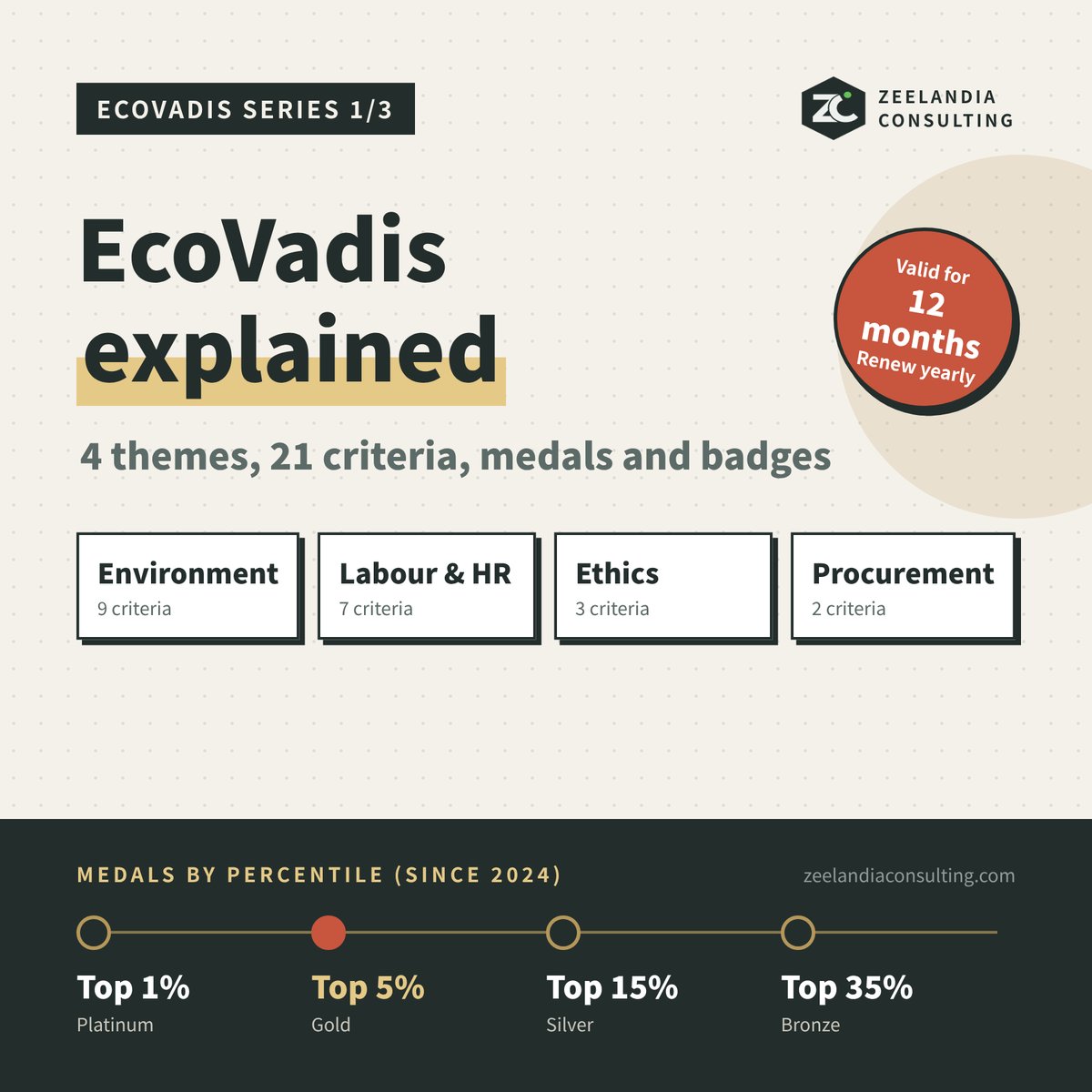
- Scores cover 4 themes and 21 criteria. Which criteria apply to a company, and how much each theme weighs, depends on its industry, size and countries of operation.
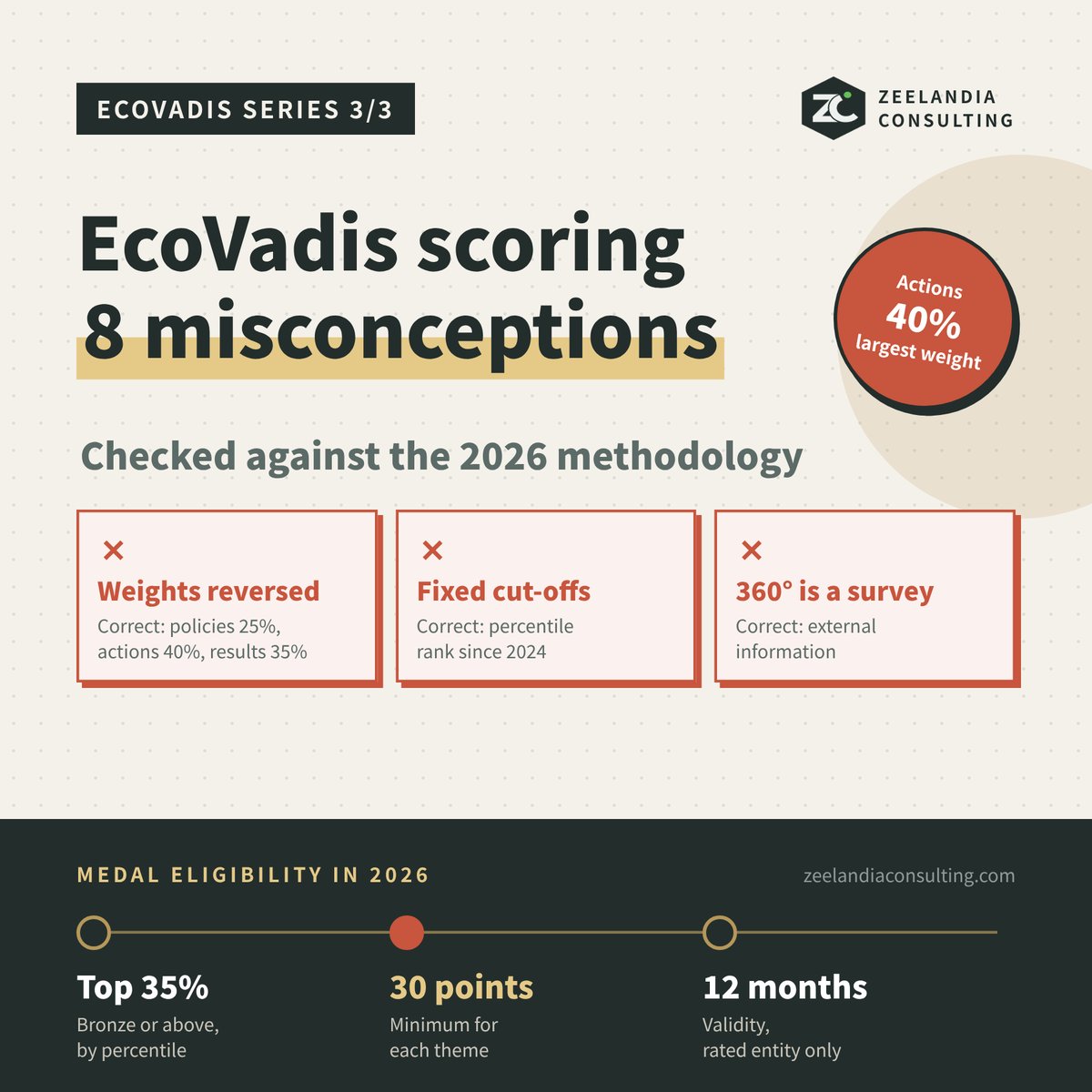
- Each theme is scored on the same set of management indicators, weighted by default at policies 25%, actions 40%, results 35%.
- Only answers backed by documents earn credit.
- Since 2024, medals depend on percentile rank: Platinum top 1%, Gold top 5%, Silver top 15%, Bronze top 35%, plus eligibility conditions.
- Scorecards, medals and badges are valid for 12 months.
What is EcoVadis?
EcoVadis provides company sustainability ratings. The rated company fills in an online questionnaire and uploads supporting documents. EcoVadis analysts review them, add external public information, and publish a scorecard with a score from 0 to 100.
The users of the ratings are mainly buyers who want to understand their suppliers’ performance. According to EcoVadis Support, around 1,200 multinational enterprises use EcoVadis to assess their suppliers. The rated company controls which customers can see its scorecard; see part 2 of this series for details.
What does EcoVadis assess? 4 themes, 21 criteria
| Theme | Criteria |
|---|---|
| Environment (9) | Energy consumption and GHG emissions; water; biodiversity; air pollution; materials, chemicals and waste; product use; product end-of-life; customer health and safety; environmental services and advocacy |
| Labour and human rights (7) | Employee health and safety; working conditions; social dialogue; career management and training; child labour, forced labour and human trafficking; discrimination and harassment; external stakeholder human rights |
| Ethics (3) | Corruption; anticompetitive practices; responsible information management |
| Sustainable procurement (2) | Supplier environmental practices; supplier social practices |
Not every company is assessed on all 21 criteria. EcoVadis decides which themes and criteria are material based on the industry’s risk profile, then adjusts for company size and countries of operation. Each theme is weighted from 1 to 4. A factory and a trading company will therefore not be asked the same things.
How is EcoVadis scored?
Management indicators and their weights
Each theme score comes from the same set of management indicators. The default weights in the V10.0 methodology are:
| Layer | Management indicator | Default weight |
|---|---|---|
| Policies | Policies | 20% |
| Policies | Endorsements (of external initiatives) | 5% |
| Actions | Measures (60%) and certifications (40%), multiplied by coverage for large companies | 40% |
| Results | Reporting | 14% |
| Results | 360° Watch | 21% |
This is often summarised as “policies 25%, actions 40%, results 35%”. Coverage only applies to large companies with more than 1,000 employees. For extra-small companies, endorsements and reporting are dropped for some themes and the weights change accordingly.
Only documented answers earn credit
The methodology is explicit: only questionnaire declarations supported by documentary evidence are credited. Documents must be formalised, complete, credible, dated, in an accepted format and machine-readable. EcoVadis does not fill gaps with estimates or industry averages, so missing data shows up in the score.
360° Watch looks at external information
360° Watch is information that EcoVadis analysts collect from external sources, such as NGOs, trade unions, government bodies, grievance mechanisms and other verified third parties. Both positive and negative findings count. It carries 21% of the default weight and is not filled in by the company.
How analysts review a rating
Every rating goes through document analysis, scoring and validation, the last step being a consistency check. The rated company gets a 48-hour preview before the scorecard is published.
Score levels
| Score | Level |
|---|---|
| 85 to 100 | Outstanding |
| 65 to 84 | Advanced |
| 45 to 64 | Good |
| 25 to 44 | Partial |
| 0 to 24 | Insufficient |
EcoVadis medals and badges
Medals are based on percentile rank
Since January 2024, EcoVadis medals have been awarded by percentile rank: at the time the scorecard is published, the company is compared with all companies rated in the previous 12 months.
| Medal | Percentile rank |
|---|---|
| Platinum | Top 1% |
| Gold | Top 5% |
| Silver | Top 15% |
| Bronze | Top 35% |
Before that, medals were based on fixed score thresholds updated each year, and Silver was the top 25% and Bronze the top 50%. Claims such as “a score of X gets you Gold” usually come from the rules before 2024.
Medal eligibility conditions
A high rank is not enough. A company must also meet these conditions:
- Each of the four themes must score at least 30.
- A company is generally not eligible if its 360° Watch indicator scores 0 in at least one theme, or 25 in at least two themes (exceptions apply).
- Certain industries, such as tobacco, weapons and ammunition manufacturing and coal-related activities, are excluded.
- A medal applies only to the rated legal entity. Parent companies, subsidiaries, sister companies and other sites cannot use it.
Committed and Fast Mover badges
| Badge | Conditions |
|---|---|
| Committed | A score of at least 45 without a medal, for example a company in the top 35% that does not meet the other medal conditions |
| Fast Mover | A score of 34 to 44, with an improvement of at least 6 points on the previous assessment within 18 months |
Companies that earn a medal are not eligible for a badge.
Validity and reassessment
A scorecard is valid for 12 months from publication, and so are medals and badges. To keep a valid rating, a company has to be reassessed every year.
EcoVadis announces methodology changes every quarter (January, April, July and October). Material changes are not applied retroactively to published scorecards.
What changed in the 2026 methodology?
Sustainability Rating Methodology V10.0 applies from January 2026. It adds resilience-based data points that assess how prepared suppliers are for environmental hazards. For the full list of changes, refer to the changelog published by EcoVadis.
FAQ
Is EcoVadis required by EU law?
No. EcoVadis is a private rating provider with no legal force. But European customers often make it a condition for purchasing or supplier approval, and some use it as one source of information for supply chain due diligence.
Can small companies get an EcoVadis rating?
Yes. Themes and weights are adjusted to company size, and for extra-small companies endorsements and reporting are not counted for some themes.
Can anyone guarantee an EcoVadis medal?
No. Medals depend on percentile rank, which means comparison with other rated companies. Together with the theme minimum and the 360° Watch conditions, no one can guarantee the outcome in advance.
Our parent company has an EcoVadis rating. Can our subsidiary use it?
No. A medal applies only to the rated legal entity, not to parent companies, subsidiaries or other sites. Check which legal entity your customer wants rated.
How often does an EcoVadis scorecard need to be renewed?
A scorecard is valid for 12 months, so a company needs to be reassessed every year to keep a valid rating.
EcoVadis series
- What is EcoVadis? Themes, scoring, medals and badges explained (this article)
- Your customer asked for an EcoVadis rating: what suppliers need to know
- 8 common misconceptions about EcoVadis scoring, checked against the 2026 methodology
Need help?
ZC’s certification and ratings advisory works with an international network of advisors experienced in EcoVadis. We can help with a readiness review before the rating, a review of your supporting documents, and reading your scorecard and planning improvements.
- Book a 30-minute online consultation: calendly.com/zc-meeting/30min
- Follow ZC on LINE: lin.ee/QKV5RTE
This article is based on EcoVadis’s public methodology documents and support pages, updated to 2 November 2026, and is not advice for any specific case. The latest methodology published by EcoVadis prevails.
Next step: have you considered these three options?
Sources · EcoVadis, Sustainability Rating Methodology disclosure document (V10.0, applicable from January 2026) · EcoVadis, Medals Methodology disclosure document (V2.0, applicable from January 2026) · EcoVadis Support, Understanding EcoVadis Medals and Badges · EcoVadis, Raising the Bar: As Sustainability Performance Accelerates, We're Adapting Our Benchmarks (23 January 2024) · EcoVadis, About us · EcoVadis Support, Who are EcoVadis customers?. This article is general information compiled from the public sources above and is not advice for any specific case.
EcoVadisEcoVadis ratingEcoVadis medalssustainability ratingsupplier assessmentsupply chain due diligence