
In this article (11 sections)
- Misconception 1: “Policies 25%, actions 35%, results 40%”
- Misconception 2: “Reach a certain score and you get Gold”
- Misconception 3: “A high enough score always gets a medal”
- Misconception 4: “360° is a stakeholder survey”
- Misconception 5: “Well-written answers earn points”
- Misconception 6: “ISO certificates guarantee a high score”
- Misconception 7: “If the group has a medal, every company in it can use it”
- Misconception 8: “A consultant can guarantee a medal”
- Why does EcoVadis information online vary so much?
- FAQ
- EcoVadis series
Search for EcoVadis and you will find plenty of guides, but some describe rules from several years ago, and some get the scoring weights the wrong way round. Plans built on that information easily focus on the wrong things.
This is part 3 of our EcoVadis series. It checks common claims against the EcoVadis Sustainability Rating Methodology V10.0 and Medals Methodology V2.0, both applicable from January 2026.
Key takeaways
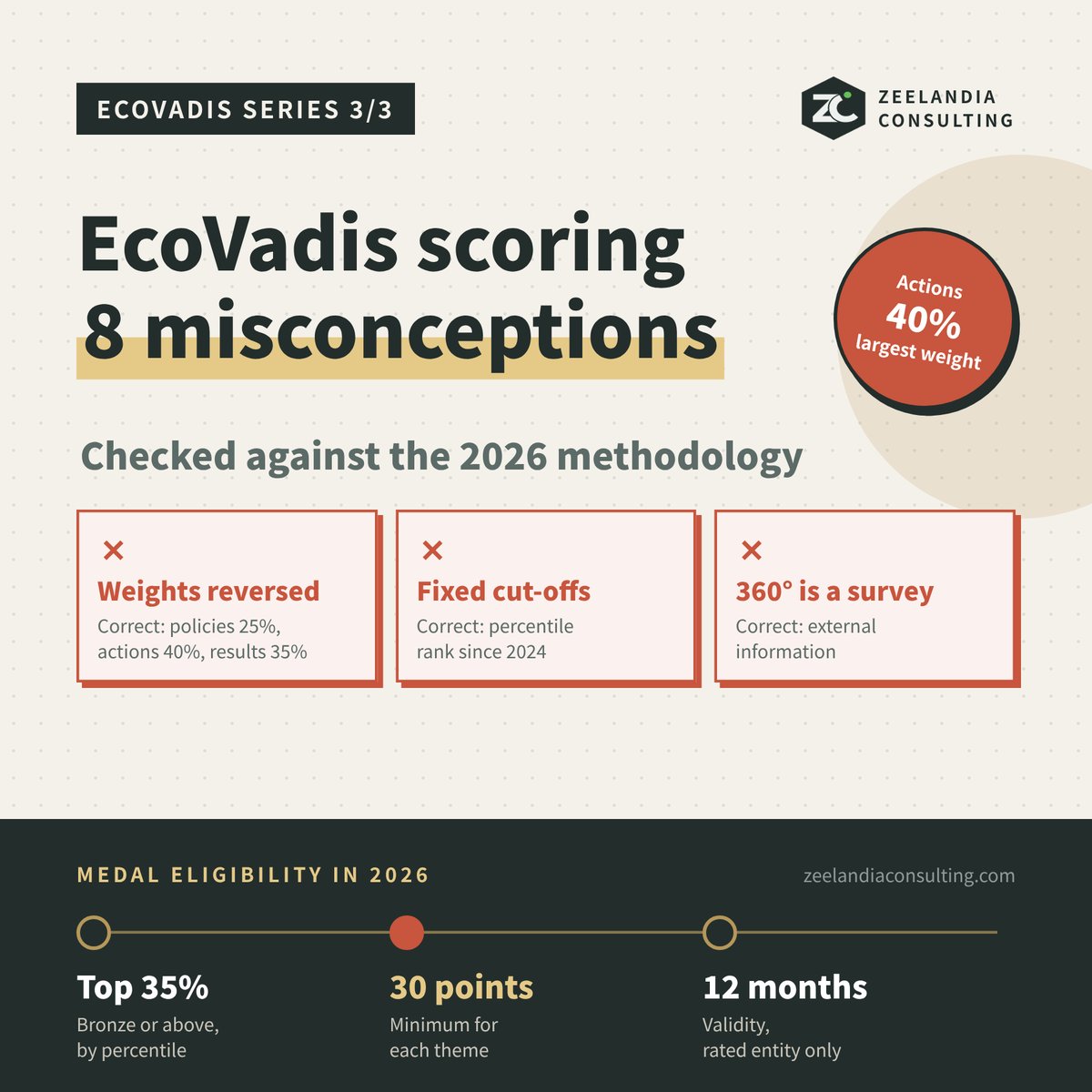
- The weights are policies 25%, actions 40%, results 35%, not “actions 35%, results 40%”.
- Since January 2024, medals depend on percentile rank; there are no fixed score thresholds.
- A high score does not guarantee a medal: each theme needs at least 30, and 360° Watch and industry restrictions also apply.
- Answers without supporting documents earn no credit; ISO certificates are only one part of the score.
- A medal applies only to the rated legal entity, is valid for 12 months, and no one can guarantee it in advance.
Misconception 1: “Policies 25%, actions 35%, results 40%”
Correct: policies 25%, actions 40%, results 35%.
Under V10.0, the default weights for each theme are policies 20% and endorsements 5% (25% together), measures and certifications 40%, and reporting 14% plus 360° Watch 21% (35% together). The actions layer carries the most weight: with policies but no documented measures, a score is hard to raise.
Misconception 2: “Reach a certain score and you get Gold”
Correct: since January 2024, medals are awarded by percentile rank.
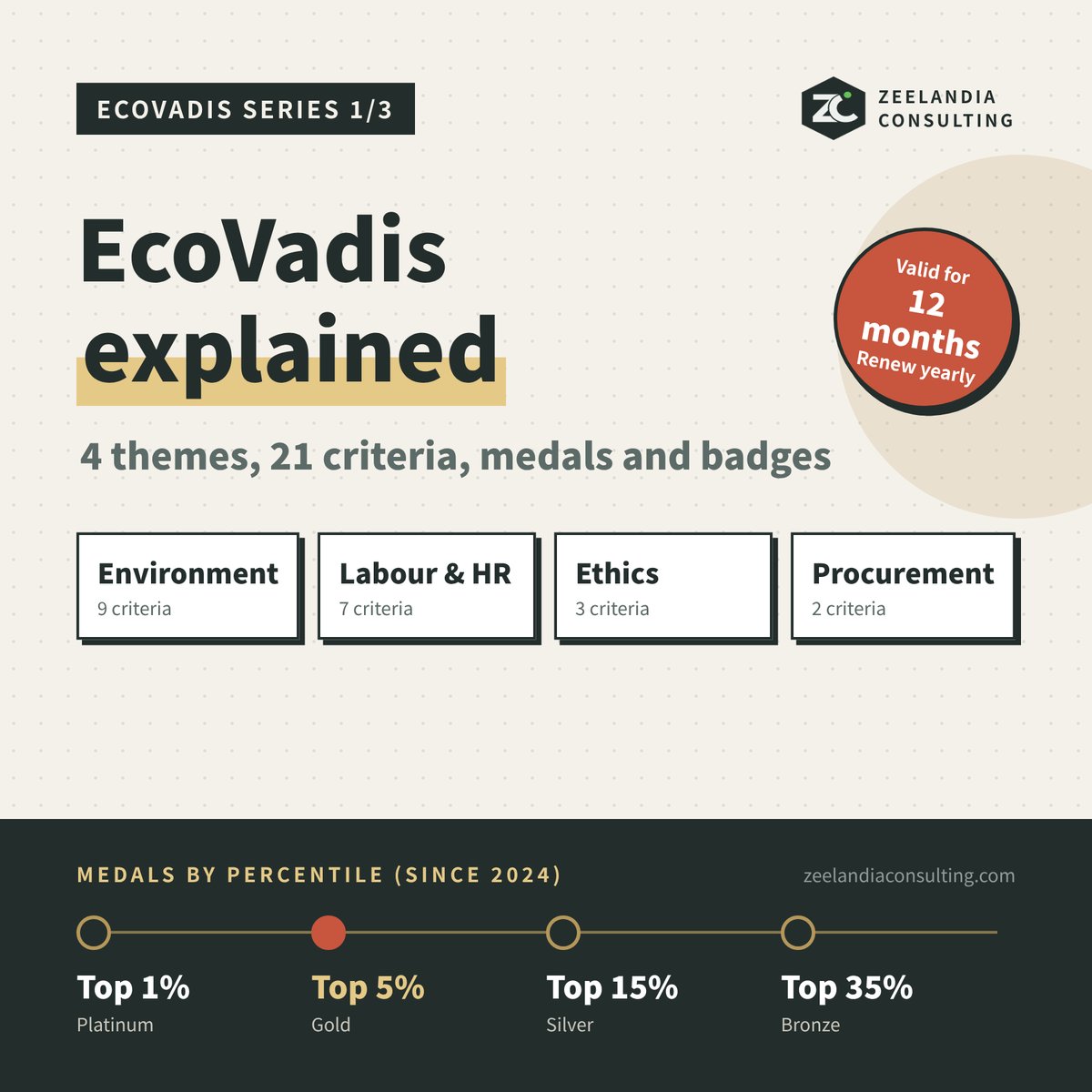
When the scorecard is published, the company is compared with all companies rated in the previous 12 months: Platinum top 1%, Gold top 5%, Silver top 15%, Bronze top 35%. Because the comparison group changes, the same score published at different times can fall into a different medal.
The “medal score ranges for 2022 and 2023” that still circulate online describe the old system. Under it, Silver was the top 25% and Bronze the top 50%, which was more generous than today.
Misconception 3: “A high enough score always gets a medal”
Correct: besides rank, there are eligibility conditions.
- Each of the four themes must score at least 30.
- A company is generally not eligible if its 360° Watch indicator scores 0 in at least one theme, or 25 in at least two themes (exceptions apply).
- Certain industries, such as tobacco, weapons and ammunition manufacturing and coal-related activities, are excluded.
A company in the top 35% that does not meet these conditions may receive a Committed badge instead of a medal.
Misconception 4: “360° is a stakeholder survey”
Correct: 360° Watch is information EcoVadis analysts collect from external sources.
Sources include NGOs, trade unions, government bodies, grievance mechanisms and other verified third parties, and both positive and negative findings count. It carries 21% of the default weight. It is not a questionnaire sent to employees or customers, and the company does not fill it in.
Misconception 5: “Well-written answers earn points”
Correct: only answers backed by documents earn credit.
The methodology states that only questionnaire declarations supported by documentary evidence are credited. Documents must be formalised, complete, credible, dated, in an accepted format and machine-readable. EcoVadis does not fill gaps with estimates or industry averages, so missing data shows up in the score.
Misconception 6: “ISO certificates guarantee a high score”
Correct: certifications are only part of the actions layer.
Under the default weights, certifications make up 40% of the actions layer, roughly 16% of each theme score. Policies, concrete measures, reporting and 360° Watch are scored separately. Certificates such as ISO 14001 and ISO 45001 are strong evidence, but they cannot stand in for the other indicators.
Misconception 7: “If the group has a medal, every company in it can use it”
Correct: a medal applies only to the rated legal entity.
Parent companies, sister companies, subsidiaries and sites cannot use it. Scorecards, medals and badges are valid for 12 months, so keeping them means being reassessed every year.
Misconception 8: “A consultant can guarantee a medal”
Correct: no one can guarantee a medal or a score in advance.
EcoVadis analysts assess the score from documents and external information, and medals depend on rank compared with other companies. Reporting and 360° Watch reflect actual performance and external information, which answering technique cannot change. What a consultant can do is help a company turn what it already does into documents that meet the requirements, and plan where to improve.
Why does EcoVadis information online vary so much?
EcoVadis announces methodology changes every quarter (January, April, July and October). The medal rules changed substantially in 2024, and the Sustainability Rating Methodology moved to V10.0 in 2026. Many articles were written before these changes and do not say when their information dates from. When you read a claim about EcoVadis, check which year’s methodology it is based on.
FAQ
What are the EcoVadis scoring weights?
Under methodology V10.0, applicable from January 2026, the default weights are policies 20%, endorsements 5%, measures and certifications 40%, reporting 14% and 360° Watch 21%, often summarised as policies 25%, actions 40%, results 35%. Weights differ for extra-small companies on some themes.
What score do you need for an EcoVadis Gold medal in 2026?
There is no fixed score. Gold means ranking in the top 5% of all companies rated in the previous 12 months when the scorecard is published, with every theme scoring at least 30 and the 360° Watch conditions met.
Is an EcoVadis rating still useful without a medal?
Yes. The scorecard shows scores by theme, strengths and areas for improvement, and customers do not always require a medal; some only require a completed rating or a minimum score. Companies scoring 45 or more without a medal may also receive a Committed badge.
How often does the EcoVadis methodology change?
EcoVadis announces changes every quarter (January, April, July and October). The current Sustainability Rating Methodology is V10.0, applicable from January 2026.
EcoVadis series
- What is EcoVadis? Themes, scoring, medals and badges explained
- Your customer asked for an EcoVadis rating: what suppliers need to know
- 8 common misconceptions about EcoVadis scoring, checked against the 2026 methodology (this article)
Need help?
ZC’s certification and ratings advisory works with an international network of advisors experienced in EcoVadis. We can help with a readiness review before the rating, a review of your supporting documents, and reading your scorecard and planning improvements.
- Book a 30-minute online consultation: calendly.com/zc-meeting/30min
- Follow ZC on LINE: lin.ee/QKV5RTE
This article is based on EcoVadis’s public methodology documents and support pages, updated to 2 November 2026, and is not advice for any specific case. The latest methodology published by EcoVadis prevails.
Next step: have you considered these three options?
Sources · EcoVadis, Sustainability Rating Methodology disclosure document (V10.0, applicable from January 2026) · EcoVadis, Medals Methodology disclosure document (V2.0, applicable from January 2026) · EcoVadis Support, Understanding EcoVadis Medals and Badges · EcoVadis, Raising the Bar: As Sustainability Performance Accelerates, We're Adapting Our Benchmarks (23 January 2024). This article is general information compiled from the public sources above and is not advice for any specific case.
EcoVadisEcoVadis scoreEcoVadis weightsEcoVadis medal thresholdssustainability ratingsupply chain due diligence