
In this article (7 sections)
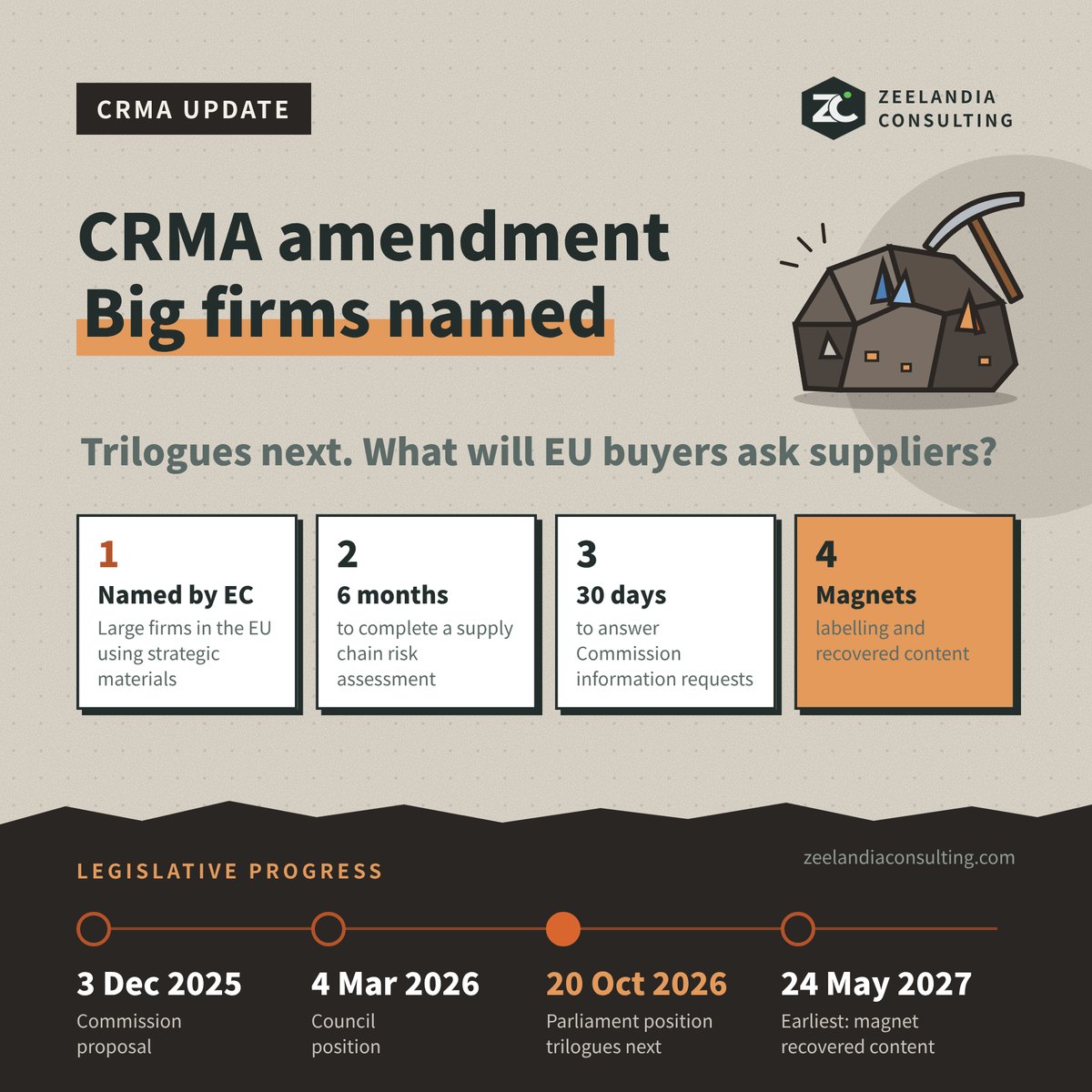
What is the CRMA amendment? It is the Commission’s proposal of 3 December 2025 (COM(2025) 946) to amend the Critical Raw Materials Act, Regulation (EU) 2024/1252. The core change: the Commission, rather than Member States, would identify the large companies operating in the EU that use strategic raw materials. Once notified, a company would have six months to complete a supply chain risk assessment, and 30 days to answer any Commission request for information.
On 20 October 2026 the European Parliament adopted its position by 470 votes to 83, with 108 abstentions. It goes further than the Commission: a self-standing critical raw materials centre, a EUR 2 billion fund, a conditional power to restrict exports of permanent magnet scrap, joint purchasing and strategic stockpiling. The Council adopted its position on 4 March 2026, so trilogue negotiations can now begin.
Key points
- Identified large companies must map their raw material supply chains, locate extraction, processing and recycling sites, assess vulnerabilities and report to their board.
- The Commission could set mitigation measures by delegated act; the proposal mentions maximum shares of reliance on a single third country.
- Products with permanent magnets (motors, household appliances, vehicles, hard disk drives, loudspeakers, civil drones and more) face labelling and recovered-content disclosure, the latter from 24 May 2027 at the earliest.
- Most non-EU manufacturers will not be named themselves, but they supply companies that will be: raw material sourcing questionnaires will travel up the chain.
- This is still a proposal. The text published in the Official Journal after trilogues is what counts.
What is the CRMA, and what is changing?
The CRMA entered into force in May 2024. It aims to reduce the EU’s dependence on single-country supply and sets 2030 benchmarks for annual consumption of strategic raw materials: 10% extracted in the EU, 40% processed in the EU, 25% from recycling, and no more than 65% from any single third country. For the policy background, see EU Critical Raw Materials Act and de-risking.
The amendment is part of the Commission’s RESourceEU Action Plan and touches three areas:
| Provision | Today | Proposal |
|---|---|---|
| Article 24, risk preparedness of large companies | Member States identify large companies | The Commission identifies them centrally and notifies each company |
| Article 24, obligations | Periodic risk assessment | Complete within 6 months of notification and at least every 3 years; report to the board; answer Commission information requests within 30 days; mitigation measures may be set by delegated act |
| Articles 28 and 29, permanent magnets | Labelling of magnet information; disclosure of recovered content | Wider product list; pre-consumer waste added to recovered content; minimum recovered shares by delegated act no later than end of 2031 |
Why move identification to the Commission? The proposal notes that large companies often operate in several Member States, so national identification duplicates work and risks fragmenting the single market.
Which large companies would be named?
Proposed Article 24(1) covers large companies operating in the EU that use strategic raw materials to manufacture:
- batteries for energy storage and e-mobility, hydrogen production and utilisation equipment, renewable energy generation equipment
- aircraft, traction motors, heat pumps
- data transmission and storage equipment, mobile electronic devices, additive manufacturing equipment
- robotics, drones, rocket launchers, radar, satellites or advanced chips
The risk assessment covers:
- mapping the supply chain of strategic raw materials
- locating extraction, processing and recycling sites
- analysing supply factors and assessing vulnerabilities
Where significant vulnerabilities are found, companies must make efforts to mitigate them, for example by diversifying supply, using secondary raw materials or substitution, and present the results to their board of directors or management board.
How do the three versions differ?
| Commission proposal (3 Dec 2025) | Council position (4 Mar 2026) | Parliament position (20 Oct 2026) | |
|---|---|---|---|
| Who identifies large companies | The Commission | Supports this; the Commission must inform Member States and the European Critical Raw Materials Board of the companies and their vulnerabilities | The Commission, not Member States |
| Company obligations | Risk assessment within 6 months, then at least every 3 years; board reporting; 30-day information requests | The Commission must notify the Member State when requesting information from its companies | Map supply chains and reduce vulnerabilities |
| Mitigation | Delegated acts, possibly including maximum reliance on a single third country | “Best efforts” measures, which may include limits on reliance on a single supplier, taking account of alternative sources | Not detailed in the press release |
| Permanent magnets | Wider labelling scope; pre-consumer waste in recovered content | Digital product passports can be used for information obligations; recycled content method aligned with ecodesign rules | Conditional power for the Commission to restrict exports of permanent magnet scrap and waste |
| New tools | Not in this proposal | Not included | Self-standing CRM centre; EUR 2 billion CRM Fund under the 2028 to 2034 budget; contracts for difference; wider joint purchasing and coordinated stockpiling; strategic project calls at least twice a year |
Parliament’s emphasis is on building capacity: a dedicated agency, a fund, price stabilisation and stockpiles, plus defence industry funding for strategic raw material projects. As rapporteur Mohammed Chahim put it: “Critical raw materials have become the currency of geopolitical power.”
Which situation are you in?
Situation 1: your group operates in the EU and uses strategic raw materials to make products on the list above Your EU entity could be named directly. Once notified, it has six months to deliver a supply chain risk assessment and 30 days to answer any Commission request. When much of the supply chain data sits with headquarters and plants in Asia, that is tight.
Situation 2: you supply large EU companies (battery cells, chips, motors, magnets, electronic components, mechanical parts) You are unlikely to be named, but your customers may be. To map their supply chains and locate extraction and processing sites, they can only ask their suppliers. Expect questionnaires on raw material origin, processing location and recycled content to move upstream.
Situation 3: you export products containing permanent magnets (motors, heat pumps, washing machines, tumble driers, microwaves, vacuum cleaners, dishwashers, hard disk drives, loudspeakers, civil drones, motorised toys, industrial robots, vehicles, light means of transport and others) These obligations sit on the product itself: a label stating whether the product contains permanent magnets and which type, and, for products whose magnets weigh more than 0.2 kg, public disclosure of the share of recovered rare earths and other materials in the magnets. The Council position allows a digital product passport to carry this information.
Is your product on the list?
Take three minutes to check:
- Do your products, or your customers' products, fall into batteries, heat pumps, motors, chips, drones or mobile electronics?
- Do they contain permanent magnets, such as NdFeB?
- Has a customer recently asked where your raw materials are mined or processed?
If any answer is yes, the CRMA amendment concerns you. We track the timeline on the CRMA page of our regulatory radar.
Common misunderstandings
“The CRMA only concerns EU mining companies.” The extraction and processing benchmarks target projects in the EU, but Article 24 applies to large companies that use strategic raw materials, and Articles 28 and 29 apply to products with permanent magnets. Manufacturers and exporters are in scope.
“We are not an EU company, so it does not affect us.” The companies named operate in the EU, but their assessments cover the whole supply chain. Requests will reach suppliers through purchasing contracts and questionnaires.
“Parliament has voted, so it applies now.” Neither position is law. The amendment applies only after trilogues conclude and the text is published in the Official Journal. Under the proposal, the Commission completes its first identification within two months of entry into force.
What happens next?
- Trilogues: both the Council and Parliament have adopted positions, and Parliament says it is ready to negotiate the final text with Member States.
- Identification timeline: under the proposal, the Commission names large companies within two months of entry into force, and again within six months of each update of the strategic raw materials list. Companies then have six months to complete their assessment.
- Permanent magnets: recovered-content disclosure applies from 24 May 2027 or two years after the relevant delegated act, whichever is later. Labelling applies two years after the implementing act enters into force.
Answering raw material questionnaires without creating risk
Answering "unknown", answering to tier 1, or answering down to the smelter tells a customer very different things about risk, and a wrong answer can become a contractual liability. How deep to go, and with what evidence, depends on your products, your customers' requirements and how far your suppliers will cooperate.
Countdown: recovered-content disclosure for products with permanent magnets, 24 May 2027 at the earliest.
Bring a list of your main products' raw materials and magnets and book a 30-minute call →
FAQ
What is the CRMA?
The Critical Raw Materials Act, Regulation (EU) 2024/1252, entered into force in May 2024. It aims to secure the EU’s supply of critical and strategic raw materials and reduce dependence on any single country. Its 2030 benchmarks are 10% extraction in the EU, 40% processing in the EU, 25% recycling, and no more than 65% from a single third country.
What does the CRMA amendment change?
Under the Commission proposal COM(2025) 946, the Commission identifies large companies centrally; they complete a supply chain risk assessment within six months of notification and at least every three years, report to their board and answer Commission information requests within 30 days. The labelling scope for products with permanent magnets widens, and pre-consumer waste counts towards recovered content.
When will the CRMA amendment apply?
It does not apply yet. The Council (4 March 2026) and Parliament (20 October 2026) have adopted positions. It applies only after trilogues conclude and the text is published in the Official Journal.
Do suppliers outside the EU have to carry out a CRMA risk assessment?
The assessment obligation falls on large companies operating in the EU that the Commission names. A non-EU group’s EU entity could be named; more commonly, suppliers outside the EU will be asked by EU customers for data on raw material origin and processing.
Next step: how ZC can help
ZC helps companies map how the CRMA and related supply chain laws affect their products and customers, and follows the trilogues as the final text takes shape. See our supply chain due diligence service.
Next step: have you considered these three options?
Sources · European Parliament press release, 20 October 2026: Critical Raw Materials: securing Europe's supply and strategic autonomy · European Commission proposal COM(2025) 946 amending Regulation (EU) 2024/1252, 3 December 2025 · Council of the EU press release, 4 March 2026: Raw materials: Council adopts position · Regulation (EU) 2024/1252 (Critical Raw Materials Act) · Legislative Observatory 2025/0385(COD). This article is general information and not legal advice for any specific case. Obligations are defined by the Official Journal of the EU.
CRMACRMA amendmentCritical Raw Materials ActRESourceEUstrategic raw materialspermanent magnetsrare earthssupply chain risk assessmentde-risking