
In this article (8 sections)
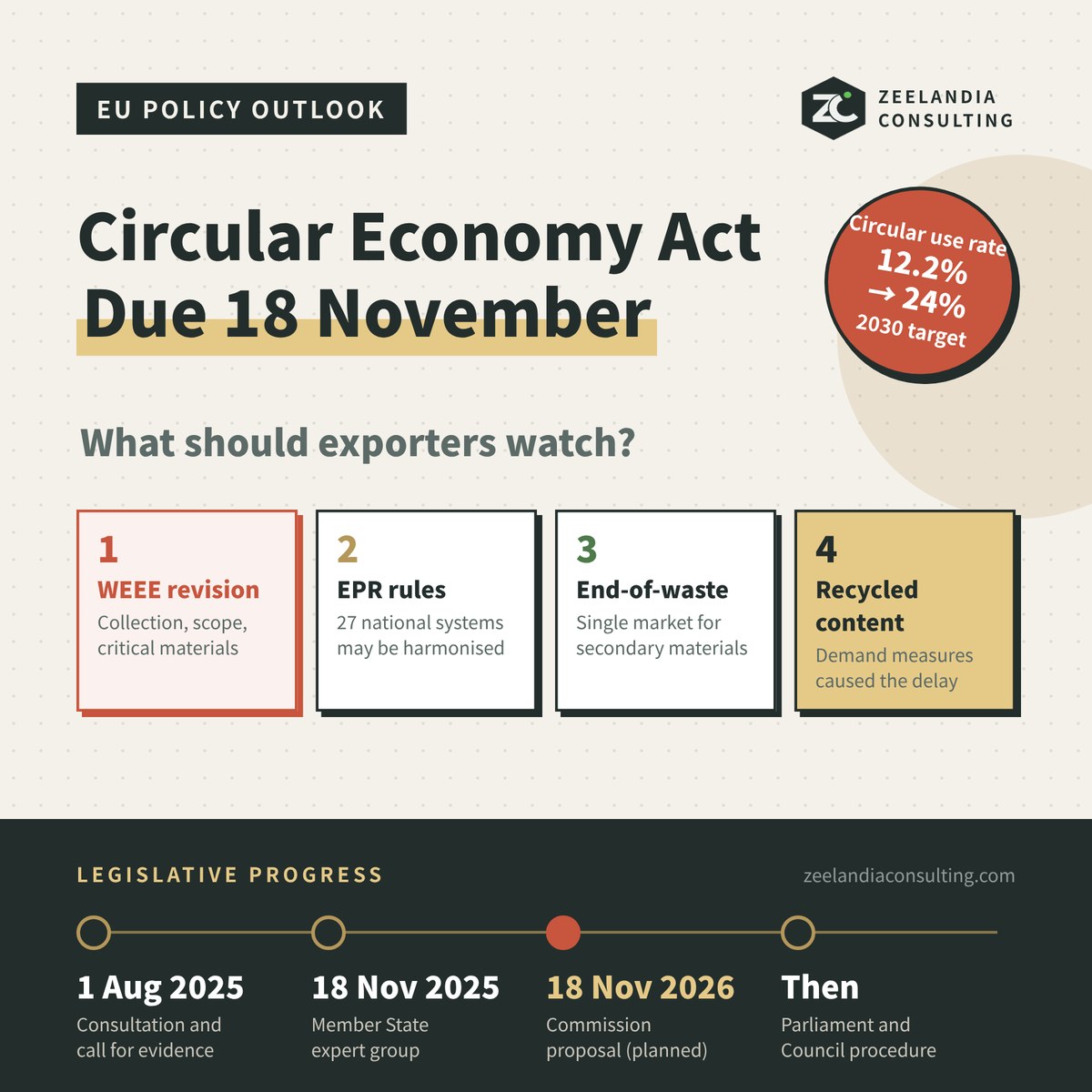
What is the Circular Economy Act? The Circular Economy Act (CEA) is a legislative proposal the European Commission is preparing. Its aims are a single EU market for secondary raw materials, less reliance on raw materials from third countries, and a doubling of the EU’s circular material use rate from 12.2% to 24% by 2030. As of 4 November 2026 the Commission has not published the proposal. According to its provisional agenda, it is due at the College meeting on 18 November.
Key points
- The CEA was planned for Q3 2026, then moved to 11 November and again to 18 November. The date may still change.
- It is framed as a competitiveness instrument and a central pillar of the Clean Industrial Deal, not only as environmental policy.
- The Commission has described three pillars: amending the Waste Framework and Landfill Directives, amending the WEEE Directive, and additional measures.
- Five things for non-EU exporters to watch: the WEEE revision, EPR harmonisation, end-of-waste criteria, demand for recycled materials, and recovery of critical raw materials.
- 18 November is only the proposal. Parliament and Council still have to legislate, so no obligations start that day.
A proposal delayed twice
The CEA was first scheduled for the third quarter of 2026, then moved to 11 November, and the Commission’s provisional agenda now shows 18 November. European press reports say the Commission’s Regulatory Scrutiny Board raised concerns about the impact assessment, mainly that measures to stimulate demand for circular products and services were insufficient.
A January 2026 briefing from the European Parliamentary Research Service (EPRS) notes that the two earlier circular economy action plans (2015 and 2020) were environmental policy. The CEA is instead positioned as a competitiveness instrument, a central pillar of the Clean Industrial Deal and the Competitiveness Compass.
For exporters this shift matters. The EU is not only asking for more recycling. It wants recycled materials to circulate freely inside the single market and to depend less on outside supply. That will reach electronics, components and materials sold into Europe.
Why the EU wants this law
The EPRS briefing cites Eurostat and European Environment Agency figures:
| Indicator | Current | Target or benchmark |
|---|---|---|
| Circular material use rate | 12.2% (2024, stagnating) | 24% by 2030 |
| Material footprint | 14.1 tonnes per capita (2024) | Well above the global average |
| E-waste rate | 30.8% (2023) | 65% WEEE target |
| Packaging recycling rate | 67.5% (2023) | 70% by 2030 |
| Heavy rare earth imports | Nearly 100%, mainly from China | CRMA: 25% of strategic raw materials from recycling |
| Lithium and rare earth recycling | Below 1% | As above |
Getting from 12.2% to 24% will not happen under the current framework. That gap is what the CEA is meant to close.
What the CEA may contain
Based on what the Commission has said so far, the CEA could rest on three pillars:
- Amending the Waste Framework Directive and the Landfill Directive
- Amending the Waste Electrical and Electronic Equipment (WEEE) Directive
- Additional measures, such as harmonising environmental taxes and requirements for extractive waste management
At a meeting of its circular economy expert group on 18 November 2025, the Commission set out its objectives to Member State directors: simple, clear and digital rules for secondary raw materials and waste; more separately collected waste and better-quality secondary raw materials; higher uptake of EU secondary raw materials in products; more collection, sorting and recycling capacity; and less waste generation.
These are objectives, not legal text. The actual content will only be known once the proposal is published.
Five things exporters should watch
1. The WEEE revision puts electronics first in line
Trade press reports that the WEEE revision is expected to focus on collection targets, extended producer responsibility (EPR), the Directive’s scope and recovery of critical raw materials. The e-waste rate has hovered around 30%, far from the 65% target, so the pressure to amend is real.
Makers of electrical and electronic equipment, IT hardware and components should watch two things. If the scope changes, products currently outside it may come in. If EPR rules change, producers already registered in several countries may see their reporting and financial obligations change too.
2. EPR harmonisation could end 27 different systems
The EPRS briefing points to a structural problem in EPR: producer responsibility organisations are incentivised to keep costs down for producers, not necessarily to maximise circular outcomes. Textiles are the example given, where reuse and collection operators have become financially vulnerable.
At the expert group meeting, Member State directors broadly agreed the CEA should prioritise harmonising end-of-waste criteria, EPR rules and standards. The recycling and waste management federations EuRIC and FEAD ask for streamlined and enforceable EPR systems. Several delegations also stressed a level playing field for online sales and imports.
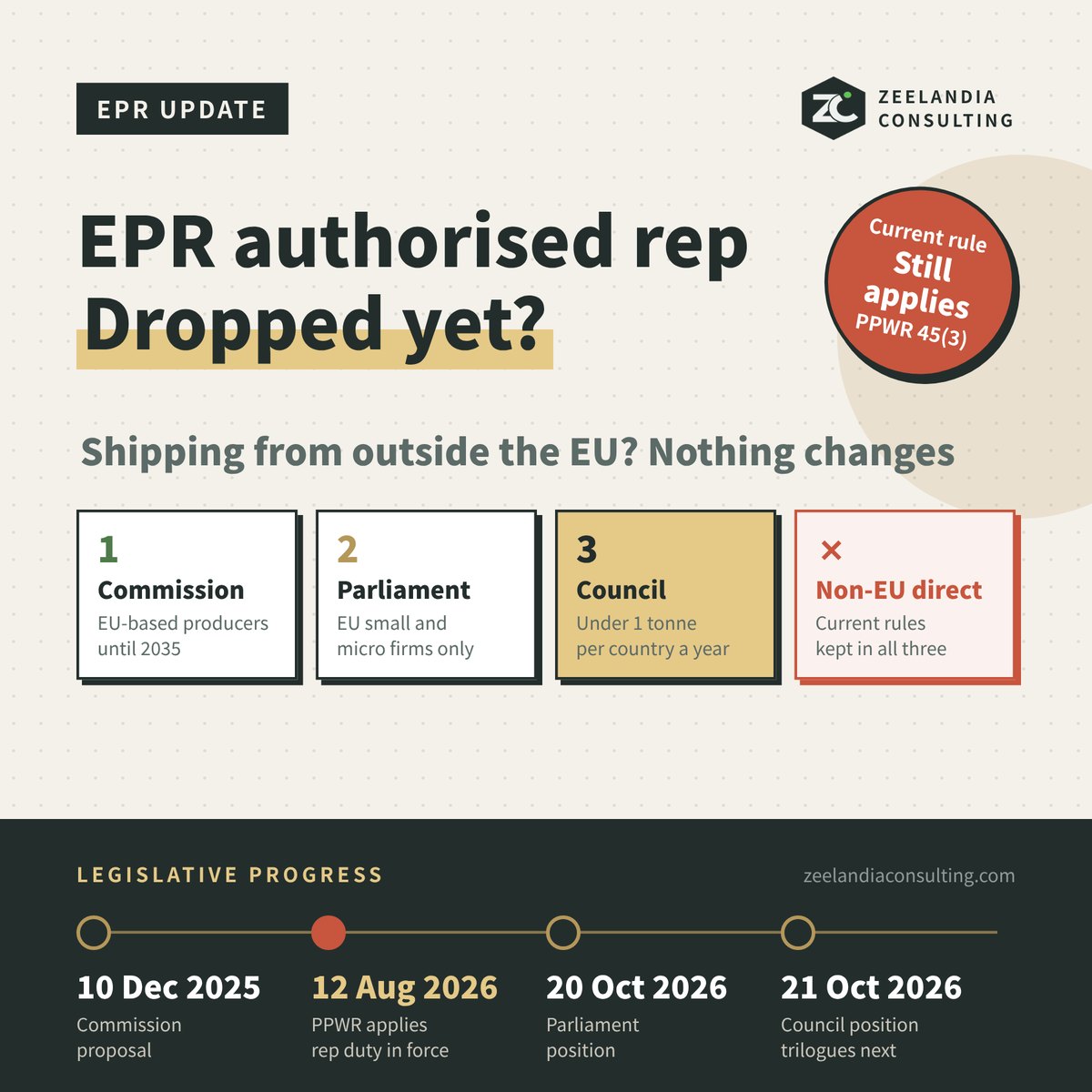
The European Parliament’s October position on the EPR authorised representative suspension already ties the relief for EU-based small and micro enterprises to “the entry into force of the Circular Economy Act or 1 January 2035, whichever comes first”. That is only Parliament’s position, and it does not affect producers shipping directly from outside the EU, but it signals that the CEA may become the vehicle for reorganising EPR. See Is the EPR authorised representative obligation being dropped?
3. Common rules on when waste stops being waste
The 27 Member States apply different end-of-waste criteria, which the EPRS identifies as a main barrier to cross-border flows of secondary raw materials. The CEA is expected to address this and to simplify cross-border shipment procedures for recyclable waste.
Common criteria would give companies buying recycled materials in Europe, or supplying them to European customers, more consistent rules. They may also bring clearer quality and hazardous-substance requirements. Member State delegations have already flagged hazardous substances in recyclates.
4. Demand for recycled materials is what delayed the proposal
The biggest obstacle for recycled materials is the price and quality gap. The EPRS uses plastics as an example: rPET often costs more than virgin PET, or is perceived as lower quality, which undermines the business case for recycling.
Member States, the recycling industry and several NGOs want mandatory recycled-content targets and green public procurement to pull demand, and the Regulatory Scrutiny Board found the demand-side measures too weak. So the key question for the proposal is whether the CEA sets recycled-content requirements beyond packaging, which the PPWR already covers. If it does, European customers will ask suppliers for recycled-content shares and evidence far more often.
Which EPR schemes cover your products today?
The CEA will amend existing systems, so the first step is knowing where you stand now. Take three minutes to check:
- Which of your products sold in Europe fall under packaging, electrical and electronic equipment or batteries?
- In which countries do you register yourself, and where does your importer handle it?
- Are European customers already asking about recycled content or material composition?
See our EPR registration and authorised representative service →
5. Critical raw materials recovery becomes a supply-security issue
The EPRS describes the CEA as a potential “geopolitical shield”: by mandating recovery of materials from waste, such as permanent magnets from electric vehicles and rare earths from e-waste, the EU could reduce its dependence on volatile supply chains and support the Critical Raw Materials Act target of 25% from recycling.
This matters most for makers of motors, magnetic components, batteries and parts containing rare earths. If recovery obligations reach upstream, they may affect product design, dismantlability and material disclosure. The Critical Raw Materials Act itself is also being amended; see What is the CRMA amendment?
The debate: efficiency or reduction
The final shape of the CEA depends on an unresolved debate:
- Industry associations (BusinessEurope, Cefic, Plastics Europe and others) support a single market for recyclates but want an enabling rather than punitive framework, and back digital tools such as product passports.
- NGOs (the European Environmental Bureau, Zero Waste Europe and others) want science-based absolute reduction targets for material consumption, with priority for prevention, reuse and repair.
- The Council asked the Commission in June 2024 to assess ambitious and economically feasible science-based targets.
- The European Parliament stressed in its 2025 resolutions that the transition must preserve competitiveness, and encouraged measures to increase the use and affordability of strategic secondary materials.
If absolute reduction targets make it into the text, the impact will go far beyond technical changes to recycling and EPR.
Three common misconceptions
“We have to comply from 18 November.” On 18 November (if it does not slip again) the Commission only presents a proposal. Parliament and Council then follow the ordinary legislative procedure, the text may change substantially, and entry into force and application will take time.
“The Circular Economy Act only concerns recyclers.” The CEA is expected to amend WEEE, EPR and waste rules and may drive demand for recycled materials. Manufacturers exporting electrical and electronic equipment, components and materials may all be in scope.
“We have done PPWR, so the CEA doesn’t concern us.” The PPWR covers packaging. The CEA is expected to deal with electrical and electronic equipment, secondary raw materials and national EPR systems. The scopes differ, but EPR harmonisation could change how both packaging and electronics are reported.
What happens next
- Proposal: expected on 18 November. ZC will summarise the text and its impact once it is published.
- Legislative procedure: Parliament and Council each adopt positions, followed by trilogue negotiations.
- Links to other files: the EPR authorised representative suspension and the CRMA amendment may interact with what the CEA contains.
Updates will appear in the Regulatory Radar.
Once the proposal is out, the impact needs reading line by line
The same law can affect different products and shipping models very differently. Whether the WEEE scope widens, how EPR is harmonised and which products get recycled-content rules can only be judged against your product mix and shipments per country.
Book a 30-minute call to review the impact once the proposal is published →
FAQ
What is the EU Circular Economy Act?
It is a legislative proposal being prepared by the European Commission to create a single EU market for secondary raw materials, reduce reliance on raw materials from third countries and raise the circular material use rate from 12.2% to 24% by 2030. The Commission has said it may amend the Waste Framework Directive, the Landfill Directive and the WEEE Directive.
When will the Circular Economy Act be proposed?
It was planned for Q3 2026, then moved to 11 November. The Commission’s provisional agenda currently shows 18 November 2026. The date may still change; the Commission’s official publication is what counts.
Will the Circular Economy Act affect non-EU exporters?
Probably. The Commission expects to revise the WEEE Directive and harmonise national EPR systems, so companies exporting electrical and electronic equipment, components and materials to the EU may see changes in scope, reporting and recycled-content requirements. The actual impact will only be clear once the proposal is published.
How is the Circular Economy Act different from the PPWR?
The Packaging and Packaging Waste Regulation (PPWR) is already in force and covers packaging design, labelling, recycled content and EPR. The Circular Economy Act is still a proposal, expected to deal with electrical and electronic equipment, the market for secondary raw materials, end-of-waste criteria and harmonisation of national EPR systems.
Next step: how ZC can help
From the Netherlands, ZC tracks EU circular economy and EPR legislation and helps companies map which EPR schemes their products fall under, register in each country and arrange authorised representatives. See our EPR registration and authorised representative service.
Next step: have you considered these three options?
Sources · European Parliamentary Research Service, Circular economy act, Briefing PE 782.628, January 2026 · European Commission, Commission launches consultation for upcoming Circular Economy Act, 1 August 2025 · European Parliament, Legislative Train Schedule: Circular Economy Act · EUWID, Circular Economy Act proposal expected on 11 November, 6 October 2026 · Ricicla News, Circular Economy Act: Bruxelles sposta la presentazione al 18 novembre, 20 October 2026. This article is general information and not legal advice for any specific case. Obligations are defined by the Official Journal of the EU.
Circular Economy ActCEAEU circular economyWEEEEPREPR harmonisationend-of-wasterecycled contentsecondary raw materialscritical raw materialsClean Industrial Deal