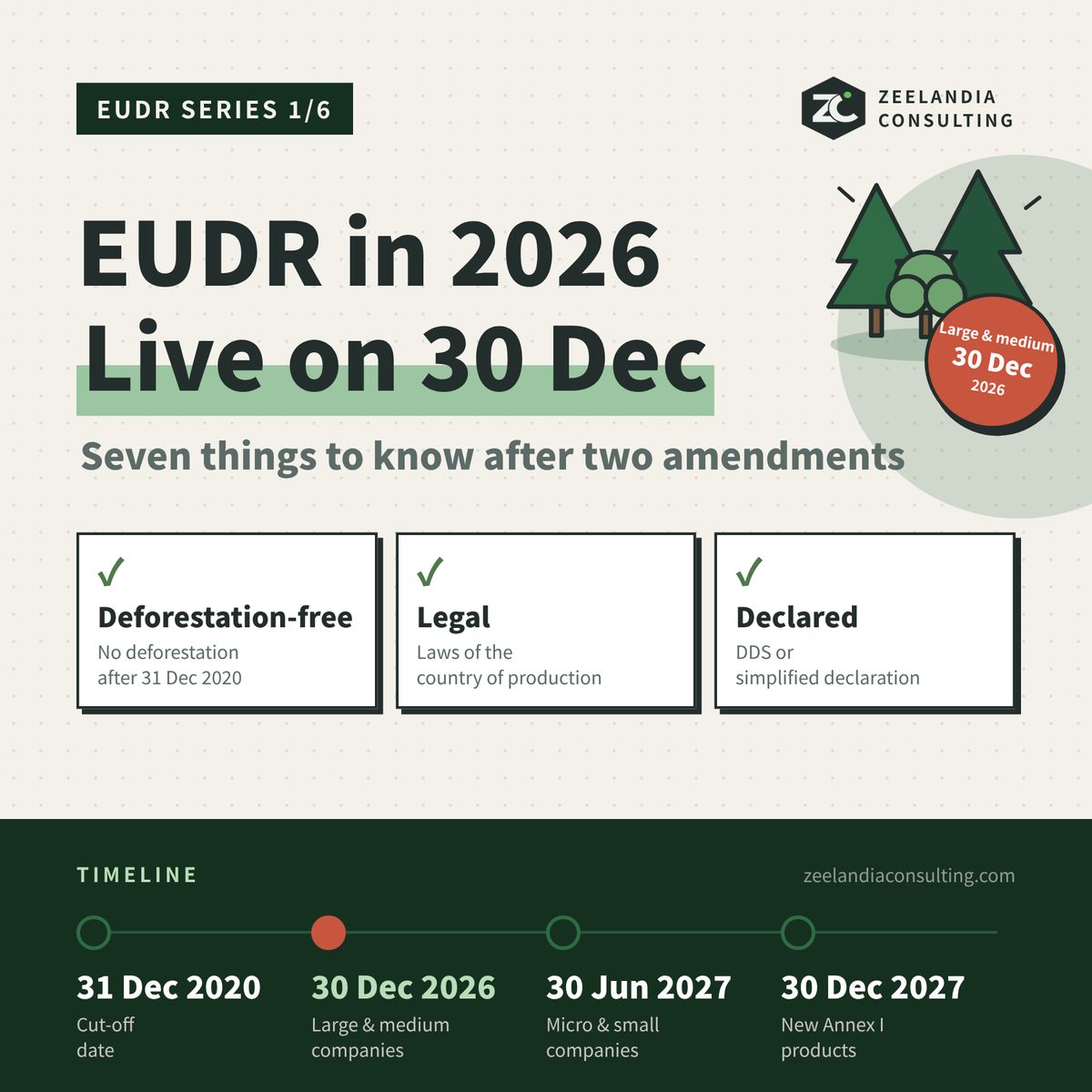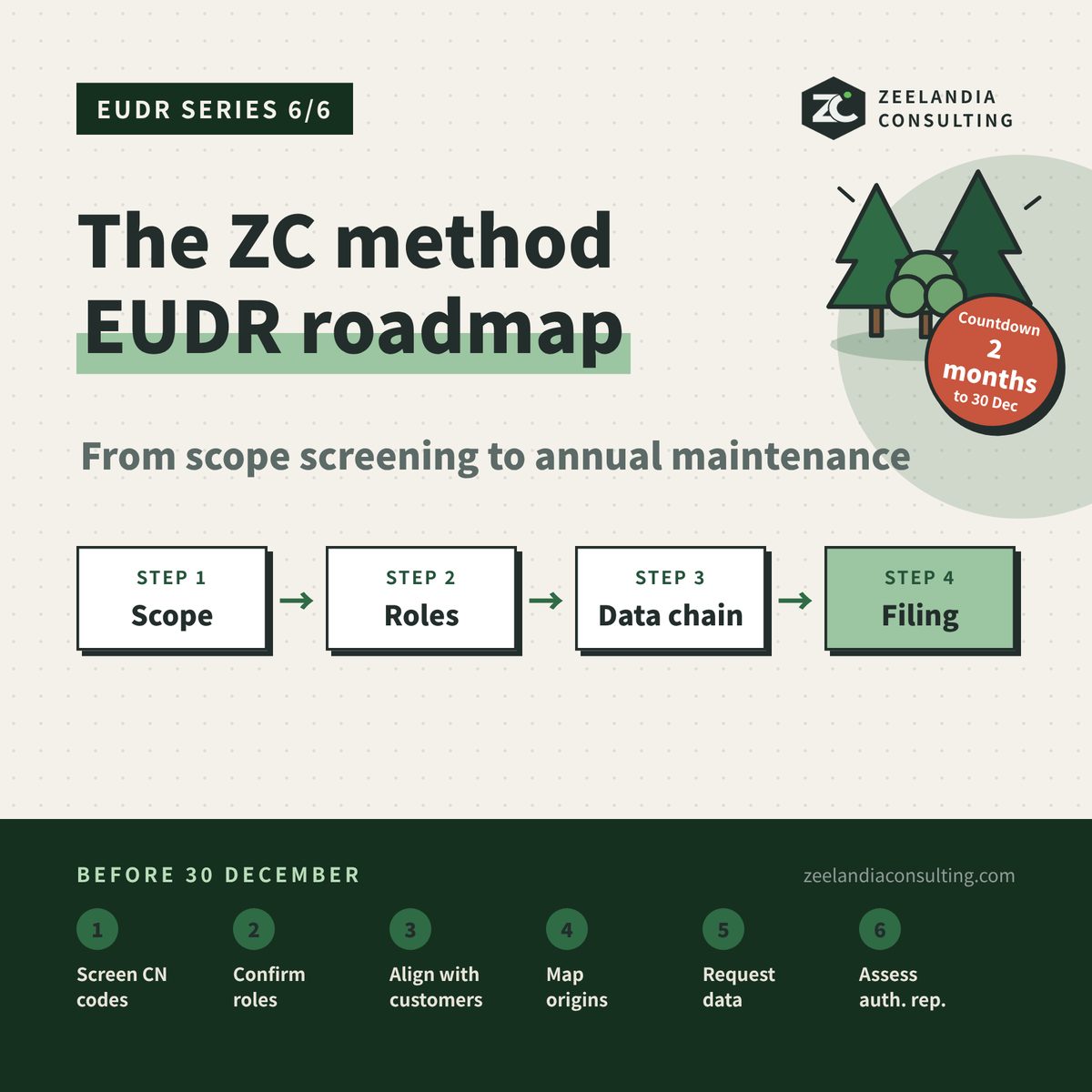
An EU Deforestation Regulation (EUDR) compliance programme for a manufacturer can be organised in four steps (scope screening, role mapping, data chain, and filing and maintenance), with large and medium-sized companies in scope from 30 December 2026. Parts 1 to 5 covered the legal framework. This final part is about execution: how a manufacturer gets from “we received an EUDR questionnaire from a European customer” to “we have a compliance routine that runs year after year”.
ZC Zeelandia Consulting helps Taiwanese and Asian manufacturers with EU sustainability regulation. We split EUDR projects into four steps.
Key takeaways
- Screen products against Annex I at CN eight-digit level, including the removals and exclusions in Delegated Regulation 2026/2102.
- Map roles per product line, shipping model and legal entity; SME status is assessed per legal entity, not per group (FAQ 3.13).
- Build the data chain on the Article 9 information requirements and the 14 risk criteria of Article 10.
- Review the due diligence system at least yearly (Article 12(2)); non-SME operators report publicly from the 2027 reporting year.
- An authorised representative must be established in the EU (Articles 2(22) and 6), and the operator remains responsible (Article 6(1)).
Step 1: Scope screening
Goal: establish exactly which products and part numbers are in scope.
- Match each item against Annex I at CN eight-digit level, including the removals and exclusions in 2026/2102 (part 5).
- Separate “the product” from “packaging, manuals and samples”, which are largely excluded.
- Confirm inputs behind “ex” codes: natural or synthetic rubber, palm-based or other fatty alcohols.
- Flag products added from 30 December 2027 and plan for them now.
Typical outcome: many electronics and machinery clients find far fewer in-scope items than expected, while tyre, furniture, paper and oleochemical producers usually have a large set to work through.
Step 2: Role mapping
Goal: for each product line and shipping model, determine which legal entity carries which obligation.
- By Incoterms: under FOB/CIF the EU importer is the operator; under DDP with your own EORI, you are the operator and the first EU buyer is also deemed an operator (Article 7).
- By legal structure: what role the EU subsidiary, the parent and third-country plants each play. SME status is assessed per legal entity, not per group (FAQ 3.13).
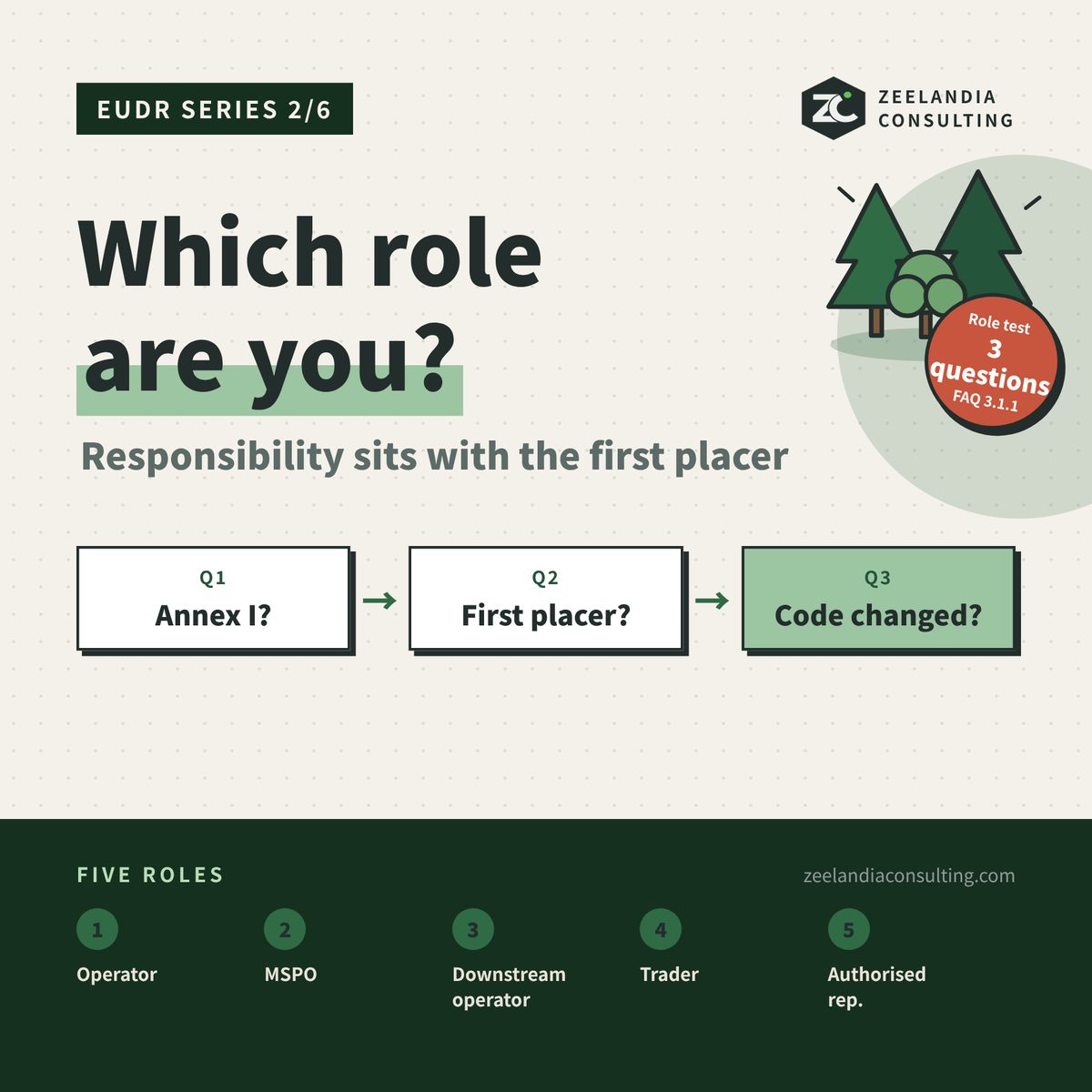
- Check for dual roles, for example importing a commodity and processing it into another Annex I product (part 2).
Output: a role matrix of product line × shipping model × legal entity, showing who files a due diligence statement (DDS), who registers in the Information System and who only keeps records.
Step 3: Data chain
Goal: make the Article 9 information flow reliably from upstream to the filing entity.
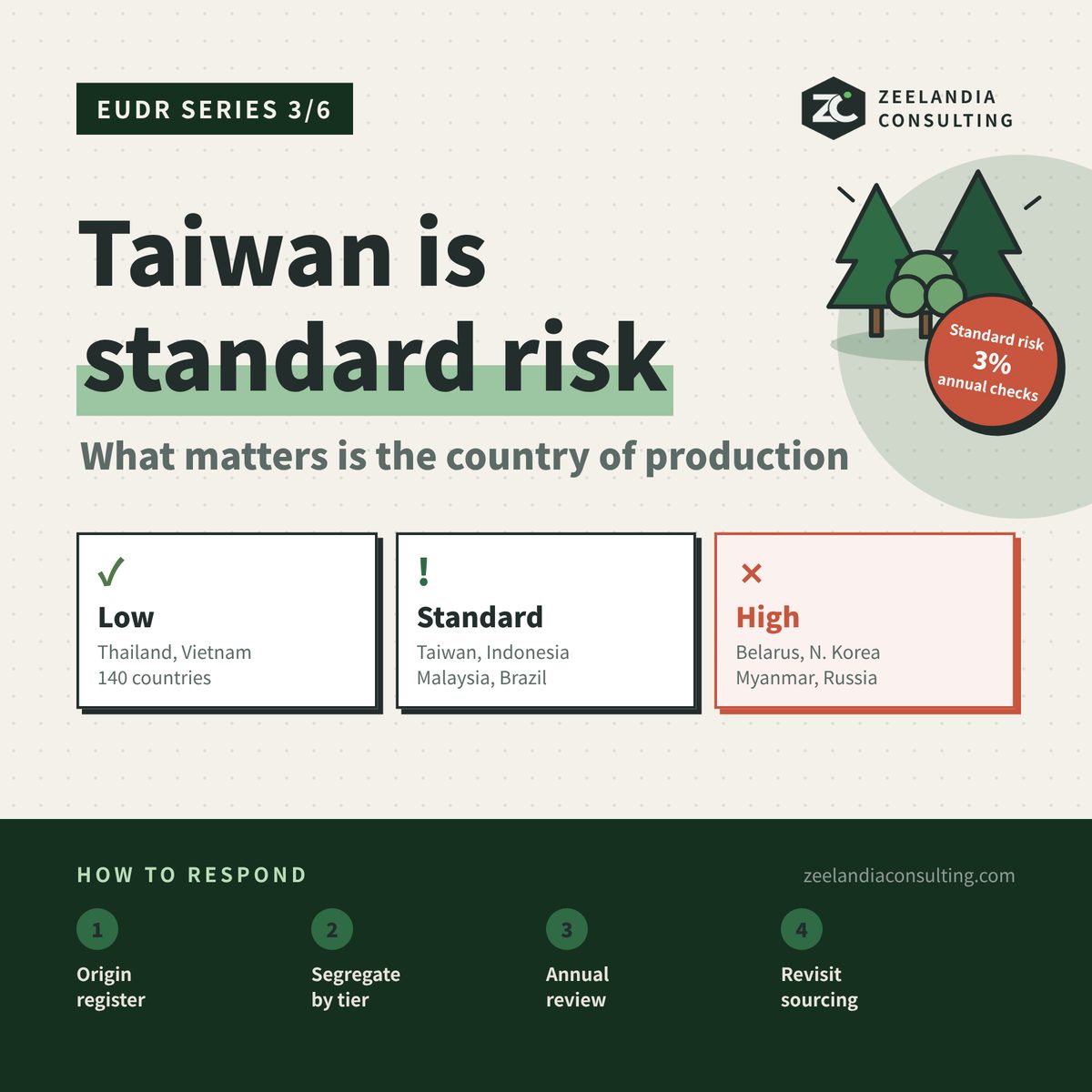
- Origin map: trace each relevant commodity to its country of production and match it against the 2025/1093 tiers (part 3). Taiwanese inputs are standard risk; low-risk origins such as Thailand or Vietnam may allow simplified due diligence.
- Supplier data requests: forms for upstream suppliers covering GeoJSON geolocation, production periods, legality documents and segregation evidence.
- Risk assessment template: built on the 14 criteria of Article 10, with the reasoning recorded, since authorities can ask how the risk level was determined (Article 10(4)).
- Use of certification: treat FSC, PEFC, RSPO and similar as supporting evidence only, confirming they are not mass balance and do not replace due diligence (Guidance, section 10).
Step 4: Filing and maintenance
Goal: turn the EUDR into routine operations rather than a project for every shipment.
- DDS strategy: assess annual multi-shipment DDS (FAQ 5.19) and the grouping feature introduced by 2026/1565 to reduce customs workload.
- System integration: high-volume operators can consider automated filing from ERP through the Information System web services.
- Annual review: review the due diligence system at least yearly (Article 12(2)), with tier updates, Annex I changes and supplier changes as fixed check items.
- Concern handling: define in advance who assesses substantiated concerns and who notifies the competent authorities.
- Public reporting: non-SME operators report annually on their due diligence system from the 2027 reporting year (Article 12(3)). Information already disclosed under Corporate Sustainability Reporting Directive (CSRD) or Corporate Sustainability Due Diligence Directive (CSDDD) reporting need not be repeated (FAQ 5.14).
Why does an EU-based partner matter?
Two features of the EUDR make an EU presence important:
1. Authorised representatives must be established in the EU Under Articles 2(22) and 6, operators may mandate an authorised representative to submit DDS on their behalf, but the representative must be established in the EU. Asian companies shipping DDP under their own EORI, or without an EU subsidiary, need an EU-based representative.
ZC is headquartered in Amsterdam, the Netherlands, and can act as EUDR authorised representative. Under Article 6(1), the operator remains responsible for compliance after mandating a representative, so we work through the due diligence content with clients rather than simply submitting forms.
2. European customers expect fast, competent responses Once the EUDR applies, supplier questionnaires, data requests and audits from European customers will multiply. ZC’s EU counterpart service acts as the client’s outward-facing point of contact on EU sustainability regulation, answering in the format European customers expect while translating requests into tasks the home team can execute.
What should be on your checklist before 30 December?
About two months remain before the EUDR applies to large and medium-sized companies on 30 December 2026. Priorities:
- Complete scope screening and list in-scope CN eight-digit codes
- Confirm the role for each product line and the shipping terms (FOB/CIF/DDP)
- Contact key European customers to agree data formats and deadlines
- Map commodity origins and match them against country tiers
- Send data requests upstream, starting with standard-risk origins
- If you are an operator: register in the Information System and plan the first DDS
- If you have no EU entity: assess whether you need an authorised representative
- Appoint an internal owner and set up the annual review cycle
ZC EUDR resources
ZC offers several EUDR resources alongside its advisory work:
- ZC RegRadar EUDR diagnostic tool: on the ZC Smart Compliance Hub for an initial self-check.
- ZC EU Regulations radar: eureg.zeelandiaconsulting.com tracks the EUDR and other EU Green Deal regulations.
- ZC YouTube channel: @zc-consulting for regulatory briefings and webinar recordings.
- ZC services: the EUDR advisory service and the EU regulatory retainer.
FAQ
Where should an EUDR compliance project start?
An EUDR project should start with scope screening: matching each item against Annex I at CN eight-digit level, including the removals and exclusions in Delegated Regulation 2026/2102. Many electronics and machinery companies find far fewer in-scope items than expected.
Does a company without an EU entity need an EUDR authorised representative?
Asian companies shipping DDP under their own EORI, or without an EU subsidiary, need an EU-based representative if they want one to submit DDS on their behalf, because the representative must be established in the EU (Articles 2(22) and 6). Under FOB/CIF terms, the EU importer is the operator.
Does mandating an authorised representative transfer EUDR responsibility?
No. Under Article 6(1), the operator remains responsible for compliance after mandating a representative. The representative submits the DDS, but the due diligence content stays the operator’s responsibility.
Do EUDR operators have to report publicly?
Non-SME operators report annually on their due diligence system from the 2027 reporting year (Article 12(3)). Information already disclosed under CSRD or CSDDD reporting need not be repeated (FAQ 5.14).
The series
- EUDR in 2026: Seven Things to Know Before 30 December, After Two Rounds of Amendments
- Which Role Are You? Determining Roles Under the EUDR: Operator, Downstream Operator, Trader, MSPO and Authorised Representative
- Taiwan Is “Standard Risk”: What EUDR Country Benchmarking Means in Practice
- EUDR Due Diligence and DDS in Practice: Geolocation, the Information System and Filing Strategy
- The New EUDR Product Scope: What Delegated Regulation 2026/2102 Removed and Added
- The ZC Methodology: An EUDR Compliance Roadmap from Scope Screening to Annual Maintenance
Ready to start? Book a 30-minute consultation. We begin with scope screening and role mapping to show what the EUDR really means for your workload.
This article provides general information and does not constitute legal advice.
Sources
- Regulation (EU) 2023/1115, consolidated, Articles 2, 6, 7, 9 to 13
- Implementing Regulation (EU) 2025/1093
- Implementing Regulation (EU) 2026/1565
- Delegated Regulation (EU) 2026/2102
- European Commission EUDR FAQ, version 5; EUDR Guidance Document C/2026/3896
Sources · Regulation (EU) 2023/1115, consolidated · Implementing Regulation (EU) 2025/1093 · Implementing Regulation (EU) 2026/1565 · Delegated Regulation (EU) 2026/2102. This article is general information and not legal advice for any specific case. Obligations are defined by the Official Journal of the EU.
EUDREU Deforestation RegulationEUDR compliance roadmapauthorised representativeEU counterpartDDS filingZC Zeelandia Consulting