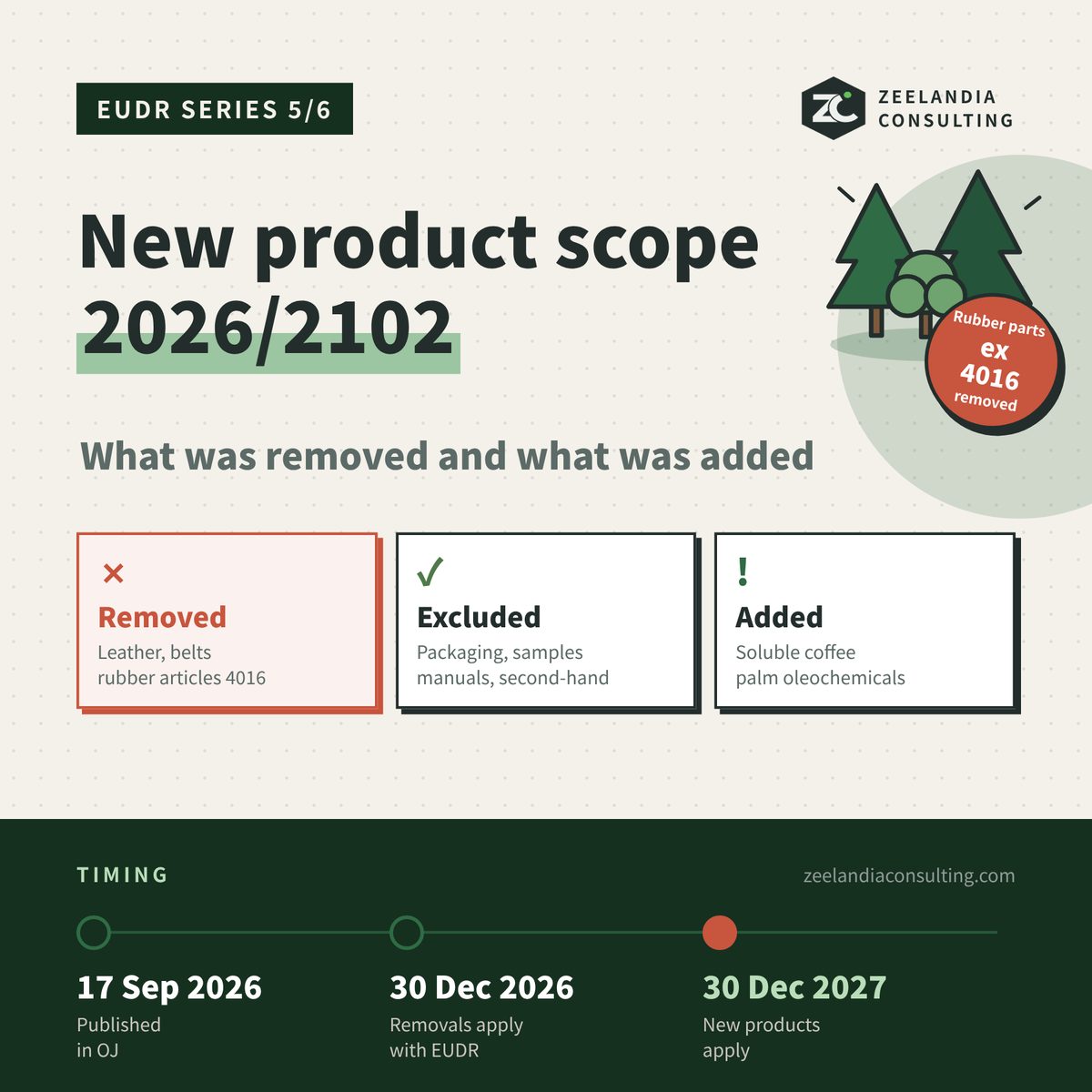
Delegated Regulation (EU) 2026/2102 revises Annex I of the EU Deforestation Regulation (EUDR): it removes products such as leather and other articles of vulcanised rubber (ex 4016), excludes packaging, samples and second-hand goods, and adds soluble coffee and palm-based oleochemicals from 30 December 2027. Whether a product is covered by the EUDR depends on the HS/CN codes listed in Annex I. That list changed twice in 2025 and 2026:
- Regulation (EU) 2025/2650 removed Chapter 49 printed matter (books, newspapers, pictures and similar).
- Delegated Regulation (EU) 2026/2102 was adopted on 13 July 2026, published in the Official Journal on 17 September 2026 and entered into force the following day. New products apply from 30 December 2027.
Key takeaways
- Delegated Regulation (EU) 2026/2102 was published on 17 September 2026 and entered into force the following day.
- Other articles of vulcanised rubber (ex 4016), cattle leather, rubber conveyor belts and aircraft and motor vehicle seats leave the scope.
- Packaging used to support, protect or carry another product is excluded whether or not the packed product is in scope; packaging sold in its own right remains covered.
- Synthetic rubber, bamboo, rattan, buffalo and bison are out of scope.
- Soluble coffee (2101 11 00) and palm-based oleochemicals are added from 30 December 2027.
1. Which products were removed from scope (out from the date of application)?
Regulation (EU) 2025/2650 and Delegated Regulation (EU) 2026/2102 remove the following products from EUDR Annex I:
| Item | Code | Commission’s rationale |
|---|---|---|
| Cattle hides, skins and leather | ex 4101, ex 4104, ex 4107 | Leather and meat value chains are separate; EU operators have little leverage to obtain upstream data |
| Conveyor and transmission belts of vulcanised rubber | ex 4010 | Low natural rubber content |
| Other articles of vulcanised rubber | ex 4016 | Low natural rubber content |
| Retreaded tyres | ex 4012 narrowed to 4012 90 30 | Only new tyre treads remain covered |
| Aircraft and motor vehicle seats | 9401 10, 9401 20 | Limited wood content |
| Soya beans for sowing | 1201 narrowed to 1201 90 00 | Separate seed value chain |
| Printed matter | ex 49 | Removed by 2025/2650 |
The removal of ex 4016 matters a great deal for Asian manufacturers. This code covers gaskets, O-rings, keypads, vibration dampers and many other vulcanised rubber parts common in electronics, machinery and automotive components. They are now out of scope.
2. Which horizontal exclusions apply?
Beyond deleting codes, Delegated Regulation 2026/2102 adds several cross-cutting exclusions to the EUDR:
1. Samples and test products Samples of negligible value and quantity used only to solicit orders, and products used up or destroyed in examination, analysis or testing, are outside the EUDR.
2. Packaging
- Single-use packing used to support, protect or carry another product and presented with it is out of scope.
- Reusable packing used for that purpose is out of scope from the moment it is so used.
- This applies whether or not the packed product is itself in scope.
- Packaging sold or exported in its own right, such as cartons sold by a box maker or pallets sold by a pallet maker, remains in scope.
FAQ 2.5 adds the test: if the packaging would be classified together with its contents at customs (General Interpretative Rule 5(b)), it falls under the exclusion.
3. Marketing and information materials, correspondence Labels, manuals and brochures accompanying a product, marketing materials supplied free of charge, and items of correspondence are out of scope.
4. Waste, used and second-hand goods, recovered material Many wood, paper and rubber codes now exclude waste and used or second-hand products. For pulp and paper, recovered (waste and scrap) material and products derived from it are excluded.
5. Species limits
- Cattle: genus Bos only; buffalo and bison excluded.
- Oil palm: Elaeis spp. only.
- Rubber: Hevea brasiliensis only; synthetic rubber is out of scope.
- Wood: bamboo, rattan and other materials of a woody nature are out of scope.
6. Medicinal use Many palm oil derivatives are excluded to the extent they are used to manufacture human or veterinary medicinal products.
3. Which products are added from 30 December 2027?
From 30 December 2027, Delegated Regulation 2026/2102 adds the following codes to EUDR Annex I:
| Category | New codes |
|---|---|
| Cattle | ex 0206 21 00 frozen cattle tongues |
| Coffee | 2101 11 00 extracts, essences and concentrates of coffee (soluble coffee) |
| Palm oils and fats | ex 1516 20 hydrogenated or inter-esterified palm oils, ex 1518 00 chemically modified palm oils, ex 1520 00 crude glycerol |
| Palm-based alcohols | ex 2905 16 octanol, ex 2905 17 00 lauryl, cetyl and stearyl alcohol, ex 2905 19 00 other saturated monohydric alcohols |
| Palm-based acids, esters, amines | ex 2915 39 acetic esters, ex 2916 15 oleic and linoleic acids, ex 2916 19 10 undecenoic acids, ex 2921 19 acyclic monoamines, ex 2923 90 00 quaternary ammonium salts, ex 2924 19 00 acyclic amides |
| Soap | ex 3401 11 00, ex 3401 20 soap containing or made using oil palm |
| Other chemicals | ex 3824 99 other chemical preparations, ex 3907 29 polyethers |
All of these carry an “ex” prefix: only products made using oil palm are covered. Fatty alcohols synthesised from petrochemicals or other vegetable oils are out of scope.
4. What does the new scope mean for Asian industries?
The 2026/2102 revision affects Asian industries very differently.
Electronics, ICT and machinery: much lighter burden
- Rubber parts (ex 4016) are gone.
- Cartons, cushioning, wooden pallets used for shipping, manuals and warranty cards fall under the exclusions.
- Still check: paper or wood products sold on their own, such as retail gift boxes or paper bags, and whether any product sets include Annex I wooden furniture or parts.
Tyres and bicycles: still a focus
- New rubber tyres (ex 4011) and inner tubes (ex 4013) remain in scope, including bicycle, motorcycle and car tyres.
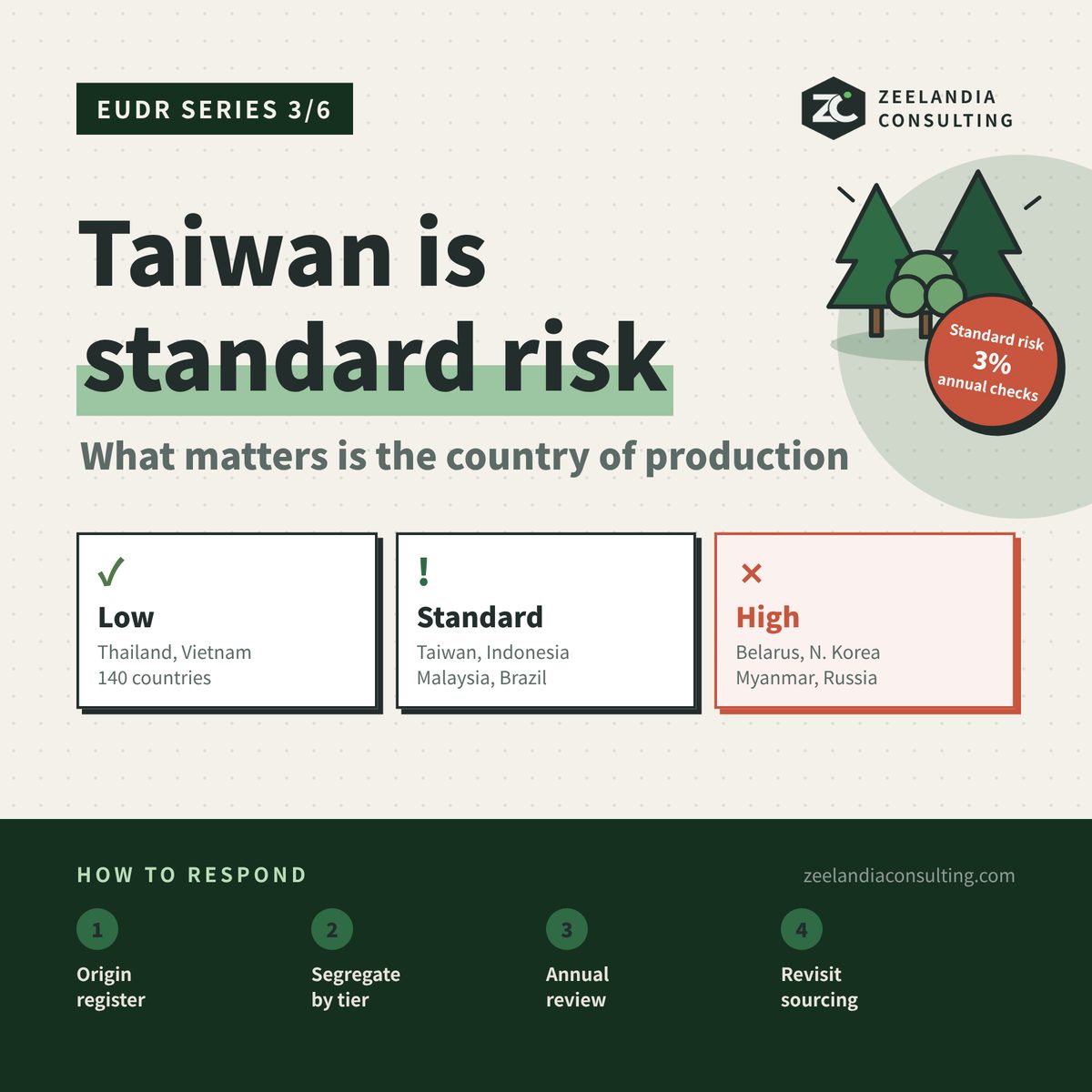
- Check the tier of each natural rubber origin: Thailand and Vietnam are low risk, Indonesia and Malaysia standard risk (part 3).
Specialty chemicals and oleochemicals: start preparing for 2027
- Asia has many producers and exporters of surfactants, fatty alcohols, fatty amines and quaternary ammonium compounds, often based on palm or palm kernel oil.
- From 30 December 2027, these products are in scope when made using oil palm.
- Confirm oil sources in formulations now and start requesting geolocation and segregation evidence from refiners.
Furniture, wood products and paper: still covered
- Wooden furniture (ex 9403), wooden seats (listed ex 9401 codes), plywood, paper and paperboard remain in scope, with second-hand and recovered material excluded.
Three reminders for your product inventory
An EUDR product inventory after 2026/2102 should follow three rules:
- Work at CN eight-digit level, not four digits. Many entries are now “ex” codes or split to eight digits.
- Confirm whether inputs come from a relevant commodity. “Ex” codes cover only products made with relevant commodities; synthetic rubber and non-palm oils are out, but you need documents to prove it.
- Prepare early for the 2027 additions. There are about 14 months until the end of 2027, and building upstream data usually takes longer than expected.
FAQ
Are rubber gaskets and O-rings still covered by the EUDR?
No. Delegated Regulation 2026/2102 removes other articles of vulcanised rubber (ex 4016), which covers gaskets, O-rings, keypads, vibration dampers and many similar parts. New rubber tyres (ex 4011) and inner tubes (ex 4013) remain in scope.
Is shipping packaging covered by the EUDR?
Single-use packing used to support, protect or carry another product and presented with it is out of scope, whether or not the packed product is itself in scope. Packaging sold or exported in its own right, such as cartons sold by a box maker, remains in scope. FAQ 2.5 links the exclusion to whether customs would classify the packaging together with its contents.
Are synthetic rubber products in scope?
No. For rubber, only Hevea brasiliensis is covered, so synthetic rubber is out of scope. Companies still need documents to prove that an input is synthetic.
When do the newly added EUDR products apply?
The products added by Delegated Regulation 2026/2102, including soluble coffee (2101 11 00) and palm-based oleochemicals, apply from 30 December 2027. Only products made using oil palm are covered under the palm-related “ex” codes.
The series
- EUDR in 2026: Seven Things to Know Before 30 December, After Two Rounds of Amendments
- Which Role Are You? Determining Roles Under the EUDR: Operator, Downstream Operator, Trader, MSPO and Authorised Representative
- Taiwan Is “Standard Risk”: What EUDR Country Benchmarking Means in Practice
- EUDR Due Diligence and DDS in Practice: Geolocation, the Information System and Filing Strategy
- The New EUDR Product Scope: What Delegated Regulation 2026/2102 Removed and Added
- The ZC Methodology: An EUDR Compliance Roadmap from Scope Screening to Annual Maintenance
Next: The ZC methodology, an EUDR compliance roadmap for Asian manufacturers.
Not sure whether your products are in scope? Start with a self-check using the ZC RegRadar EUDR diagnostic tool, or book a 30-minute consultation to review your codes with a consultant.
This article provides general information and does not constitute legal advice. Tariff classification is ultimately determined by customs.
Sources
- Delegated Regulation (EU) 2026/2102
- Regulation (EU) 2025/2650
- Regulation (EU) 2023/1115, consolidated, Annex I
- European Commission EUDR FAQ, version 5: 2.5, 2.12, 2.14
- COM(2026) 191 simplification review
Sources · Delegated Regulation (EU) 2026/2102 · Regulation (EU) 2025/2650 · Regulation (EU) 2023/1115, consolidated · COM(2026) 191 simplification review. This article is general information and not legal advice for any specific case. Obligations are defined by the Official Journal of the EU.
EUDREU Deforestation RegulationAnnex Iproduct scope2026/2102packaging exclusionrubber partspalm oil derivatives