Taiwan is classified as standard risk under the EU Deforestation Regulation (EUDR), because Implementing Regulation (EU) 2025/1093 does not list it and every unlisted country stays at standard risk. In May 2025 the Commission published the EUDR country classification in that Implementing Regulation. Many Taiwanese companies looked for Taiwan on the list and could not find it.
Not on the list means standard risk.
Key takeaways
- Implementing Regulation (EU) 2025/1093 lists 4 high-risk and 140 low-risk countries; every unlisted country, Taiwan included, is standard risk (Article 1(2)).
- The tier follows the country of production of the commodity (Article 2(24)), not the place of processing or manufacturing.
- Simplified due diligence under Article 13 is possible only if all relevant commodities come from low-risk countries.
- Taiwanese smallholders cannot use the micro or small primary operator (MSPO) regime, which requires establishment in a low-risk country (Article 2(15a)).
- Minimum annual check rates are 1% for low-risk, 3% for standard-risk and 9% for high-risk origins (Article 16(8) to (10)).
How does EUDR country benchmarking work? Three tiers, unlisted means standard
Article 29 of the EUDR places every country or part of a country in one of three tiers:
- High risk: the assessment identifies a high risk of producing commodities that are not deforestation-free.
- Low risk: there is sufficient assurance that such production is exceptional.
- Standard risk: everything that falls in neither category.
The annex to Implementing Regulation (EU) 2025/1093 lists only low-risk and high-risk countries. Article 1(2) states that a standard level is maintained for all countries not listed.
The current list:
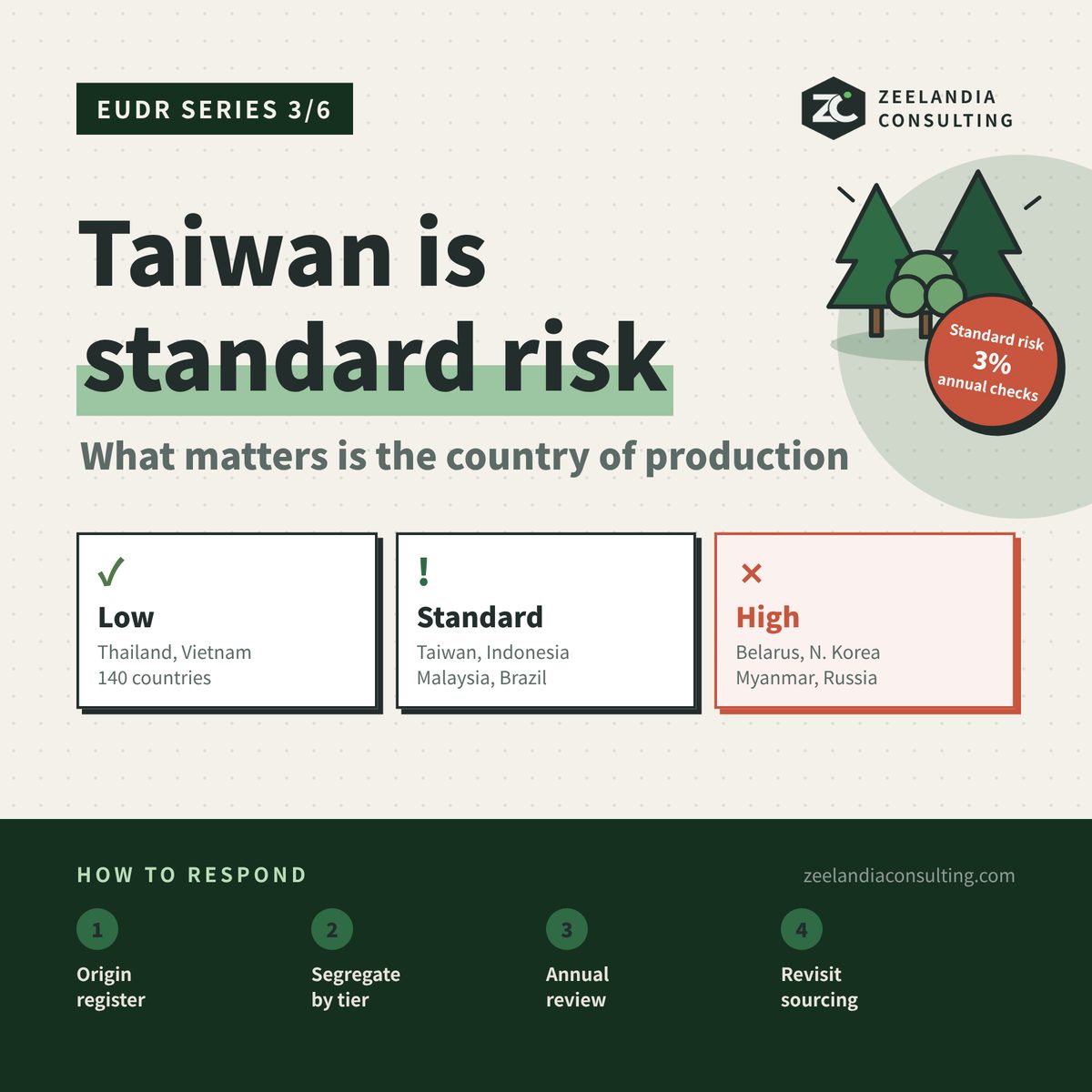
- High risk (4): Belarus, North Korea, Myanmar, Russia.
- Low risk (140): including all EU Member States, the United States, the United Kingdom, Japan, the Republic of Korea, China, India, Singapore, Thailand, Vietnam, the Philippines, Australia and New Zealand.
- Standard risk: every country not listed, including Taiwan, Indonesia, Malaysia, Brazil and Côte d’Ivoire.
The classification relies primarily on internationally recognised deforestation and forest degradation data, mainly the Food and Agriculture Organization (FAO) Global Forest Resources Assessment, complemented by qualitative criteria (recital 4 of 2025/1093). The list is to be reviewed as often as necessary in light of new evidence (Article 29(2)).
Which country’s tier applies: production or manufacturing?
The EUDR risk tier applies to the country of production of the commodity (Article 2(24)), meaning where it was grown, harvested or raised. Where the product is processed or manufactured does not change the tier.
| Scenario | Country of production | Applicable tier |
|---|---|---|
| Taiwanese tyre maker, natural rubber from Thailand | Thailand | Low |
| Taiwanese tyre maker, natural rubber from Indonesia | Indonesia | Standard |
| Taiwanese furniture maker, plantation wood from Vietnam | Vietnam | Low |
| Taiwanese furniture maker, some wood from Malaysia | Malaysia | Standard |
| Coffee grown in Taiwan exported to the EU | Taiwan | Standard |
So Taiwan’s standard-risk status directly affects commodities produced in Taiwan, such as Taiwanese coffee, timber or cattle. Most Taiwanese manufacturers use imported raw materials, and what matters for them is the tier of each commodity’s origin.
What does standard risk mean in practice? Three impacts
Taiwan’s standard-risk status under the EUDR has three practical impacts.
Impact 1: No simplified due diligence for Taiwan-grown commodities
Under Article 13, operators may skip risk assessment (Article 10) and risk mitigation (Article 11) only after ascertaining that all relevant commodities were produced in low-risk countries and that the risk of circumvention or mixing is negligible.
The Commission’s Guidance adds that even under simplified due diligence, information collection (Article 9) and a due diligence system (Article 12) are still required.
If any part of the input comes from a standard-risk country, Taiwan included, the full risk assessment and mitigation apply.
Impact 2: Taiwanese smallholders cannot use the MSPO regime
The micro or small primary operator (MSPO) category introduced in 2025 allows a one-time simplified declaration instead of a due diligence statement (DDS), and even a postal address instead of geolocation.
But an MSPO must be established in a low-risk country and produce the commodities there (Article 2(15a)). Because Taiwan is standard risk, Taiwanese coffee farmers or small forest owners cannot use the MSPO regime, however small they are, and must follow the full DDS route.
Impact 3: Higher minimum check rates
Annual minimum check rates for competent authorities depend on the tier of the country of production (Article 16(8) to (10)):
| Tier of origin | Minimum annual checks |
|---|---|
| Low risk | 1% of operators, non-SME downstream operators and non-SME traders |
| Standard risk | 3% |
| High risk | 9%, plus 9% of quantities |
Checks target operators in the EU, but supplier data is examined as part of any check.
Can processing in a low-risk country change the tier?
Processing standard-risk commodities in a low-risk country does not open the door to simplified due diligence under the EUDR. Could standard-risk commodities be processed in a low-risk country and then shipped to the EU under simplified due diligence?
No. Article 13(3) states that where commodities from standard-risk or high-risk countries are processed in a low-risk country before being placed on or leaving the market, this indicates a risk of circumvention, and competent authorities must act immediately and may adopt interim measures. The reference point is always the country of production.
How Taiwanese companies can respond
Taiwanese companies can respond to the standard-risk classification in four steps:
- Build an origin register: for each relevant commodity and supplier, record origin at country level and match it against 2025/1093.
- Segregate inputs by tier: if low-risk inputs can be physically separated from standard-risk inputs, the low-risk chain may qualify for simplified due diligence. Mass balance mixing is not allowed under the EUDR in any case (Infographics, Text Box 8).
- Make tier changes part of the annual review: the list will be updated, and the due diligence system must be reviewed at least once a year (Article 12(2)).
- Revisit sourcing strategy: where quality and cost allow, a higher share of low-risk inputs lowers both compliance cost and check probability.
For help with the full due diligence route, see the EUDR service page and part 4 on due diligence and DDS.
FAQ
Is Taiwan high risk under the EUDR?
No. Taiwan does not appear in the annex to Implementing Regulation (EU) 2025/1093, and Article 1(2) maintains a standard level for every country not listed. Taiwan is therefore standard risk, alongside Indonesia, Malaysia, Brazil and Côte d’Ivoire.
Does Taiwan’s tier apply to products made in Taiwan from imported materials?
No. The tier applies to the country where the commodity was produced (Article 2(24)), not where the product was processed or manufactured. A Taiwanese tyre maker using natural rubber from Thailand works with a low-risk origin; rubber from Indonesia is standard risk.
Can Taiwanese coffee farmers use the MSPO simplified declaration?
No. An MSPO must be established in a low-risk country and produce the commodities there (Article 2(15a)). Taiwanese coffee farmers and small forest owners must follow the full DDS route, however small they are.
Can processing in a low-risk country unlock simplified due diligence?
No. Under Article 13(3), processing standard-risk or high-risk commodities in a low-risk country indicates a risk of circumvention, and competent authorities must act immediately. The reference point is always the country of production.
Will the EUDR country list change?
The list is to be reviewed as often as necessary in light of new evidence (Article 29(2)). Operators should build tier changes into the annual review of their due diligence system (Article 12(2)).
The series
- EUDR in 2026: Seven Things to Know Before 30 December, After Two Rounds of Amendments
- Which Role Are You? Determining Roles Under the EUDR: Operator, Downstream Operator, Trader, MSPO and Authorised Representative
- Taiwan Is “Standard Risk”: What EUDR Country Benchmarking Means in Practice
- EUDR Due Diligence and DDS in Practice: Geolocation, the Information System and Filing Strategy
- The New EUDR Product Scope: What Delegated Regulation 2026/2102 Removed and Added
- The ZC Methodology: An EUDR Compliance Roadmap from Scope Screening to Annual Maintenance
Next: Due diligence and DDS in practice, from geolocation to the Information System and filing strategy.
Want to know the tiers behind your inputs? ZC can map your commodity origins and assess which product lines can use simplified due diligence. Book a 30-minute consultation.
This article provides general information and does not constitute legal advice. Country classifications follow the Commission’s latest publication.
Sources
- Implementing Regulation (EU) 2025/1093 country benchmarking
- Regulation (EU) 2023/1115, consolidated, Articles 2, 13, 16, 29
- European Commission Green Forum: country classification list
- European Commission EUDR Guidance Document C/2026/3896, section 4(e)
Sources · Implementing Regulation (EU) 2025/1093 country benchmarking · Regulation (EU) 2023/1115, consolidated · European Commission Green Forum: country classification list. This article is general information and not legal advice for any specific case. Obligations are defined by the Official Journal of the EU.
EUDREU Deforestation Regulationcountry benchmarkingstandard risk2025/1093simplified due diligenceMSPOTaiwan