The EU Deforestation Regulation (Regulation (EU) 2023/1115, “EUDR”) applies to large and medium-sized companies from 30 December 2026: from that date, products made from seven commodities may only be placed on the EU market or exported if they are deforestation-free, legal and covered by a due diligence statement (DDS). The EUDR entered into force in 2023 and has since been postponed twice, and many suppliers in Asia have been waiting to see whether it slips again.
This time it will not. In its simplification review of 4 May 2026 (COM(2026) 191), the European Commission stated that it does not consider it appropriate to propose further amendments to the legal text, citing legal certainty and the burden reductions already achieved. 30 December 2026 is the date of application for large and medium-sized companies.
Key takeaways
- The EUDR applies from 30 December 2026 for large and medium-sized companies and from 30 June 2027 for micro and small companies established by 31 December 2024.
- Seven commodities are covered (cattle, cocoa, coffee, oil palm, rubber, soya and wood), but scope is decided by the HS/CN codes listed in Annex I.
- Products must be deforestation-free after 31 December 2020, legal and covered by a DDS or simplified declaration (Article 3).
- Taiwan is not listed in Implementing Regulation (EU) 2025/1093, so it is standard risk, with a minimum annual check rate of 3%.
- For legal persons, the maximum fine must be at least 4% of total annual EU-wide turnover (Article 25(2)).
This is part 1 of the ZC EUDR Practice Series. We start with the big picture.
1. What did the two amendments change?
The EUDR has been amended twice since it entered into force, and in its 2026 review the Commission did not consider further amendments appropriate.
| Act | Published | Key points |
|---|---|---|
| Regulation (EU) 2024/3234 | December 2024 | First postponement by 12 months |
| Regulation (EU) 2025/2650 | 23 December 2025 | Second 12-month postponement plus major simplification: new “downstream operator” and “micro or small primary operator” categories; downstream operators and traders no longer submit due diligence statements (DDS) |
| COM(2026) 191 simplification review | 4 May 2026 | No further amendments; combined simplification measures estimated to cut annual compliance costs by about 75%, from roughly EUR 8.1 billion to EUR 2.0 billion per year |
The legal text to work from is the consolidated version of 26 December 2025, which incorporates both amendments.
2. Which products does the EUDR cover?
The EUDR covers seven “relevant commodities”: cattle, cocoa, coffee, oil palm, rubber, soya and wood (Article 2(1)).
What is actually regulated are the “relevant products” listed in Annex I by HS/CN code, meaning products that contain, have been fed with or have been made using those commodities. Examples include wooden furniture, paper and paperboard, new rubber tyres, chocolate, palm oil and certain oleochemicals.
Whether you are in scope depends on the tariff code, not on your industry. Annex I was revised again in 2026 by Delegated Regulation (EU) 2026/2102, which we cover in part 5.
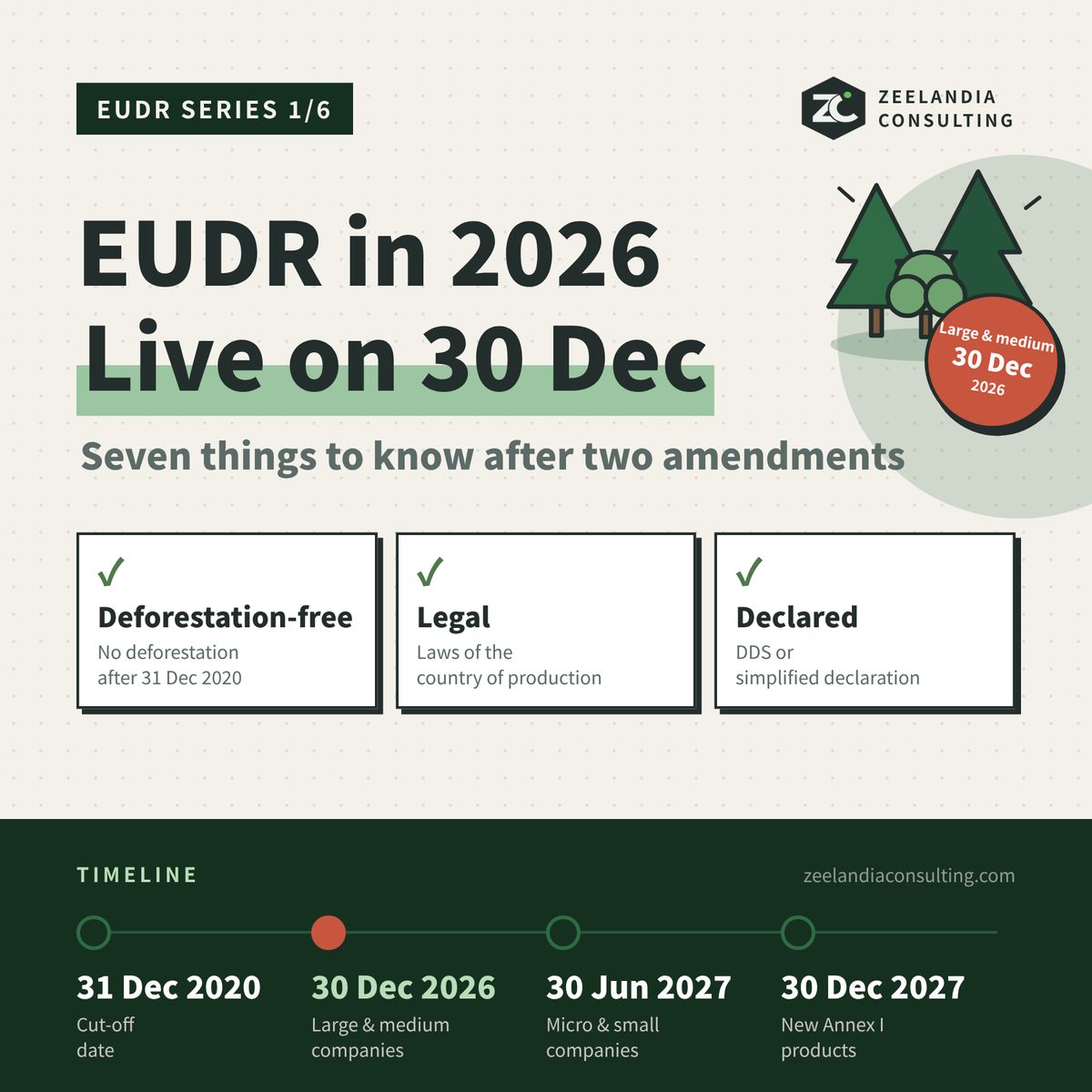
3. Three requirements: deforestation-free, legal, declared
Under Article 3 of the EUDR, relevant products may only be placed or made available on the EU market, or exported, if all three conditions are met:
- Deforestation-free: produced on land not subject to deforestation after 31 December 2020; for wood, harvested without inducing forest degradation after that date (Article 2(13)).
- Legal: produced in line with the relevant legislation of the country of production, covering land use rights, environmental protection, forest rules, third-party rights, labour rights, human rights, free, prior and informed consent (FPIC), and tax, anti-corruption, trade and customs rules (Article 2(40)).
- Declared: covered by a due diligence statement or a simplified declaration.
“Forest” has precise thresholds: more than 0.5 hectares, trees higher than 5 metres and canopy cover above 10%, excluding land predominantly under agricultural or urban use (Article 2(4)). “Deforestation” means conversion of forest to agricultural use (Article 2(3)).
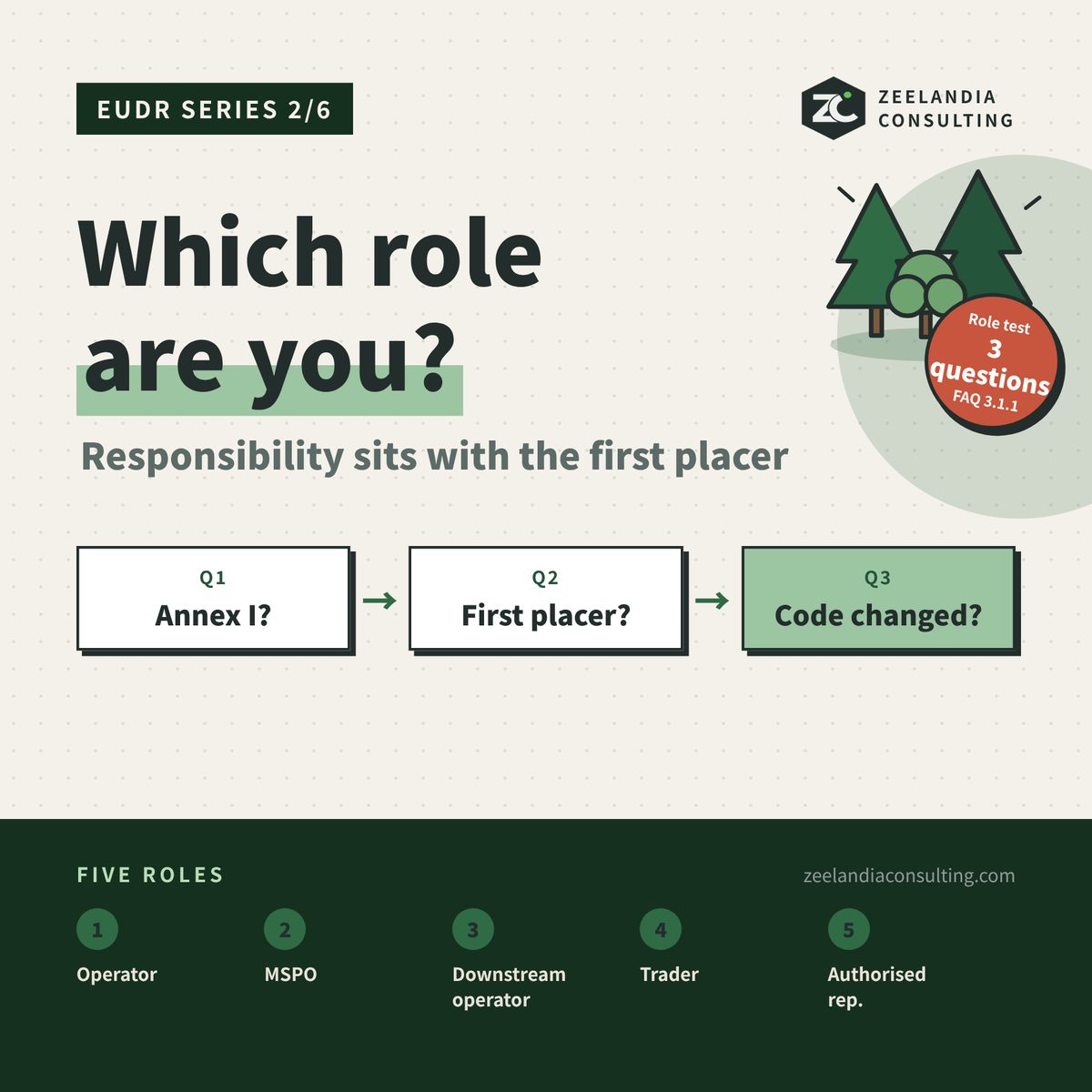
4. Who is responsible under the EUDR?
Since the 2025 amendment (Regulation (EU) 2025/2650), EUDR responsibility is concentrated on whoever first places a product on the EU market or exports it, and the structure is clear:
- Operators: the first to place a relevant product on the EU market or export it. They exercise due diligence, submit the DDS and take responsibility for compliance.
- Downstream operators and traders: no due diligence and no DDS. Their main duty is to keep supply chain information; non-SMEs must also register in the Information System.
- Micro or small primary operators (MSPOs): small producers in low-risk countries, who file a one-time simplified declaration instead of a DDS.
Role determination is the starting point for everything. Part 2 covers it in detail.
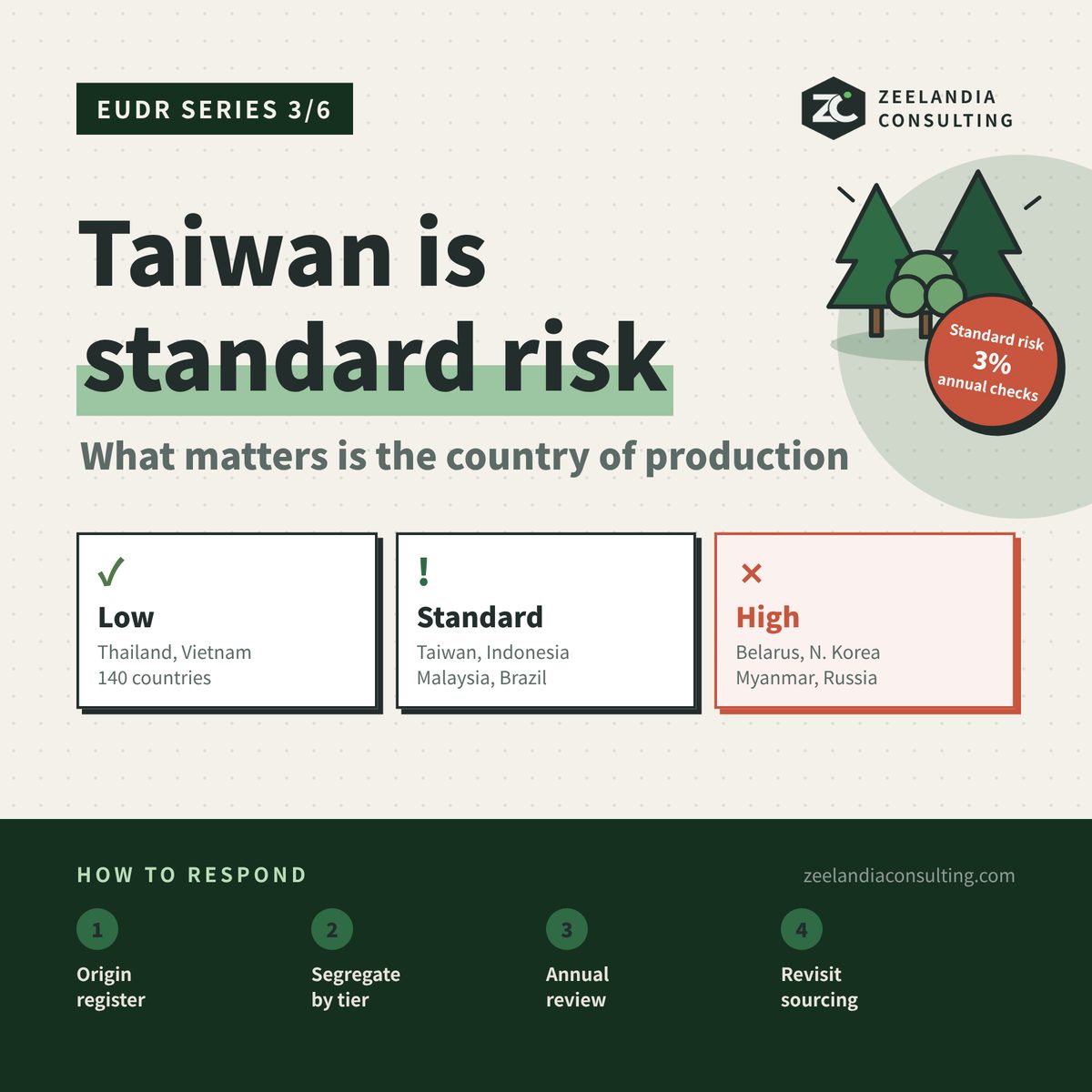
5. Country benchmarking: Taiwan is “standard risk”
The Commission published its EUDR country classification in Implementing Regulation (EU) 2025/1093. The annex lists only low-risk and high-risk countries; every country not listed stays at standard risk (Article 1(2)). Taiwan is not listed, so it is standard risk.
Note that the classification refers to the country where the commodity was produced, not where the product was manufactured. Part 3 explains what this means in practice.
6. What are the EUDR penalties and checks?
EUDR enforcement combines fines, minimum annual check rates and customs controls:
- Fines: for legal persons, the maximum fine must be at least 4% of total annual EU-wide turnover in the preceding financial year, alongside confiscation of products and of revenues from the transaction (Article 25(2)).
- Annual check rates: competent authorities must check at least 1% of operators, non-SME downstream operators and non-SME traders sourcing from low-risk countries, 3% for standard-risk countries and 9% for high-risk countries (plus 9% of quantities for high risk) (Article 16(8) to (10)).
- Customs: the DDS reference number or simplified declaration identifier must be available to customs at release for free circulation and at export (Article 26(4)).
7. The full timeline
The EUDR timeline runs from the 31 December 2020 deforestation cut-off date to the Commission’s first general review on 30 June 2030.
| Date | Milestone |
|---|---|
| 31 Dec 2020 | Cut-off date for deforestation-free status |
| 22 May 2025 | Country benchmarking, Implementing Regulation (EU) 2025/1093 |
| 23 Dec 2025 | Amending Regulation (EU) 2025/2650 published |
| 4 May 2026 | Commission simplification review COM(2026) 191 |
| 13 Jul 2026 | Information System amendment (EU) 2026/1565 and Annex I Delegated Regulation (EU) 2026/2102 adopted |
| 30 Dec 2026 | Application for large and medium-sized companies |
| 30 Dec 2026 | EU Timber Regulation (Regulation (EU) No 995/2010) repealed |
| 30 Jun 2027 | Application for micro and small companies established by 31 December 2024 (except for products previously covered by the EUTR) |
| 30 Dec 2027 | New Annex I products (soluble coffee, certain palm oil derivatives and others) apply |
| From 2028 | First annual public report by non-SME operators, covering 2027 |
| 31 Dec 2029 | End of EUTR transitional application for timber produced before 29 June 2023 |
| 30 Jun 2030 | First general review by the Commission |
Three common misconceptions among Asian suppliers
Asian suppliers often misread the EUDR in three ways.
“We are outside the EU, so the EUDR does not apply to us.” Legally, obligations usually sit with the EU importer. But the importer cannot submit a DDS without geolocation data and legality evidence from upstream. FAQ 1.27 is blunt: if operators cannot obtain the required information from suppliers, they must refrain from placing the products on the market. In practice, suppliers who cannot deliver data put orders at risk.
“We make electronics, deforestation has nothing to do with us.” Most electronic products are not in Annex I. But whether packaging, manuals, rubber parts or wooden pallets are covered depends on tariff codes and how they are used. The 2026 scope revision excludes many of these; part 5 goes through them item by item.
“We have FSC or another certification, so we are covered.” The Commission’s Guidance is explicit that certification can support risk assessment but is not a “green lane”. Operators still have to exercise due diligence and remain liable, and mass balance models that mix sources are not acceptable under the EUDR.
FAQ
When does the EUDR apply?
The EUDR applies from 30 December 2026 for large and medium-sized companies and from 30 June 2027 for micro and small companies established by 31 December 2024, except for products previously covered by the EUTR. New Annex I products such as soluble coffee apply from 30 December 2027.
Does the EUDR apply to suppliers outside the EU?
EUDR obligations usually sit with the EU importer, not the supplier abroad. However, the importer cannot submit a DDS without geolocation data and legality evidence from upstream, and under FAQ 1.27 it must refrain from placing the products if it cannot obtain them. In practice, suppliers who cannot deliver data put orders at risk.
Is Taiwan high risk under the EUDR?
No. Taiwan is not listed in Implementing Regulation (EU) 2025/1093, so it is standard risk. The tier refers to the country where the commodity was produced, not where the product was manufactured.
Does FSC certification make a product EUDR compliant?
No. The Commission’s Guidance states that certification can support risk assessment but is not a “green lane”; operators still have to exercise due diligence and remain liable. Mass balance models that mix sources are not acceptable under the EUDR.
What are the penalties for breaching the EUDR?
For legal persons, the maximum fine must be at least 4% of total annual EU-wide turnover in the preceding financial year (Article 25(2)). Fines come alongside confiscation of the products and of revenues from the transaction.
The series
- EUDR in 2026: Seven Things to Know Before 30 December, After Two Rounds of Amendments
- Which Role Are You? Determining Roles Under the EUDR: Operator, Downstream Operator, Trader, MSPO and Authorised Representative
- Taiwan Is “Standard Risk”: What EUDR Country Benchmarking Means in Practice
- EUDR Due Diligence and DDS in Practice: Geolocation, the Information System and Filing Strategy
- The New EUDR Product Scope: What Delegated Regulation 2026/2102 Removed and Added
- The ZC Methodology: An EUDR Compliance Roadmap from Scope Screening to Annual Maintenance
Need support? ZC Zeelandia Consulting is based in Amsterdam and helps Taiwanese and Asian manufacturers with EU sustainability regulation. Book a 30-minute consultation.
This article provides general information and does not constitute legal advice. Obligations depend on the facts of each case and the latest official documents.
Sources
- Regulation (EU) 2023/1115, consolidated (EUR-Lex)
- Regulation (EU) 2025/2650
- Regulation (EU) 2024/3234
- COM(2026) 191 simplification review
- Implementing Regulation (EU) 2025/1093 country benchmarking
- European Commission EUDR FAQ, version 5 (April 2026); EUDR Guidance Document C/2026/3896 (July 2026)
Sources · Regulation (EU) 2023/1115, consolidated (EUR-Lex) · Regulation (EU) 2025/2650 · Regulation (EU) 2024/3234 · COM(2026) 191 simplification review · Implementing Regulation (EU) 2025/1093 country benchmarking. This article is general information and not legal advice for any specific case. Obligations are defined by the Official Journal of the EU.
EUDREU Deforestation RegulationRegulation (EU) 2023/1115deforestation-freedue diligence statementsupply chain due diligenceAsian exporters