Under the EU Deforestation Regulation (EUDR), due diligence and the due diligence statement (DDS) are the responsibility of the operator, the first to place a relevant product on the EU market or export it. A product passes through many hands, but not every hand has to exercise due diligence. Since the 2025 amendment (Regulation (EU) 2025/2650), responsibility is concentrated on whoever first places the product on the EU market or exports it. Everyone after that mainly keeps records.
So the first step in EUDR compliance is not collecting coordinates. It is establishing your role.
Key takeaways
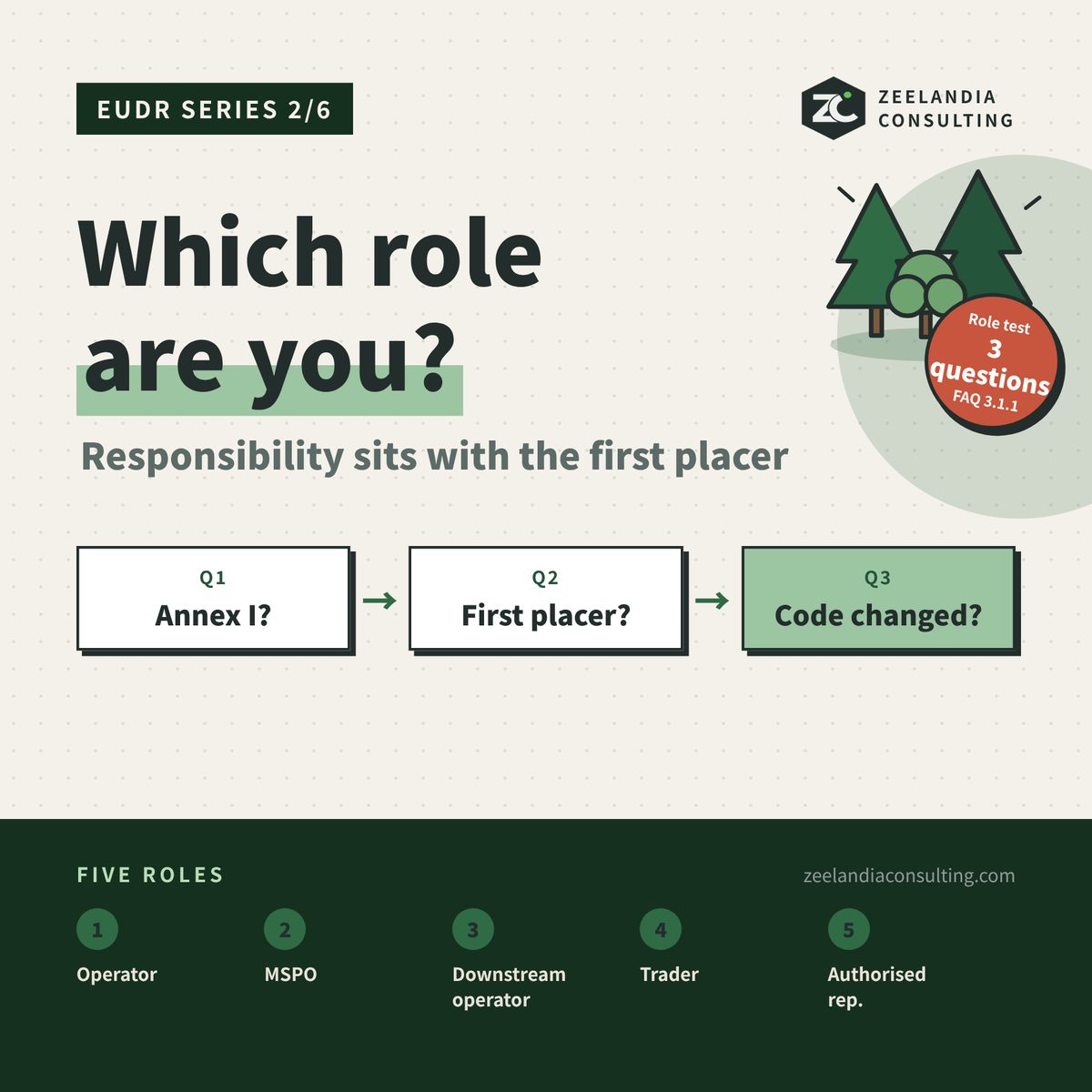
- The EUDR defines five roles: operator, micro or small primary operator (MSPO), downstream operator, trader and authorised representative (Article 2).
- Three questions decide your role: is the HS/CN code in Annex I, are you the first to place or export it, and has the tariff code changed?
- Downstream operators and traders have identical obligations and file no DDS (Article 5); non-SMEs must register in the Information System.
- An authorised representative must be established in the EU (Article 2(22)), and responsibility stays with the operator (Article 6(1)).
- Every role keeps records for 5 years.
What are the five EUDR roles?
The EUDR, as amended by Regulation (EU) 2025/2650, defines five roles in Article 2.
| Role | Definition | In one sentence |
|---|---|---|
| Operator | Art. 2(15) | First to place a relevant product on the EU market or export it. Commission documents call this the “upstream operator” |
| Micro or small primary operator (MSPO) | Art. 2(15a) | A natural person, micro or small undertaking established in a low-risk country placing or exporting products it has grown, harvested or raised itself |
| Downstream operator | Art. 2(15b) | Places or exports relevant products made from relevant products already covered by a DDS or simplified declaration |
| Trader | Art. 2(17) | Anyone else in the supply chain making relevant products available on the market |
| Authorised representative | Art. 2(22), Art. 6 | A person established in the EU mandated in writing by an operator to submit the DDS or simplified declaration on its behalf |
Which three questions determine your EUDR role?
EUDR role determination comes down to three questions, asked in order.
Question 1: Is the product’s HS/CN code listed in Annex I? If not, there are no EUDR obligations. Margarine made from palm oil (HS 1517) or cosmetics (HS 3304), for example, are not relevant products (Supply Chain Infographics, scenario 6).
Question 2: Are you the first to place it on the EU market or export it? If yes, you are the operator. That includes importers declaring goods for release for free circulation, EU producers first selling their own commodities, and exporters of products not yet covered by a DDS.
Question 3: If not, have you transformed it into a product with a different tariff code? FAQ 3.1.1 sets a clear test:
- The code changes (green coffee 0901 11 roasted into 0901 21, for example) and the new product is in Annex I: you are a downstream operator.
- The code does not change (simple resale): you are a trader.
Downstream operators and traders have identical obligations (Article 5).
How do EUDR obligations differ by role?
EUDR obligations differ sharply between operators and everyone else in the supply chain.
| Obligation | Operator | MSPO | First downstream / trader | Subsequent downstream / trader |
|---|---|---|---|---|
| Due diligence | Yes | Yes | No | No |
| Information System | Submit DDS | One-time simplified declaration | Register if non-SME | Register if non-SME |
| Responsibility for compliance | Yes | Yes | No | No |
| DDS reference numbers | Pass on downstream | Pass identifier downstream | Collect and keep | Keep basic supplier and customer data only |
| Record retention | 5 years | 5 years | 5 years | 5 years |
| When concerns arise | Inform authorities | Inform | Inform; non-SMEs verify upstream due diligence in case of substantiated concerns | Same |
| Annual public report | Non-SMEs | No | No | No |
Sources: EUDR Articles 4, 4a, 5 and 12; Commission Supply Chain Infographics, 5th edition, Table 1.
“First” means buying directly from an operator. Only the first downstream operator or trader collects DDS reference numbers; those further down record only names, addresses and email addresses of suppliers and customers (Article 5(3), recital 6 of Regulation 2025/2650).
Five situations that are easy to get wrong
Five EUDR role situations are commonly misread.
1. Importing and then processing: one company, two roles. A tyre maker importing vulcanised rubber (ex 4008) is an operator; when it sells tyres (ex 4011) made from that rubber, it is a downstream operator (FAQ 3.8, Infographics scenario 5). Once due diligence was done at import, selling the tyres triggers no further DDS.
2. Importing finished products makes you an operator, not a downstream operator. A company importing wooden furniture (HS 9403 30) from a third country is an operator, because the furniture is not yet covered by any DDS (Infographics, Text Box 4).
3. A non-EU company imports itself: two operators. Under Article 7, when a person established outside the EU places products on the EU market, the first person established in the EU to make them available is also deemed an operator. FAQ 3.7 confirms there will be two operators and two DDS. Non-EU companies can access the Information System only with an EORI number issued by an EU Member State.
4. Corporate groups: each legal entity counts separately. SME status depends on the balance sheet, turnover and headcount of the individual entity, not the group (FAQ 3.13). Each entity with obligations needs its own account, but a group can mandate one EU-established member as authorised representative to file for all.
5. Own use and logistics are not placing on the market. Using products within your own business (logs used to heat your own premises, for example) is not placing them on the market (FAQ 2.10). Freight forwarders and shipping agents that only provide logistics are neither operators nor traders (Infographics scenario 8).
Three typical shipping models for Asian suppliers
The shipping model determines which entity is the EUDR operator when Asian suppliers sell into the EU.
Model A: FOB/CIF to an EU importer The EU importer is the operator and the Asian supplier has no direct EUDR obligation. But the importer needs geolocation, production dates and legality evidence to file the DDS, and without them cannot place the goods (FAQ 1.27). In practice the supplier is the data provider, and data quality drives orders.
Model B: DDP, with the supplier declaring imports under its own EORI The supplier is the operator: it exercises due diligence, files the DDS and is responsible for compliance. Under Article 7, the first EU buyer is also deemed an operator and files its own DDS.
Model C: Imports through an EU subsidiary The EU subsidiary is the operator. The parent typically compiles supply chain data; the subsidiary files and keeps records.
What can an EUDR authorised representative do, and what not?
An EUDR authorised representative files on behalf of an operator but does not take over the operator’s responsibility.
- An authorised representative must be established in the EU (Article 2(22)). A company in Taiwan or elsewhere in Asia cannot act as one.
- It can submit the DDS or simplified declaration, but responsibility stays with the operator (Article 6(1)).
- On request, it must provide a copy of the mandate to the competent authorities in an official EU language, plus a copy in the official language of the Member State where the DDS is handled, or in English where that is not possible (Article 6(2)).
- Operators that are natural persons or microenterprises may mandate the next non-micro downstream operator or trader in the chain as their authorised representative (Article 6(3)).
FAQ
Do Asian suppliers shipping FOB have EUDR obligations?
Under FOB or CIF terms, the EU importer is the operator and the Asian supplier has no direct EUDR obligation. The importer still needs geolocation, production dates and legality evidence to file the DDS, and cannot place the goods without them (FAQ 1.27). In practice the supplier is the data provider.
Is a company importing finished wooden furniture a downstream operator?
No. A company importing wooden furniture (HS 9403 30) from a third country is an operator, because the furniture is not yet covered by any DDS (Infographics, Text Box 4).
Can a company in Taiwan act as an EUDR authorised representative?
No. An authorised representative must be established in the EU (Article 2(22)), so a company in Taiwan or elsewhere in Asia cannot act as one. Even when a representative is mandated, responsibility stays with the operator (Article 6(1)).
Is EUDR SME status assessed per group or per company?
SME status depends on the balance sheet, turnover and headcount of the individual legal entity, not the group (FAQ 3.13). Each entity with obligations needs its own account, but a group can mandate one EU-established member as authorised representative to file for all.
Do freight forwarders have EUDR obligations?
No. Freight forwarders and shipping agents that only provide logistics are neither operators nor traders (Infographics scenario 8).
The series
- EUDR in 2026: Seven Things to Know Before 30 December, After Two Rounds of Amendments
- Which Role Are You? Determining Roles Under the EUDR: Operator, Downstream Operator, Trader, MSPO and Authorised Representative
- Taiwan Is “Standard Risk”: What EUDR Country Benchmarking Means in Practice
- EUDR Due Diligence and DDS in Practice: Geolocation, the Information System and Filing Strategy
- The New EUDR Product Scope: What Delegated Regulation 2026/2102 Removed and Added
- The ZC Methodology: An EUDR Compliance Roadmap from Scope Screening to Annual Maintenance
Next: Taiwan is “standard risk”. What does that actually mean?
Need help mapping roles? ZC can build a role map per product line, shipping model and legal entity. Book a 30-minute consultation.
This article provides general information and does not constitute legal advice.
Sources
- Regulation (EU) 2023/1115, consolidated, Articles 2, 4, 4a, 5, 6, 7
- Regulation (EU) 2025/2650
- European Commission EUDR FAQ, version 5: 1.27, 2.10, 3.1.1, 3.7, 3.8, 3.13
- European Commission / UNEP-WCMC, EUDR Supply Chain Infographics, 5th edition (August 2026)
Sources · Regulation (EU) 2023/1115, consolidated · Regulation (EU) 2025/2650. This article is general information and not legal advice for any specific case. Obligations are defined by the Official Journal of the EU.
EUDREU Deforestation RegulationEUDR rolesoperatordownstream operatortraderauthorised representativeMSPO