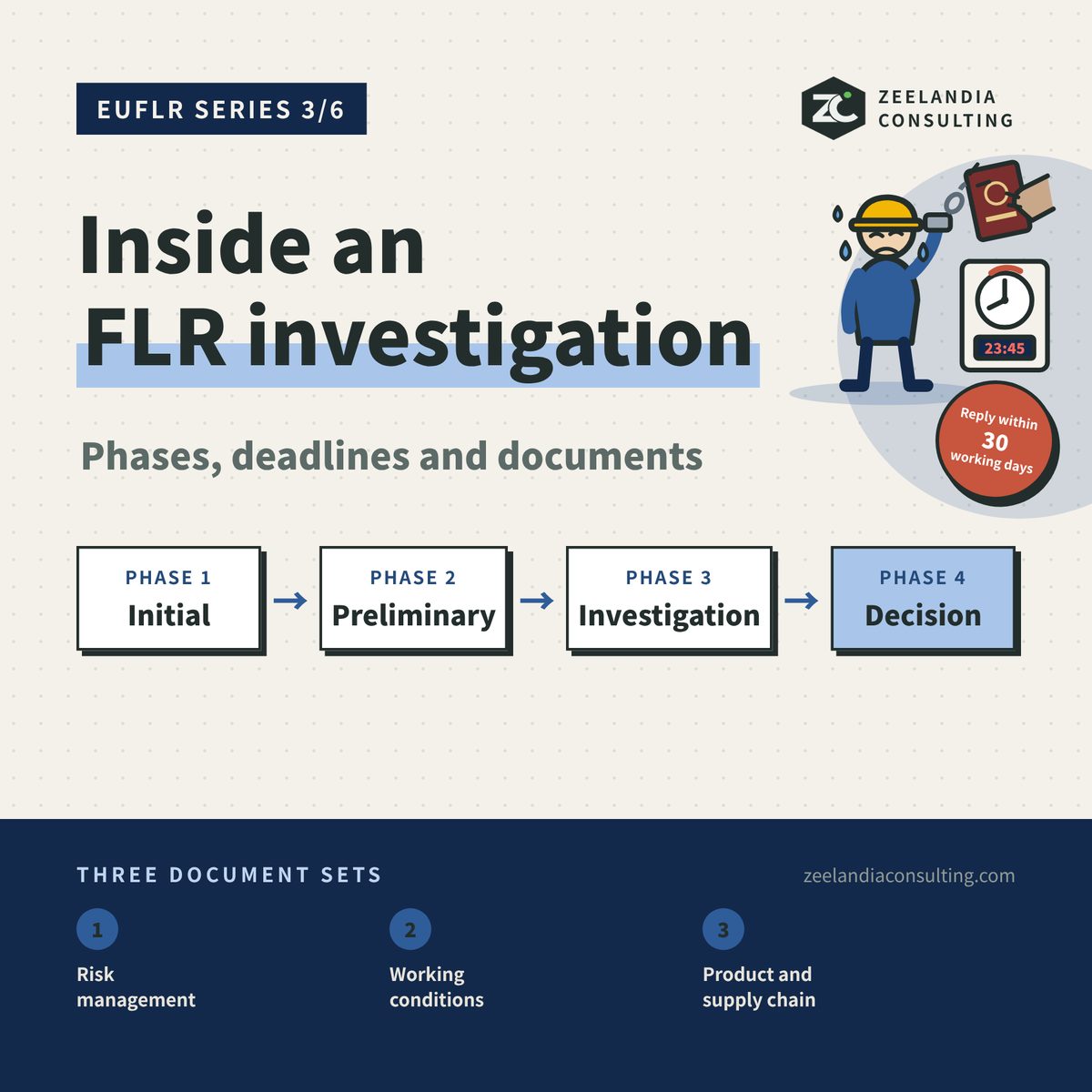
An investigation under the EU Forced Labour Regulation (FLR) runs in four phases, from initial assessment to a decision in principle within 9 months of opening, and a company asked for information in the preliminary phase has 30 working days to reply. FLR investigations follow defined phases and deadlines, and each phase is a chance to make your case. But the shortest response window is 30 working days. If you start collecting evidence only when the letter arrives, you will almost certainly run out of time.
Key takeaways
- The Commission leads investigations where the suspected forced labour occurs outside the EU (Article 15).
- Authorities prioritise by scale and severity, volume on the EU market and the share of the suspect part in the final product (Article 14(2)).
- In the preliminary phase you reply within 30 working days; no investigation may be opened where due diligence has eliminated the concern (Article 17(5)).
- Non-cooperation allows a violation to be established on “any other facts available” (Article 20(2)).
- Authorities ask for three document sets: risk management actions, working conditions on site, and product and supply chain evidence.
Who investigates FLR cases?
The lead competent authority for an FLR investigation depends on where the suspected forced labour occurs (Article 15): the Commission for cases outside the EU, a national authority for cases inside a Member State. For Asian supply chains, that means the Commission.
How do authorities decide where investigations start?
FLR authorities prioritise using three criteria (Article 14(2)): the scale and severity of the suspected forced labour, with state-imposed forced labour ranked highest; the quantity or volume of products on the EU market; and the share of the suspect part in the final product. They then focus on operators closest to the risk and with the most leverage, taking size into account while guarding against circumvention through outsourcing to smaller firms.
What are the four phases of an FLR investigation?
An FLR investigation has four phases, each with its own deadlines:
| Phase | What happens | Deadline |
|---|---|---|
| 1. Initial assessment | Authority gathers objective, verifiable information | None fixed |
| 2. Preliminary phase | Authority requests information on your risk management to decide whether there is a “substantiated concern” | You reply within 30 working days; authority concludes within 30 working days of receipt |
| 3. Investigation | You are notified within 3 working days; authority requests information and may carry out field inspections | 30 to 60 working days to submit; extensions possible with justification |
| 4. Decision or closure | Ban-violation decision or case closed | In principle within 9 months of opening |
The preliminary phase: your most important 30 days
The preliminary phase is your best chance to avoid a formal FLR investigation. You will be asked what you have done to identify, prevent, mitigate, end or remediate forced labour risks (Article 17(1)). If there is no substantiated concern, or your due diligence has eliminated it, the authority must not open an investigation (Article 17(5)). If you show you are taking appropriate steps, you may be given reasonable time to finish them.
The authority can skip the request if contacting you risks destroying evidence, compromising a criminal case or endangering workers. You will still be heard during the investigation.
What happens if you do not cooperate?
Under Article 20(2) of the FLR, the authority may establish a violation on “any other facts available” if you refuse, miss deadlines without justification, or provide incomplete, misleading or irrelevant information to stall. The guidelines say non-cooperation in principle constitutes evidence and, with other facts, is generally enough to find a violation. Refusing consent to a Commission field inspection outside the EU may also count as non-cooperation.
The standard of proof is administrative, not criminal. Circumstantial evidence such as satellite images, media reports and trade data is admissible. Where high-risk inputs may have been mixed in, an inability to provide traceability information weighs against you.
Which documents will authorities ask for?
FLR authorities typically ask for three sets of documents:
| Set | Typical documents |
|---|---|
| Your risk management actions | Policies and codes of conduct, supplier code and contract clauses, sector risk assessments, grievance mechanism, corrective action plans, third-party audit reports |
| Working conditions on site | Worker interviews, social audits, workplace and dormitory photos, worker lists, contracts, payroll |
| Product and supply chain | Bills of materials, certificates of origin, multi-tier supply chain maps, supplier list with EORI numbers, site addresses and GPS coordinates, purchase orders, invoices, bills of lading, capacity reports, input-output consistency evidence |
Input-output consistency is often overlooked: if your declared sources cannot physically supply your shipped volumes, authorities will suspect blending.
Practical tips
Four practical tips help companies respond well to an FLR information request:
- Designate one English-speaking contact person, as the guidelines encourage.
- Flag unavoidable delays before the deadline, with reasons.
- SMEs can ask a Member State SME contact point for help (Article 10).
- Aim for accurate, relevant and complete, not voluminous.
The ZC view
Thirty working days are enough to organise evidence, not to create it. Supply chain maps, recruitment fee records and traceability proof take months to collect upstream. Keep the table above as a living “investigation readiness pack”. The same pack answers customer questionnaires and audits.
FAQ
How long do you have to respond to an FLR information request?
In the preliminary phase you reply within 30 working days. In the formal investigation you have 30 to 60 working days to submit information, with extensions possible if justified.
Who investigates forced labour in Asian supply chains?
The Commission leads FLR investigations where the suspected forced labour occurs outside the EU (Article 15). For Asian supply chains, that means the Commission rather than a national authority.
Can an FLR investigation be avoided?
Yes. If there is no substantiated concern, or your due diligence has eliminated it, the authority must not open an investigation (Article 17(5)). The preliminary phase is your best chance to show this.
What happens if a company does not cooperate?
Under Article 20(2), the authority may establish a violation on “any other facts available”. The guidelines say non-cooperation in principle constitutes evidence and, with other facts, is generally enough to find a violation.
How long does an FLR investigation take?
A decision or closure should in principle come within 9 months of opening the investigation. Companies are notified within 3 working days of an investigation being opened.
Next: After a ban: withdrawal, disposal, customs holds and penalties
The series
- The EU Forced Labour Regulation explained: what changes on 14 December 2027
- What counts as forced labour? The ILO indicators Taiwanese suppliers should know
- Inside an FLR investigation: phases, deadlines and the documents you need
- After a ban: withdrawal, disposal, customs holds and penalties
- Forced labour due diligence with the OECD six-step framework
- The FLR action checklist for suppliers: now to December 2027
Need a document checklist aligned with Section 4.7 of the guidelines? Book a free 30-minute call or email [email protected].
Sources · Regulation (EU) 2024/3015 (Forced Labour Regulation) · RVO: Forced Labour Regulation. This article is general information and not legal advice for any specific case. Obligations are defined by the Official Journal of the EU.
FLREU Forced Labour RegulationFLR investigationsubstantiated concernpreliminary phasenon-cooperationforced labour evidence