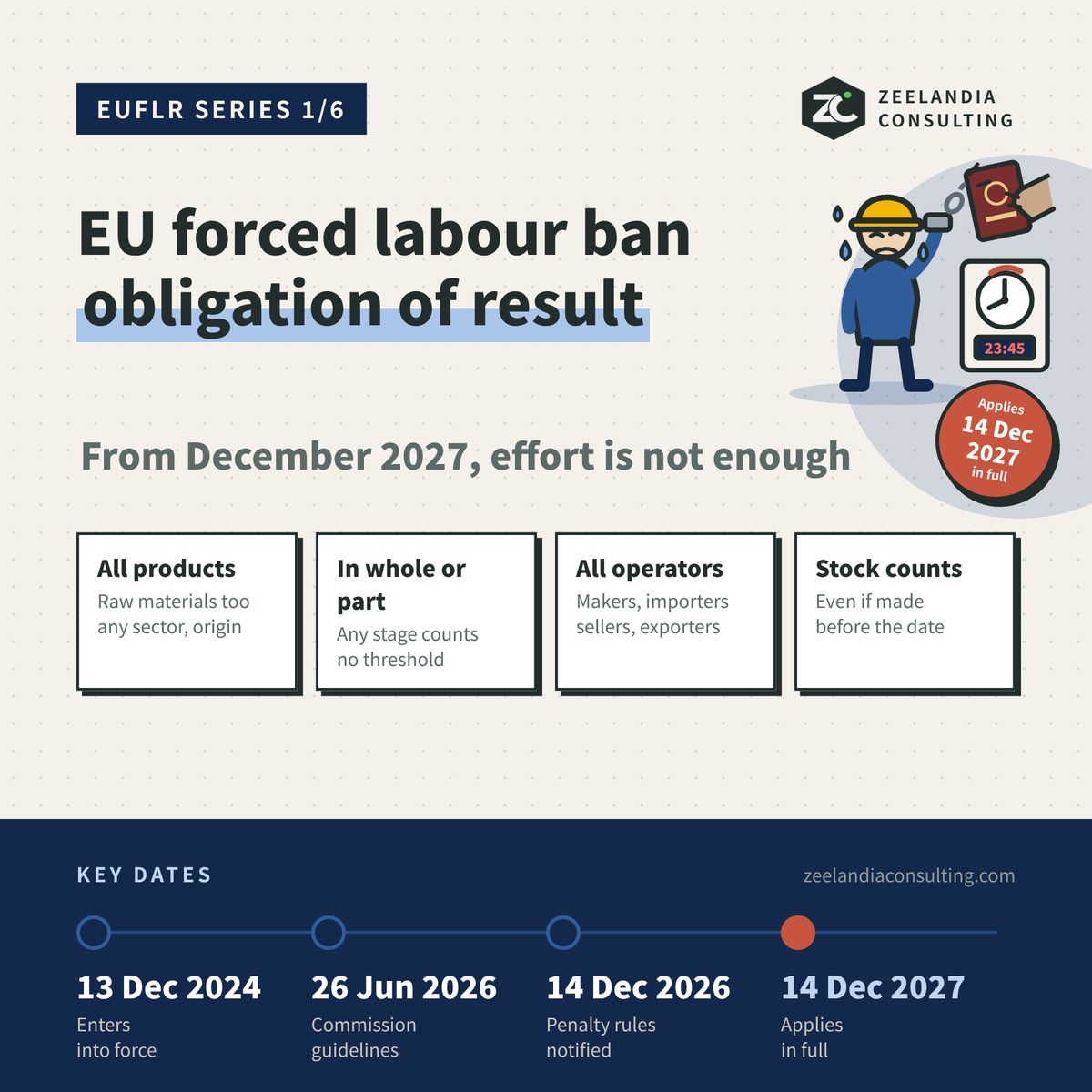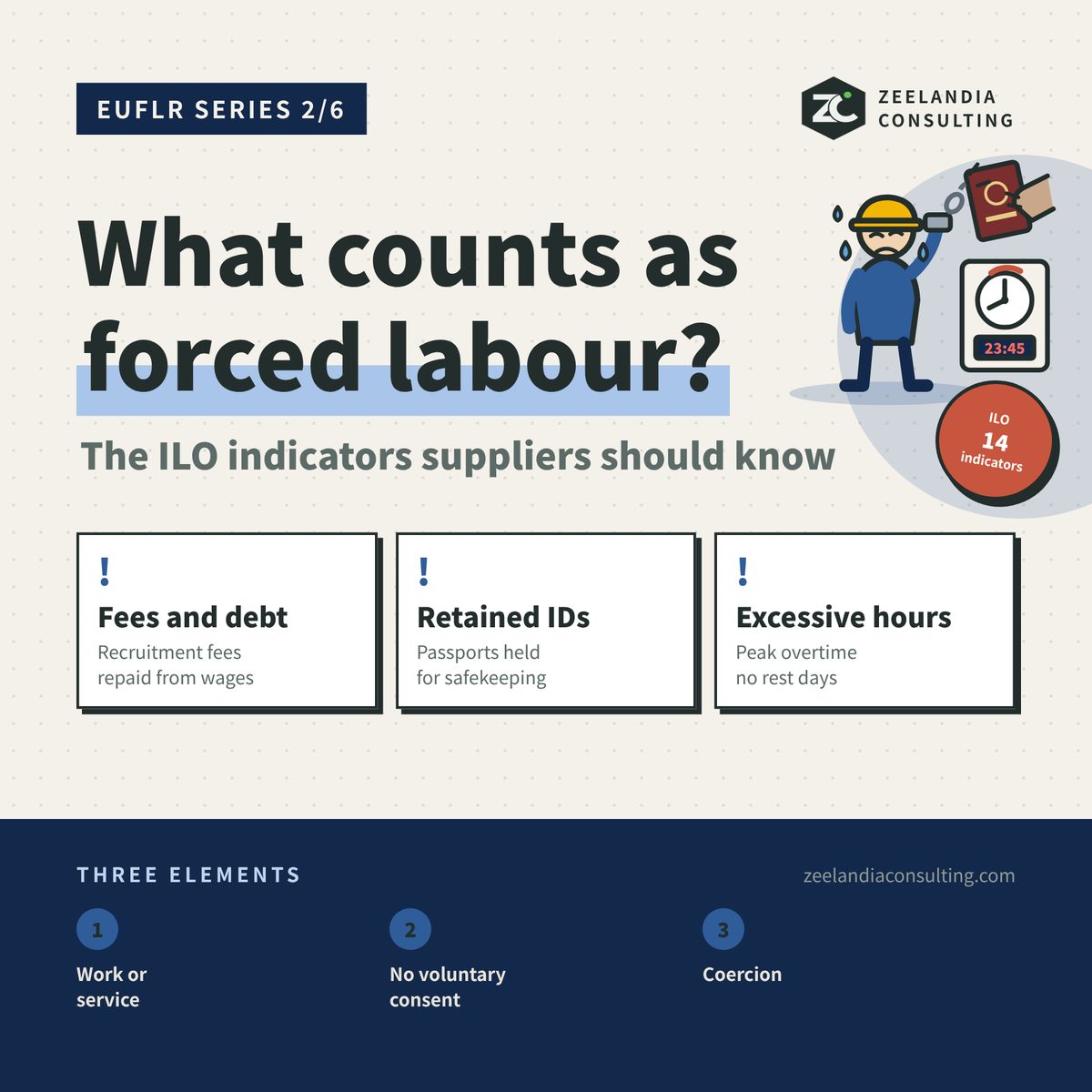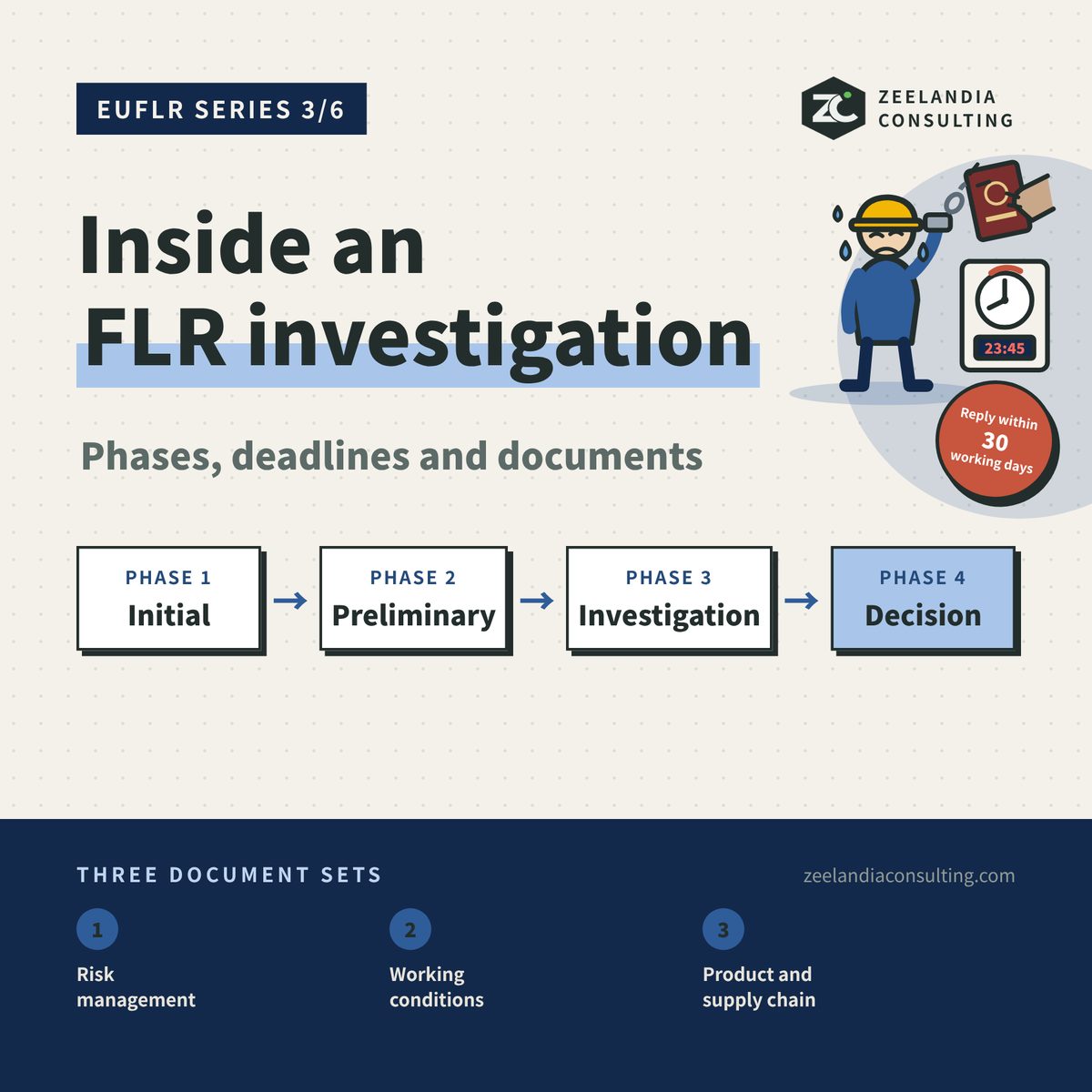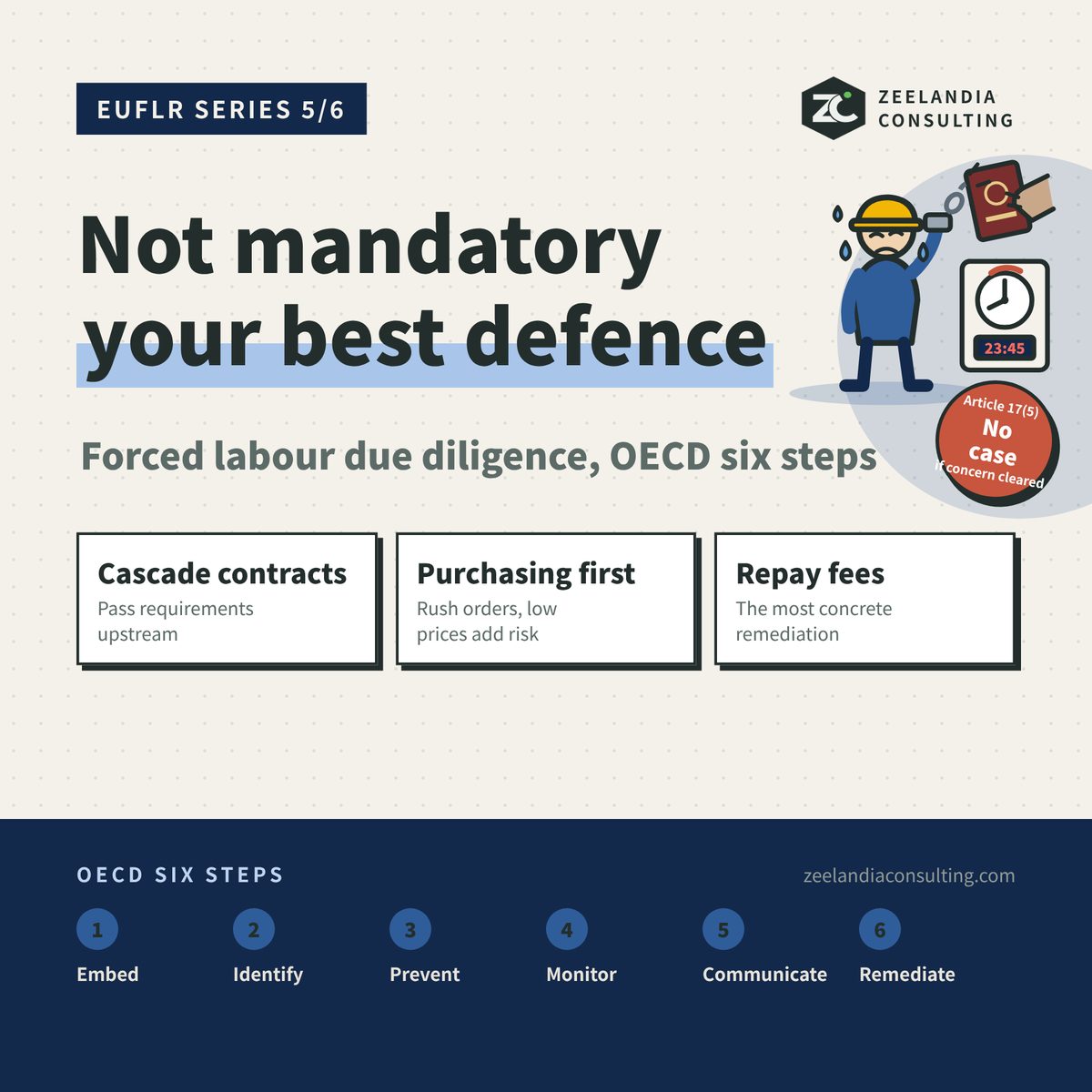
Due diligence is not mandatory under the EU Forced Labour Regulation (FLR), but it is a company’s strongest evidence when an authority asks what it has done about forced labour risks. Article 1(3) is clear: the FLR creates no new due diligence obligations. Yet the first question an authority asks in the preliminary phase is what you have done, under which laws, guidelines or UN, International Labour Organization (ILO) and OECD recommendations (Article 17(1)). And under Article 17(5), due diligence that eliminates the concern means no investigation may be opened. Due diligence is not an obligation. It is your best defence.
Chapter 6 of the Commission’s guidelines applies the six due diligence steps of the Organisation for Economic Co-operation and Development (OECD) specifically to forced labour, replacing the 2021 guidance.
Key takeaways
- Article 1(3) creates no new due diligence obligations, but Article 17(1) asks what you have done and Article 17(5) bars an investigation where due diligence has eliminated the concern.
- Chapter 6 of the Commission’s guidelines applies the OECD six steps to forced labour, replacing the 2021 guidance.
- On-site audits are “deeply compromised” in state-imposed forced labour contexts; a clean audit report is not evidence there.
- Repaying recruitment fees, returning documents and returning withheld wages are listed as restitution measures.
- One OECD-based backbone can serve the FLR, the Battery Regulation, CSDDD and CSRD, with the EUDR as a separate module.
What are the OECD six steps for forced labour due diligence?
The six OECD due diligence steps, as applied to forced labour in the FLR guidelines, set out what companies are expected to do, with a lighter approach for SMEs:
| Step | What the guidelines expect | Lighter SME approach | Output |
|---|---|---|---|
| 1. Embed in policy and management | Commit to ILO principles; assign responsibility and senior oversight; build requirements into supplier contracts | Adapt an industry model policy; publish it and add it to procurement | Forced labour policy, supplier code, contract clauses |
| 2. Identify and assess | Scope by geography, sector and product; assess high-risk points in depth; determine whether you cause or contribute | Use the EU risk database for scoping | Risk map, high-risk supplier list |
| 3. Prevent, mitigate, end | Corrective action plans, purchasing practice changes, leverage, supplier support; disengage as a last resort | Join sector initiatives; screen suppliers with checklists | Corrective action plan |
| 4. Monitor | Track qualitative and quantitative indicators; monitor high-risk points most intensively | A few key indicators, such as grievances raised and resolved | Monitoring records, KPI dashboard |
| 5. Communicate | Publish risk areas, prioritisation criteria, actions and outcomes; handle sensitive data carefully | A short update in the annual report | Report section, customer response pack |
| 6. Remediate | Provide remedy where you cause or contribute; run grievance mechanisms meeting quality criteria | Simple channels such as messaging apps or suggestion boxes | Grievance mechanism design, remediation records |
What matters most for Taiwanese suppliers?
Several points in the FLR guidelines matter most for Taiwanese suppliers.
Step 1: contracts must cascade. Clauses should cover adherence to international standards, transparency and reporting, passing the same requirements upstream, and grounds for suspension or termination. The guidelines warn that clauses and assurances are not sufficient on their own without follow-up and verification.
Step 2: on-site audits do not work for state-imposed forced labour. In state-imposed forced labour (SIFL) contexts, traditional audits are “deeply compromised”. Assessments must rely on independent desktop research, international organisation reports and credible civil society data. A clean audit report is not evidence there.
Step 3: look at your own purchasing practices first. Short lead times and low prices can push suppliers into excessive overtime. The guidelines ask companies to assess how their own business model may contribute to risk.
Step 3: disengagement is a last resort, but a real one. Where risks cannot be remedied, companies need to disengage responsibly, with escalation steps agreed upfront, reasonable notice and attention to the impact on workers. A contract term or a supplier’s importance cannot justify non-compliance with the ban.
Step 6: repaying recruitment fees is remediation. The guidelines list repayment of recruitment fees, return of documents and return of withheld wages among restitution measures. For factories employing migrant workers, this is the most concrete and most likely question.
Throughout: worker interviews by trusted third parties, to protect confidentiality, accuracy and safety.
How can one system serve several regulations? The ZC method
The same European customers may ask for data under the FLR, the Battery Regulation, the Corporate Sustainability Due Diligence Directive (CSDDD) or the Corporate Sustainability Reporting Directive (CSRD). ZC builds one OECD-based human rights due diligence system and adds regulation-specific modules:
| Regulation | Link to due diligence | Module on the shared backbone |
|---|---|---|
| FLR | Not mandatory, but the primary evidence | Product traceability, investigation readiness pack |
| Battery Regulation (Article 48 onwards) | Mandatory supply chain due diligence for lithium, nickel, cobalt and natural graphite, consistent with OECD standards | Raw material risk assessment, third-party verification |
| CSDDD | Large companies from July 2029; requirements will cascade to suppliers | Standardised customer responses and data sharing |
| CSRD | Reporting on human rights risks and impacts | Step 5 disclosure content |
| EUDR | Batch traceability and geolocation; a different logic | Separate module outside the six steps |
Existing schemes such as RBA, SMETA, amfori BSCI and EcoVadis feed steps 2 and 4 but do not replace the system, and the guidelines stress that companies remain responsible for effective due diligence even when collaborating. One risk map, one supplier dataset and one grievance mechanism, reused across five use cases.
FAQ
Is due diligence mandatory under the FLR?
No. Article 1(3) states that the FLR creates no new due diligence obligations. Due diligence is still your best defence, because authorities ask what you have done (Article 17(1)) and no investigation may be opened where due diligence has eliminated the concern (Article 17(5)).
Are social audits enough to rule out state-imposed forced labour?
No. In state-imposed forced labour contexts, the guidelines describe traditional audits as “deeply compromised”. Assessments must rely on independent desktop research, international organisation reports and credible civil society data.
Is repaying recruitment fees part of remediation?
Yes. The guidelines list repayment of recruitment fees, return of documents and return of withheld wages among restitution measures. For factories employing migrant workers, this is the most concrete and most likely question.
Can RBA or SMETA audits replace a due diligence system?
No. Existing schemes such as RBA, SMETA, amfori BSCI and EcoVadis feed steps 2 and 4 but do not replace the system. The guidelines stress that companies remain responsible for effective due diligence even when collaborating.
Can one due diligence system cover the FLR and the Battery Regulation?
Yes. One OECD-based human rights due diligence system can serve the FLR, the Battery Regulation, CSDDD and CSRD through regulation-specific modules. The EUDR follows a different logic and needs a separate module.
Next: The FLR action checklist for suppliers: now to December 2027
The series
- The EU Forced Labour Regulation explained: what changes on 14 December 2027
- What counts as forced labour? The ILO indicators Taiwanese suppliers should know
- Inside an FLR investigation: phases, deadlines and the documents you need
- After a ban: withdrawal, disposal, customs holds and penalties
- Forced labour due diligence with the OECD six-step framework
- The FLR action checklist for suppliers: now to December 2027
How far is your RBA or SMETA programme from the six steps? Book a free 30-minute call for a quick gap analysis.
Sources · Regulation (EU) 2024/3015 (Forced Labour Regulation) · RVO: Forced Labour Regulation. This article is general information and not legal advice for any specific case. Obligations are defined by the Official Journal of the EU.
FLREU Forced Labour Regulationforced labour due diligenceOECD six stepsHRDDhuman rights due diligenceCSDDDBattery Regulation