The EU Forced Labour Regulation (FLR) defines forced labour as work exacted under the menace of a penalty and not offered voluntarily, adopting the definition in International Labour Organization (ILO) Convention No 29. “Nobody in our factory is forced to work.” We hear this often. But because the FLR uses the ILO definition, the question is whether workers consented freely and can leave at any time. Many routine management practices can trigger red flags under the ILO indicators.
Key takeaways
- Article 2(1) of the FLR adopts the forced labour definition of ILO Convention No 29.
- Forced labour requires lack of voluntary consent and coercion at the same time; low pay or heavy overtime alone is not forced labour.
- The 14 ILO indicators range from deception and debt to retention of ID documents and withholding of wages.
- In Taiwanese supply chains, risk concentrates where recruitment fees, document retention and working hours intersect.
- State-imposed forced labour upstream can lead to a ban even when your own factory is fully compliant, and the FLR covers forced child labour (under 18).
How does the FLR define forced labour? Three elements, two must coincide
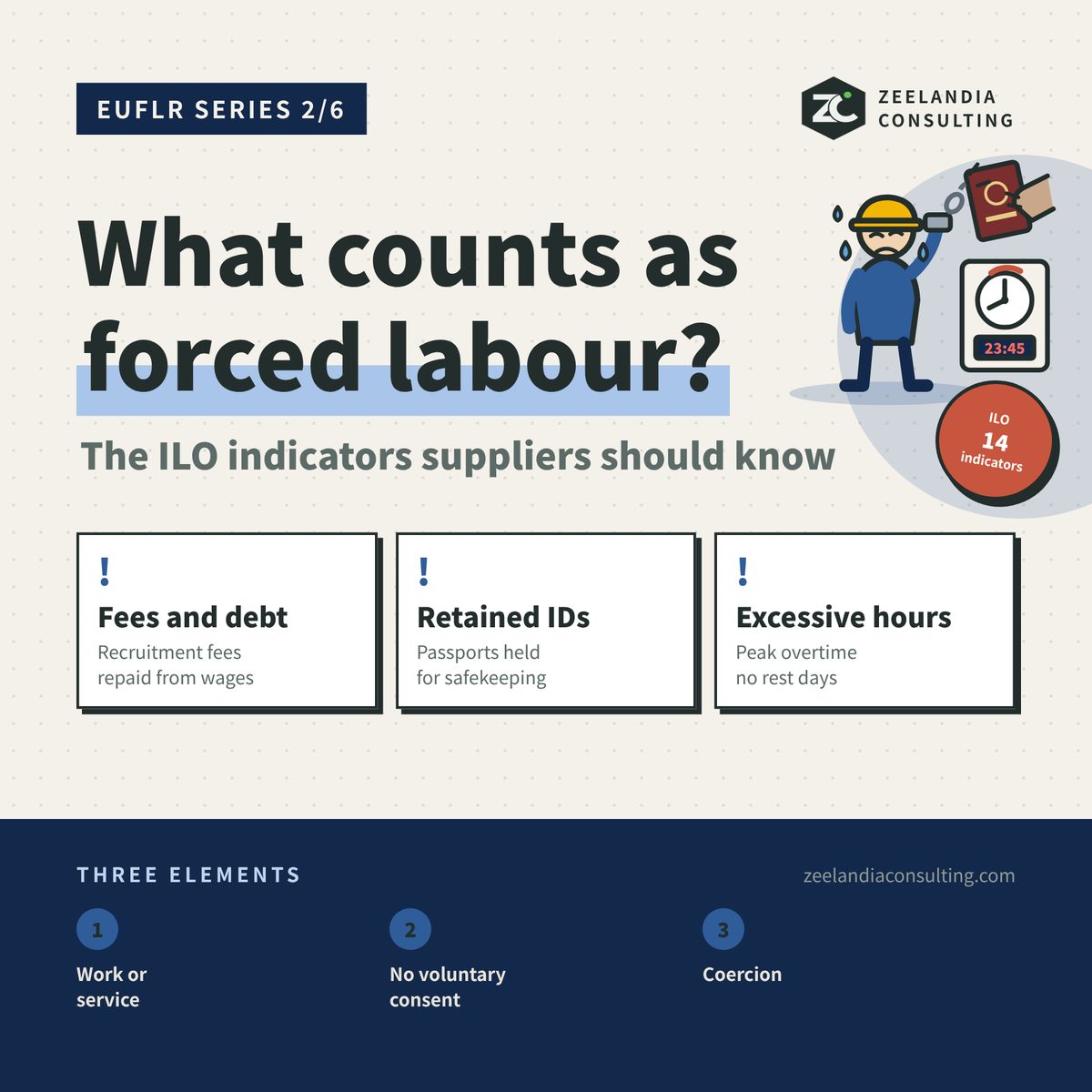
Article 2(1) of the FLR adopts ILO Convention No 29: forced labour is “all work or service which is exacted from any person under the menace of any penalty and for which the said person has not offered himself voluntarily.” Section 3.2 of the guidelines breaks it into three elements:
- Work or service producing goods. Services such as domestic work fall outside the FLR, which covers products only.
- Lack of voluntary consent: no free and informed consent to take the job, or no freedom to leave.
- Coercion: the means used to impose work, including violence, debt, withholding wages or documents, and threats of dismissal or deportation.
Involuntariness and coercion must occur at the same time at some point in the period analysed. Low pay or heavy overtime alone is not forced labour. Combined with “cannot resign”, “passport held” or “owes the broker”, it may well be.
What are the 14 ILO indicators of forced labour?
The ILO uses 14 indicators of forced labour; the table maps each one to how it can show up in a factory and what to check first.
| ILO indicator | How it can show up | What to check first |
|---|---|---|
| Forced recruitment | Unlicensed brokers; contracts signed under pressure | Broker contracts and licences |
| Deception | Promised pay or job differs from reality; contract not in the worker’s language | Native-language contracts |
| Exploitation of debt | Home-country recruitment fees repaid through wage deductions | Recruitment fee tracking, payslips |
| Hazardous or degrading working conditions | No protective equipment, no hazard compensation | Safety records, PPE logs |
| Onerous working hours | Peak-season overtime without rest days | Time and overtime records |
| Degrading living conditions | Overcrowded dormitories, excessive dorm fees | Dormitory photos, fee schedules |
| Abusive additional obligations | Compulsory savings or purchases | Signed deduction consents |
| Physical or sexual violence | Abuse by supervisors | Grievance records, interviews |
| Abuse of isolation | Remote sites, language barriers | Grievance channel accessibility |
| Restriction of movement | Dormitory curfews, permission to leave | Dormitory rules |
| Retention of cash, assets or ID | Employer or broker “safekeeping” of passports | Document policy, worker lockers |
| Withholding of wages | Late pay, final wages withheld | Payroll and transfer records |
| Threats or intimidation | Threats of termination or deportation | Interviews, grievance records |
| Abuse of vulnerability | Exploiting language, legal status or job-change limits | Worker rights induction |
In Taiwanese supply chains, risk concentrates where recruitment fees, document retention and working hours intersect. Since 2020 the US Department of Labor has also listed fish from Taiwan’s distant-water fleet as produced with forced labour, so seafood processors should prepare early.
Why is state-imposed forced labour an upstream risk?
The FLR pays particular attention to state-imposed forced labour (SIFL), defined by ILO Convention No 105, and the guidelines add ten structural indicators such as detention, state confiscation of property, surveillance and collective punishment. The practical exposure for Taiwanese firms lies in upstream inputs. If raw materials come from a region with systemic SIFL risk, the finished product can be banned even when your own factory is fully compliant. Social audits in such regions are not considered credible where access is restricted or workers cannot speak freely, and responsible disengagement may be the only viable response.
Does the FLR cover forced child labour?
The FLR definition expressly includes forced child labour (under 18), including children working alongside parents who are themselves in forced labour. Family-based agriculture and small-scale mining are high-risk settings.
The ZC view
Run an internal check against the table above, starting with the full trail of recruitment fees: what workers paid at home, to whom, and what was deducted in Taiwan. European customers, RBA audits and FLR investigators all ask the same question. One well-kept recruitment fee tracker answers all three.
FAQ
Is low pay or heavy overtime forced labour under the FLR?
Not on its own. Under the FLR, involuntariness and coercion must occur at the same time; low pay or heavy overtime combined with “cannot resign”, “passport held” or “owes the broker” may well amount to forced labour.
Is holding workers’ passports a forced labour indicator?
Yes. Retention of cash, assets or ID is one of the 14 ILO indicators, and it can show up as an employer or broker “safekeeping” passports. Check first the document policy and whether workers have their own lockers.
Can a product be banned if my own factory is compliant?
Yes. If raw materials come from a region with systemic state-imposed forced labour risk, the finished product can be banned even when your own factory is fully compliant.
Are social audits enough in high-risk regions?
Social audits are not considered credible in regions where access is restricted or workers cannot speak freely. In such cases responsible disengagement may be the only viable response.
Where should Taiwanese suppliers start?
Start with the full trail of recruitment fees: what workers paid at home, to whom, and what was deducted in Taiwan. The same recruitment fee tracker answers European customers, RBA audits and FLR investigators.
Next: Inside an FLR investigation: phases, deadlines and the documents you need
The series
- The EU Forced Labour Regulation explained: what changes on 14 December 2027
- What counts as forced labour? The ILO indicators Taiwanese suppliers should know
- Inside an FLR investigation: phases, deadlines and the documents you need
- After a ban: withdrawal, disposal, customs holds and penalties
- Forced labour due diligence with the OECD six-step framework
- The FLR action checklist for suppliers: now to December 2027
Want to know which indicators light up in your factories and suppliers? Book a free 30-minute call.
Sources · Regulation (EU) 2024/3015 (Forced Labour Regulation) · RVO: Forced Labour Regulation. This article is general information and not legal advice for any specific case. Obligations are defined by the Official Journal of the EU.
FLREU Forced Labour Regulationforced labour definitionILO indicatorsILO Convention No 29recruitment feesdebt bondagestate-imposed forced labour