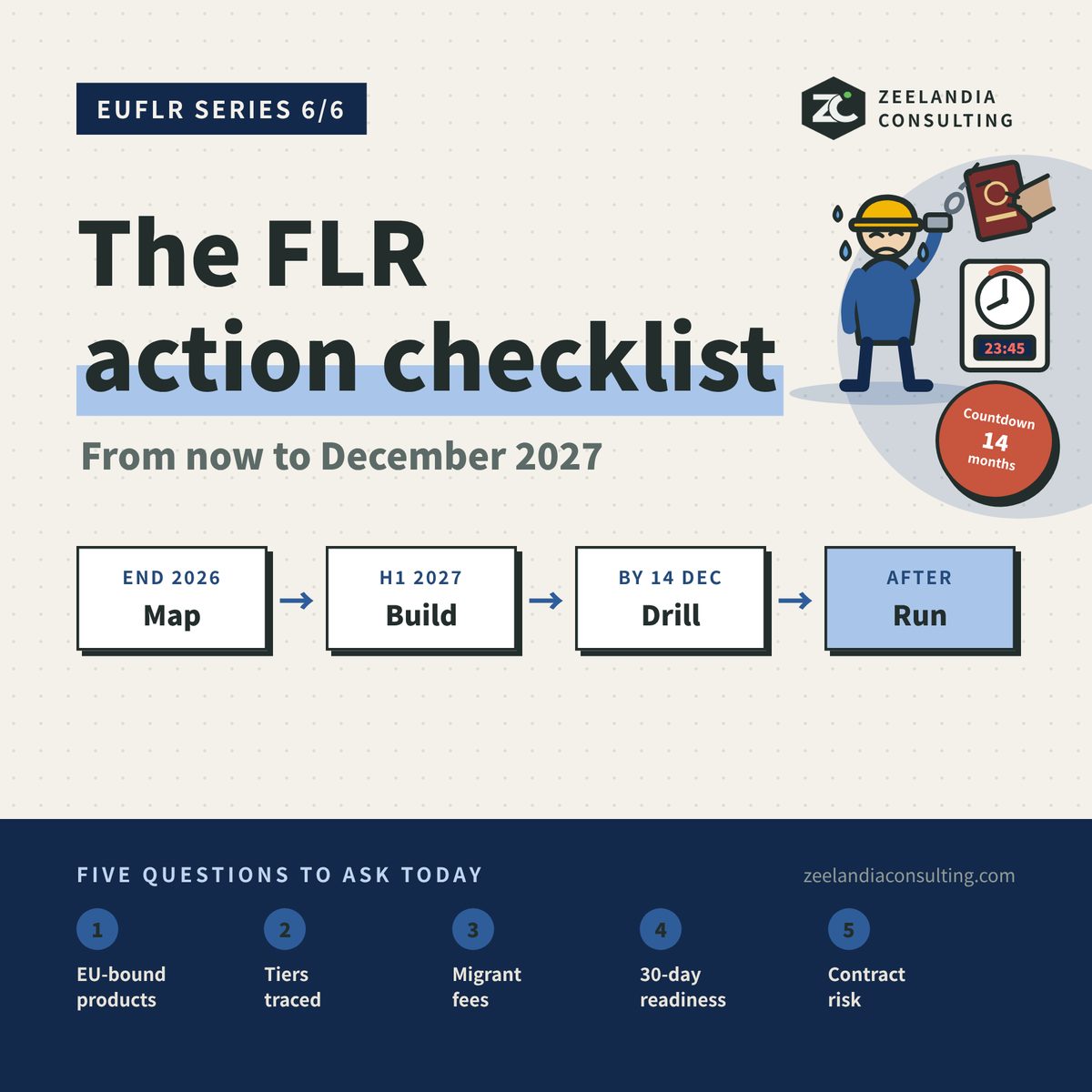
The EU Forced Labour Regulation (FLR, Regulation (EU) 2024/3015) applies in full on 14 December 2027, and suppliers can prepare in four phases: map and scope, build the system, get ready, and keep it running. That date is less than 14 months away. This final article turns the series into work you can put in the calendar.
Key takeaways
- Phase 1, by the end of 2026: map EU-bound products and suppliers, and track Member State penalty rules due by 14 December 2026.
- Phase 2, first half of 2027: publish a forced labour policy, update contract clauses and set up a grievance channel in workers’ own languages.
- Phase 3, before 14 December 2027: assemble an investigation readiness pack and drill a mock information request within 30 working days.
- Products still on the market after 14 December 2027 are in scope, whenever they were made.
- SMEs get lighter expectations, but the ban has no size exemption.
Which five questions should suppliers ask today?
Five questions show where a supplier stands on FLR readiness:
- Which of our products reach the EU market, directly or through customers?
- How many tiers back can we trace their main inputs?
- Do our factories and key suppliers employ migrant workers, and who pays the recruitment fees?
- If an authority wrote to us today, what could we produce within 30 working days?
- How do our European customer contracts allocate forced labour risk?
Any question you cannot answer is your starting point.
Phase 1: by end-2026, map and scope
Phase 1 of FLR preparation, to be completed by the end of 2026, focuses on mapping and scoping:
- Appoint an owner and a cross-functional team (procurement, HR, sales, quality, sustainability) with senior backing.
- Map EU-bound products, customers and volumes, including indirect exports.
- Screen suppliers by geography, sector and product; flag high-risk inputs and origins.
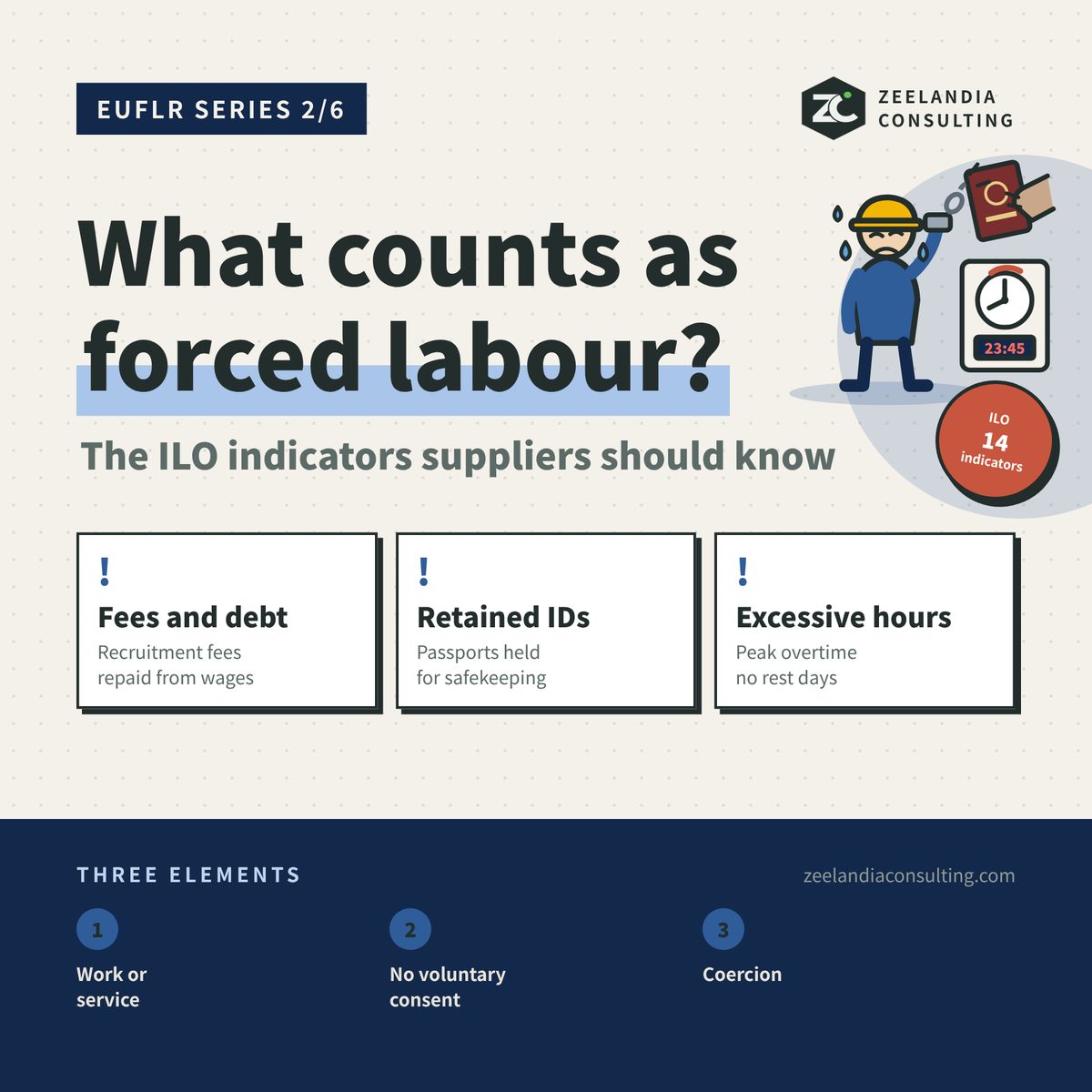
- Self-check against the International Labour Organization (ILO) indicator table in Part 2, starting with recruitment fees, document retention and hours.
- Review customer contracts and questionnaires received.
- Track Member State penalty rules due by 14 December 2026 and the EU risk database, still pending.
Phase 2: first half of 2027, build the system
Phase 2 of FLR preparation, in the first half of 2027, builds the due diligence system:
- Publish a forced labour policy and embed it in procurement and risk management.
- Update the supplier code and contract clauses: standards, transparency, cascading, termination grounds.
- Assess high-risk suppliers in depth, with third-party worker interviews where needed.
- Map multi-tier supply chains for key products; compile bills of materials and certificates of origin.
- Set up a grievance channel workers understand and can use, in their own languages.
- Agree corrective action plans for issues found, including recruitment fee repayment.
Phase 3: before 14 December 2027, get ready
Phase 3 of FLR preparation, before 14 December 2027, focuses on investigation readiness:
- Assemble an investigation readiness pack covering the three document sets in Section 4.7 of the guidelines.
- Run a drill: answer a mock information request in English within 30 working days.
- Review stock: products still on the market after 14 December 2027 are in scope, whenever they were made.
- Prepare manufacturer and supplier data in a standard format for customers’ customs declarations.
- Prepare customer-facing and public versions of your disclosures, with sensitive data tiered.
Phase 4: after December 2027, keep it running
Phase 4 of FLR preparation, after December 2027, keeps the system running:
- Track key indicators: corrective actions completed on time, grievances raised and resolved, recurring issues.
- Refresh risk scoping at least annually and whenever products, suppliers or risk information change.
- Monitor ban decisions published on the Forced Labour Single Portal for links to your supply chain.
What does the FLR expect of SMEs?
The FLR guidelines expect less of SMEs: model templates, the risk database for scoping, checklist-based supplier screening, messaging apps as grievance channels, and the SME checklist on the Single Portal. But the ban has no size exemption. Simplified does not mean exempt.
How can ZC help?
ZC supports suppliers preparing for the FLR in three ways:
- Rapid diagnosis of product and supply chain risk against the ILO indicators.
- One-backbone system build on the six due diligence steps of the Organisation for Economic Co-operation and Development (OECD), serving the FLR, the Battery Regulation and customers’ Corporate Sustainability Due Diligence Directive (CSDDD) requirements together.
- Outsourced point of contact for EU regulatory requests, customer questionnaires and, where needed, dialogue with authorities.
With teams in Amsterdam and Taipei, ZC works with you in Chinese and with your European counterparts in English.
FAQ
When does the EU Forced Labour Regulation apply?
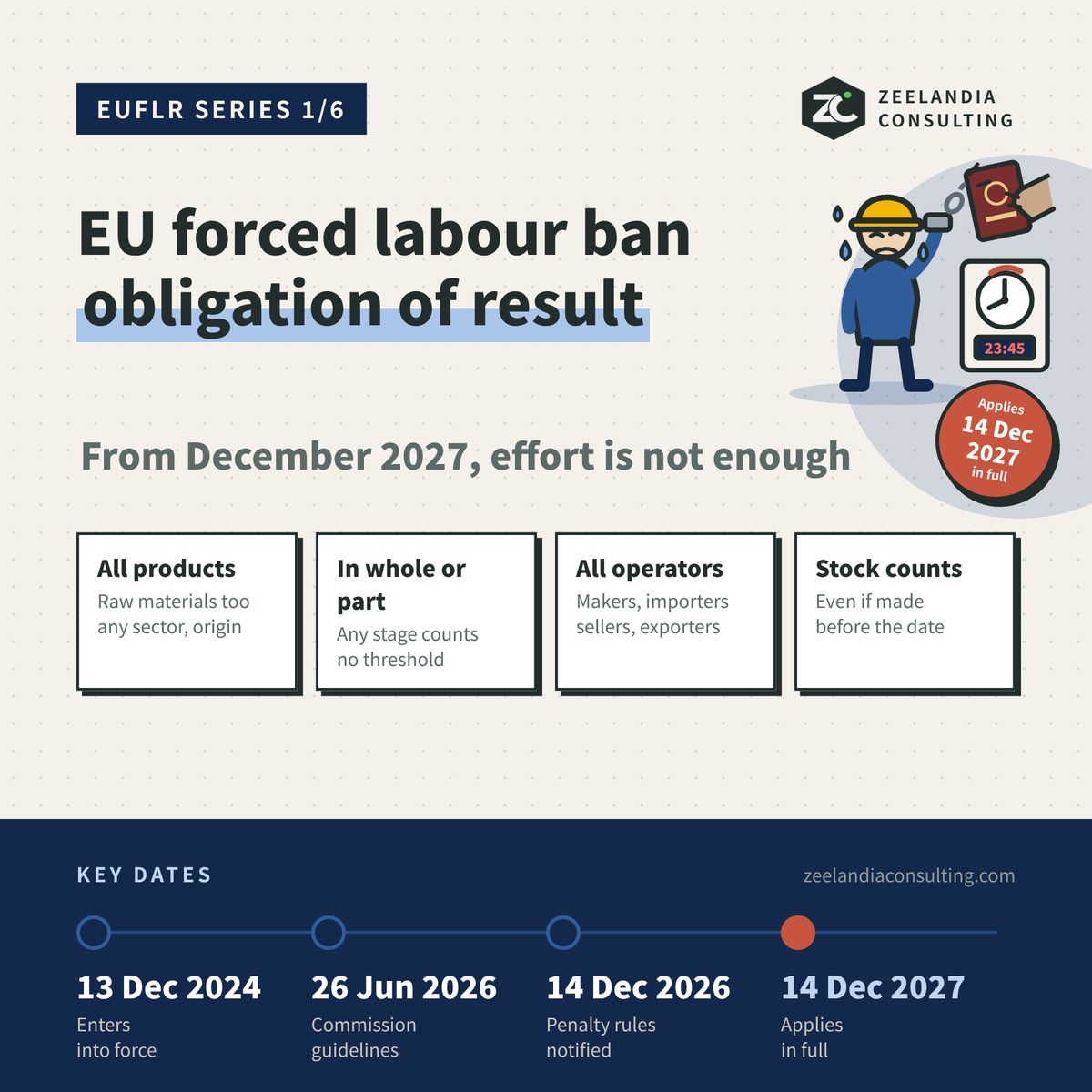
The FLR applies in full on 14 December 2027. Member States must notify their penalty rules by 14 December 2026.
Are SMEs exempt from the FLR?
No. The guidelines expect less of SMEs, such as model templates and checklist-based supplier screening, but the ban has no size exemption. Simplified does not mean exempt.
Do products made before December 2027 fall under the FLR?
Yes. Products still on the market after 14 December 2027 are in scope, whenever they were made. Reviewing stock is therefore part of Phase 3.
How quickly must a supplier be able to answer an authority?
Plan on 30 working days. A useful drill is to answer a mock information request in English within that window, using an investigation readiness pack built on the three document sets in Section 4.7 of the guidelines.
The series
- The EU Forced Labour Regulation explained: what changes on 14 December 2027
- What counts as forced labour? The ILO indicators Taiwanese suppliers should know
- Inside an FLR investigation: phases, deadlines and the documents you need
- After a ban: withdrawal, disposal, customs holds and penalties
- Forced labour due diligence with the OECD six-step framework
- The FLR action checklist for suppliers: now to December 2027
The Commission’s guidance runs to 74 pages. We have marked up what matters for you. Book a free 30-minute call or follow ZC EU Regulations for updates.
Sources · Regulation (EU) 2024/3015 (Forced Labour Regulation) · RVO: Forced Labour Regulation. This article is general information and not legal advice for any specific case. Obligations are defined by the Official Journal of the EU.
FLREU Forced Labour RegulationFLR checklistforced labour compliancesupply chain mappinginvestigation readinessTaiwan suppliers