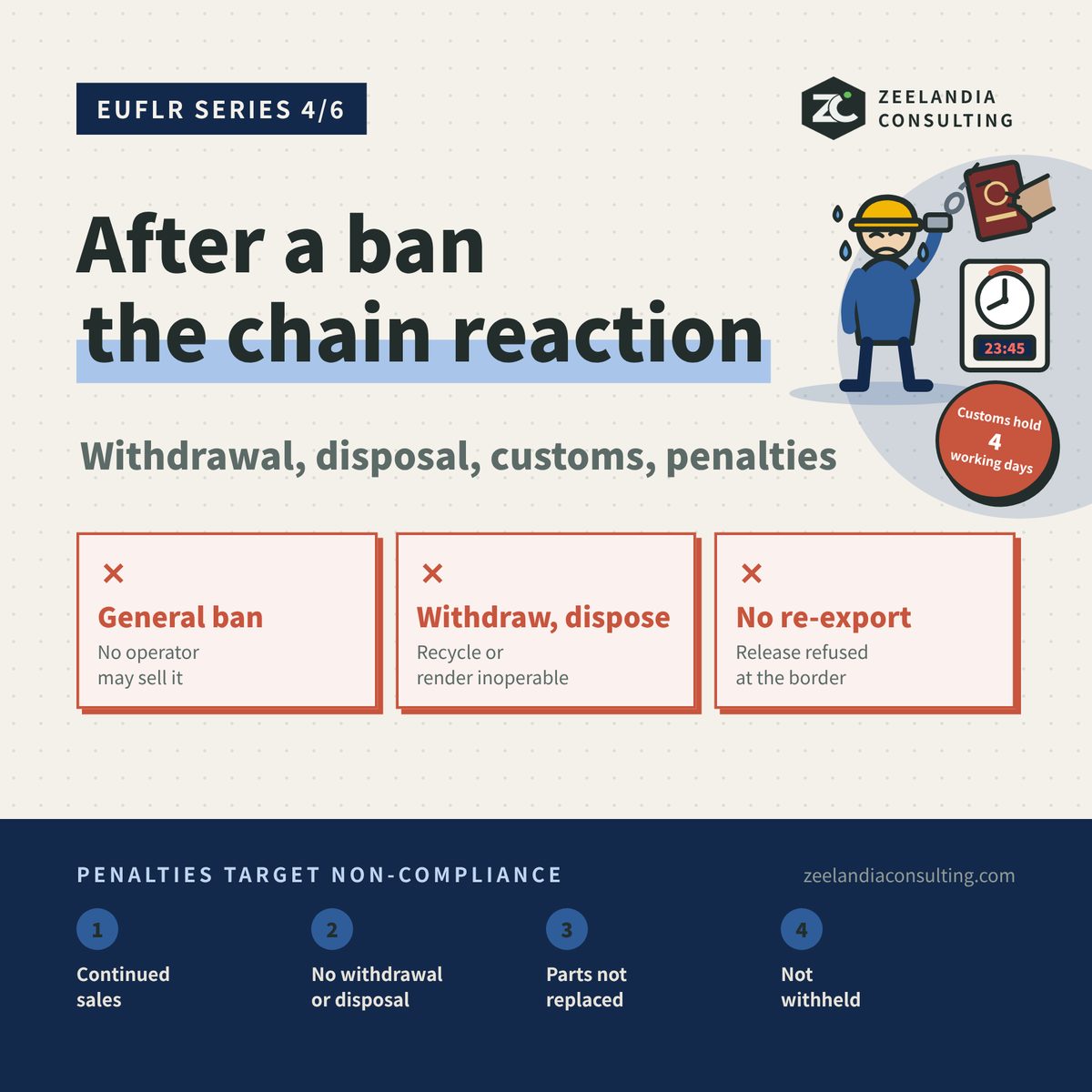
A ban decision under the EU Forced Labour Regulation (FLR) prohibits every operator from making the product available in the EU or exporting it, and orders its withdrawal and disposal at the operator’s cost. The FLR sets no minimum or maximum fine, so some assume the risk is modest. In fact the real cost lies in the ban itself: no access to the EU market, stock withdrawn and disposed of at your expense, and your name published on an official EU website.
Key takeaways
- A ban decision has general application to every operator and is published on the Forced Labour Single Portal (Articles 20(4), 20(8) and 22).
- Deadlines to comply are at least 30 working days, or 10 for perishables, animals and plants.
- Customs release suspended goods unless the authority asks to maintain the suspension within 4 working days (2 for perishables) (Article 29).
- FLR penalties apply to non-compliance with a ban decision, not to the use of forced labour itself; Member States notify penalty rules by 14 December 2026.
- Operators may request a review at any time; the authority decides within 30 working days (Article 21).
What does an FLR ban decision contain?
Under Articles 20(4) and 22 of the FLR, a ban decision includes at least:
- A general prohibition on making the product available in the EU or exporting it. It applies to every operator, not only the one investigated, to prevent circumvention.
- A withdrawal order covering products on the market and online listings, though not products already with end users.
- A disposal order for the products, or for replaceable parts found to be made with forced labour.
- Deadlines of at least 30 working days, or 10 for perishables, animals and plants.
- Identification details, including manufacturers, producers, suppliers, importers, exporters and production sites.
Decisions are published on the Forced Labour Single Portal, and a decision by one Member State must be recognised and enforced by the others (Article 20(8)).
How must banned products be disposed of? Recycling or rendering inoperable
Article 25 of the FLR follows the waste hierarchy: recycle first, otherwise render inoperable; donate perishables to charitable or public interest causes. High-value durables such as vehicles, machinery and electronics need a technical feasibility assessment, and the operator must not benefit economically from disposal. The operator pays.
Two exceptions matter:
- Replaceable parts: if only a replaceable part is banned, it can be swapped for a forced-labour-free part and the product returned to market.
- Strategic or critical supply chains: the authority may order the product to be withheld, at the operator’s cost, while forced labour is eliminated, drawing on the Net-Zero Industry Act, the Critical Raw Materials Act and the critical technologies recommendation. But Recital 48 is explicit: switching suppliers does not count as eliminating forced labour, because that produces a different product.
How do customs enforce an FLR ban? A four-working-day window
Because forced labour leaves no trace on the product, EU customs act on FLR ban decisions transmitted through the information and communication system for market surveillance (ICSMS):
- Suspension: customs suspend release for free circulation or export and notify the competent authority (Article 28).
- Assessment: unless the authority asks to maintain the suspension within 4 working days (2 for perishables), the goods are released (Article 29).
- Refusal: if covered by a ban, release is refused, the notice “Product made with forced labour – release for free circulation/export not authorised – Regulation (EU) 2024/3015” is added to customs records and invoices, and the goods are disposed of. No modification and no re-export, at the operator’s cost (Article 30).
Release is not proof of compliance. Under Article 27, the Commission may also require extra information on manufacturers and suppliers for specific products at import, which is why customers may start asking you for it before declaration. For online marketplaces, authorities can order listings to be restricted under the Digital Services Act.
What do FLR penalties target?
FLR penalties are widely misunderstood: they apply to failing to comply with a ban decision, not to the use of forced labour itself, for example continuing to sell, failing to withdraw or dispose, failing to replace a part or to withhold. Member States set the rules and must notify them by 14 December 2026.
The guidelines set out five steps: establish the facts, set a basic amount by gravity and duration, adjust for mitigating and aggravating factors, apply national limits, and check the result is effective and dissuasive. The adopted version gives two illustrative methods:
| Method | Base | Example ranges |
|---|---|---|
| Product-based | Total value of products sold in breach, times a duration coefficient | Low 0 to 10%, medium 10 to 30%, high 30 to 60% |
| Turnover-based | Annual global turnover | Low 0 to 1%, medium 1 to 2%, high up to 4% |
These are examples only; national laws will decide.
Can a ban be lifted?
An FLR ban can be lifted, but the bar is high. Affected operators may request a review at any time with new substantial information; the authority decides within 30 working days (Article 21). Withdrawal for the future requires proof of compliance with the decision and of forced labour having been eliminated, with measures against recurrence. Judicial review is available; Commission decisions go to the Court of Justice of the EU.
The ZC view
Ban costs rarely stay with the European importer. Recall, disposal, storage, reputational damage and contract claims flow upstream through purchase agreements. Review your customer contracts now for forced labour warranties, indemnities and disclosure duties, and check you have equivalent protection from your own suppliers.
FAQ
Does the FLR set a maximum fine?
No. The FLR sets no minimum or maximum fine; Member States set penalty rules and must notify them by 14 December 2026. The Commission’s guidelines give illustrative methods only, such as a turnover-based range of up to 4% of annual global turnover for high gravity.
Does an FLR ban apply only to the company investigated?
No. A ban decision has general application and applies to every operator, not only the one investigated, to prevent circumvention. A decision by one Member State must be recognised and enforced by the others (Article 20(8)).
Can goods refused by customs be modified or re-exported?
No. If goods are covered by a ban, release is refused and the goods are disposed of at the operator’s cost, with no modification and no re-export (Article 30).
Does switching suppliers lift a ban?
No. Recital 48 states that switching suppliers does not count as eliminating forced labour, because that produces a different product. Withdrawal of a ban for the future requires proof of compliance with the decision and of forced labour having been eliminated.
How quickly is a review request decided?
Affected operators may request a review at any time with new substantial information, and the authority decides within 30 working days (Article 21). Judicial review is also available.
Next: Forced labour due diligence with the OECD six-step framework
The series
- The EU Forced Labour Regulation explained: what changes on 14 December 2027
- What counts as forced labour? The ILO indicators Taiwanese suppliers should know
- Inside an FLR investigation: phases, deadlines and the documents you need
- After a ban: withdrawal, disposal, customs holds and penalties
- Forced labour due diligence with the OECD six-step framework
- The FLR action checklist for suppliers: now to December 2027
Want to review how your customer contracts allocate FLR risk? Book a free 30-minute call.
Sources · Regulation (EU) 2024/3015 (Forced Labour Regulation) · RVO: Forced Labour Regulation. This article is general information and not legal advice for any specific case. Obligations are defined by the Official Journal of the EU.
FLREU Forced Labour RegulationFLR ban decisioncustoms suspensionproduct withdrawalproduct disposalFLR penalties