
In this article (11 sections)
- 1. Is PEF the same as a corporate carbon inventory?
- 2. Which 16 impact categories does PEF cover?
- 3. Is PEF mandatory?
- 4. What is a PEFCR, and why does it matter most?
- 5. Where does PEF stand now?
- 3 things to check now
- Common misconceptions
- What the carbon accounting series covers
- FAQ
- Next in the series
- Legal sources and references
PEF (Product Environmental Footprint) is the European Commission’s method for calculating a product’s environmental impact over its life cycle, based on life cycle assessment (LCA) and set out in Commission Recommendation (EU) 2021/2279. The Recommendation itself is voluntary, but EU laws such as the Batteries Regulation and the Ecodesign for Sustainable Products Regulation (ESPR) already build PEF into their legal definitions, and how a given product group is calculated is decided by its Product Environmental Footprint Category Rules (PEFCR). Most suppliers outside the EU first meet these terms in a data request from a European customer.
Key points
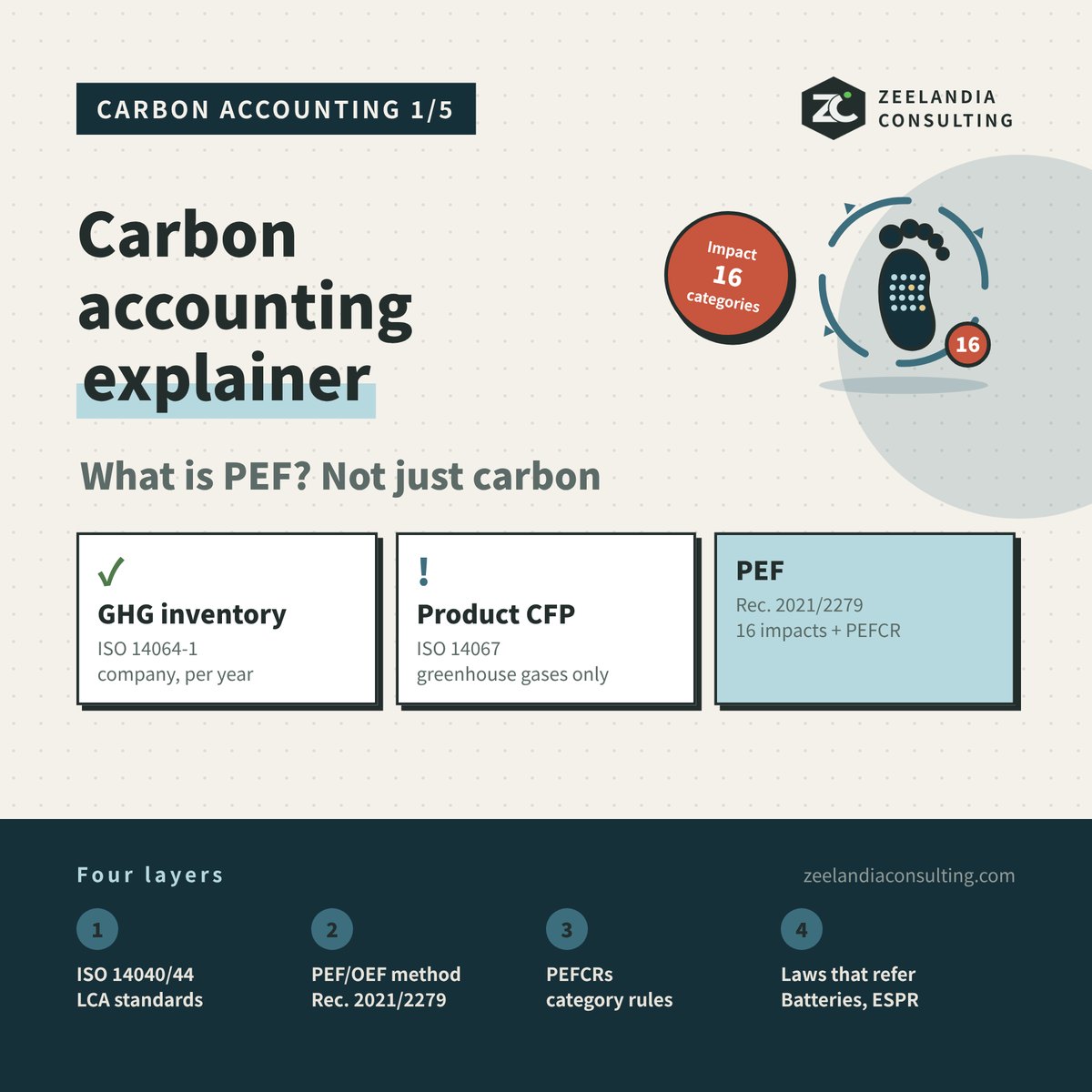
- PEF is not only about carbon. It covers 16 environmental impact categories, of which climate change is just one.
- There is no single EU “carbon accounting” law. Corporate GHG inventories, product carbon footprints, PEF and battery carbon footprint declarations each follow different methods, so one number cannot serve them all.
- Recommendation (EU) 2021/2279 is not binding. PEF becomes mandatory when another law refers to it, for example the carbon footprint definition in Article 3 of the Batteries Regulation.
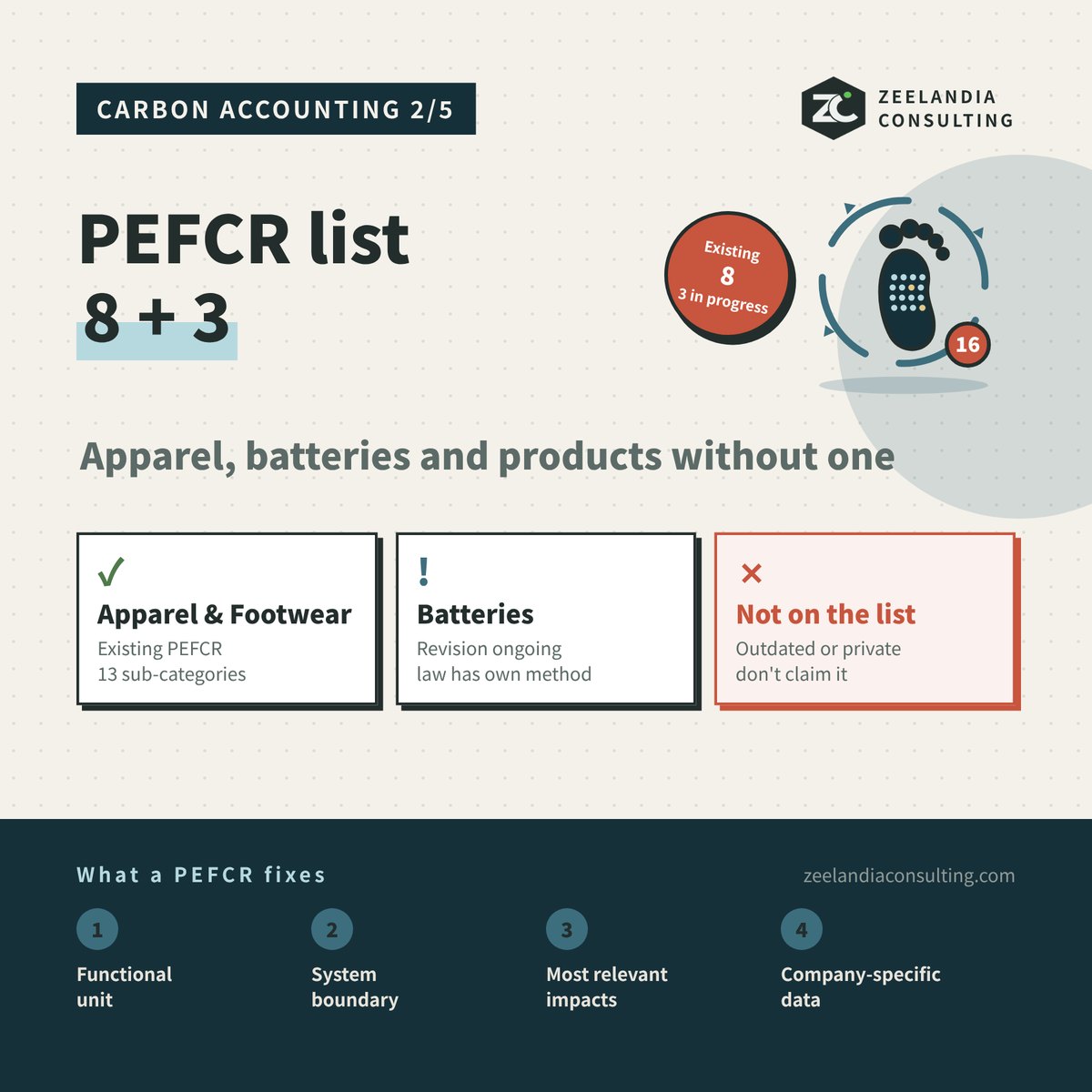
- What makes results comparable is the PEFCR. As of November 2026, the Commission’s official list contains 8 existing PEFCRs and 3 in progress.
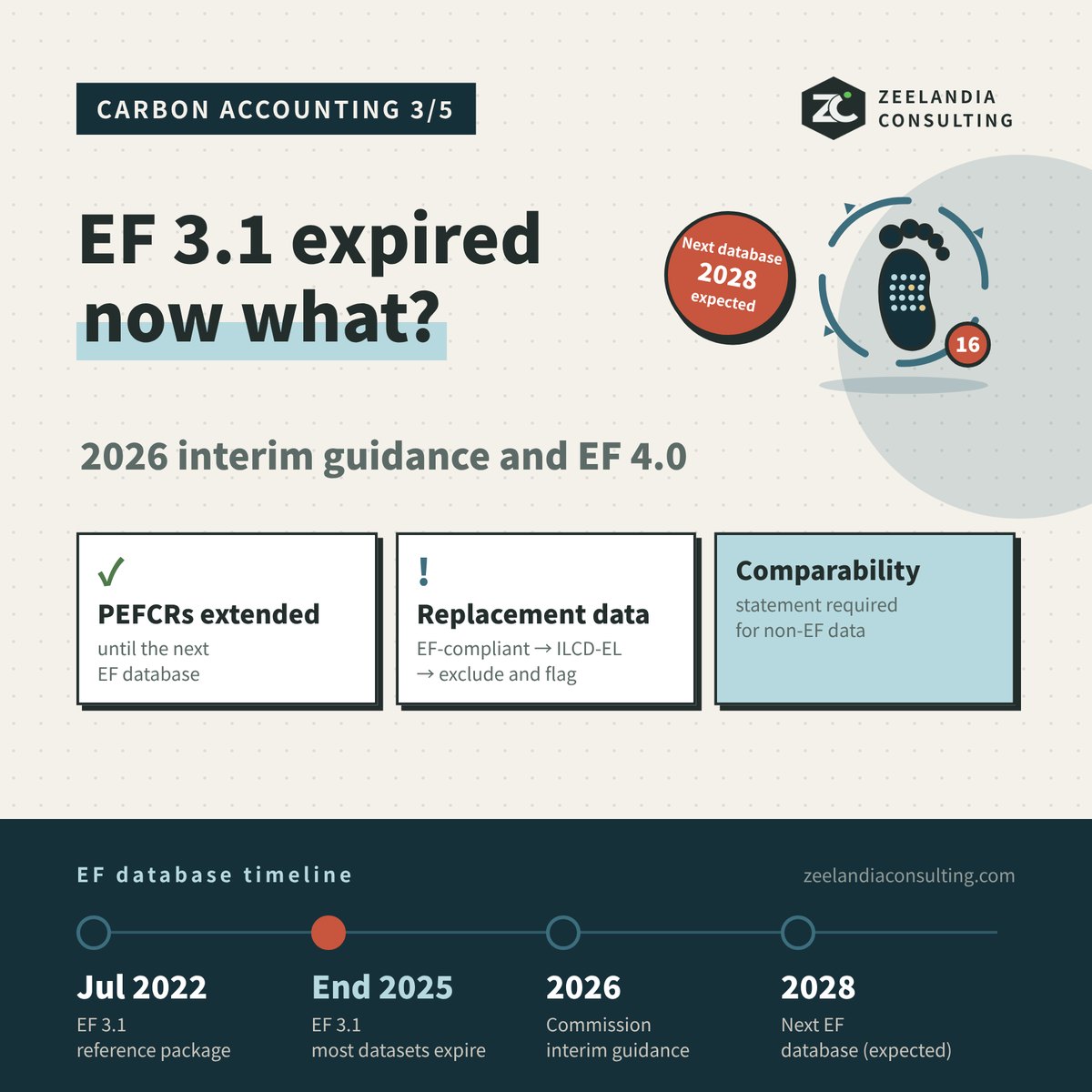
- PEF is changing versions: most EF 3.1 datasets expired at the end of 2025, and the next EF database is expected in 2028.
1. Is PEF the same as a corporate carbon inventory?
No. Many companies use “carbon accounting” to mean a corporate greenhouse gas inventory, but there is no single EU law by that name. The figure a European customer or regulation asks for may be any of the following:
| Type | Basis | What it measures | Typical situation for a non-EU supplier |
|---|---|---|---|
| Corporate GHG inventory | ISO 14064-1, GHG Protocol | Annual GHG emissions of a company or site | Customer questionnaires, CSRD value-chain data |
| Product carbon footprint | ISO 14067, plus national product category rules where they exist | GHG emissions over one product’s life cycle | Customer Scope 3, carbon labels |
| Product Environmental Footprint (PEF) | Recommendation (EU) 2021/2279 plus the product’s PEFCR | 16 environmental impacts over one product’s life cycle | A European brand runs a study under a PEFCR and asks suppliers for data |
| Battery carbon footprint declaration | Batteries Regulation (EU) 2023/1542, Article 7, and the methodology delegated act | Climate change only, based on PEF | EV, LMT and industrial batteries above 2 kWh |
The boundaries, databases and allocation rules of these four are all different. Using a corporate inventory result as a product carbon footprint, or entering an ISO 14067 figure into a PEF data request, are the most common mistakes.
2. Which 16 impact categories does PEF cover?
The PEF method (Annex I to the Recommendation) requires every PEF study to calculate these 16 impact categories:
| Area | Impact categories |
|---|---|
| Climate | Climate change |
| Air and health | Ozone depletion, particulate matter, ionising radiation, photochemical ozone formation, human toxicity (cancer), human toxicity (non-cancer) |
| Water and soil | Acidification, eutrophication (terrestrial), eutrophication (freshwater), eutrophication (marine), ecotoxicity (freshwater) |
| Resources | Land use, water use, resource use (fossils), resource use (minerals and metals) |
PEF also includes normalisation and weighting, so the 16 results can be combined into a single score. Each PEFCR then identifies the “most relevant” impact categories and life cycle stages for its product group, showing companies where improvement matters most.
This is why a product with a low carbon footprint does not necessarily perform well under PEF. For textiles, for example, water use, land use and toxicity often weigh more than carbon.
3. Is PEF mandatory?
PEF itself is not mandatory. Under Article 288 TFEU a recommendation has no binding force. In the Recommendation the Commission encourages Member States, companies and labelling schemes to use it, and states that it may be referred to by EU legislation or policy as a calculation method.
So the question is not PEF itself but which law refers to it:
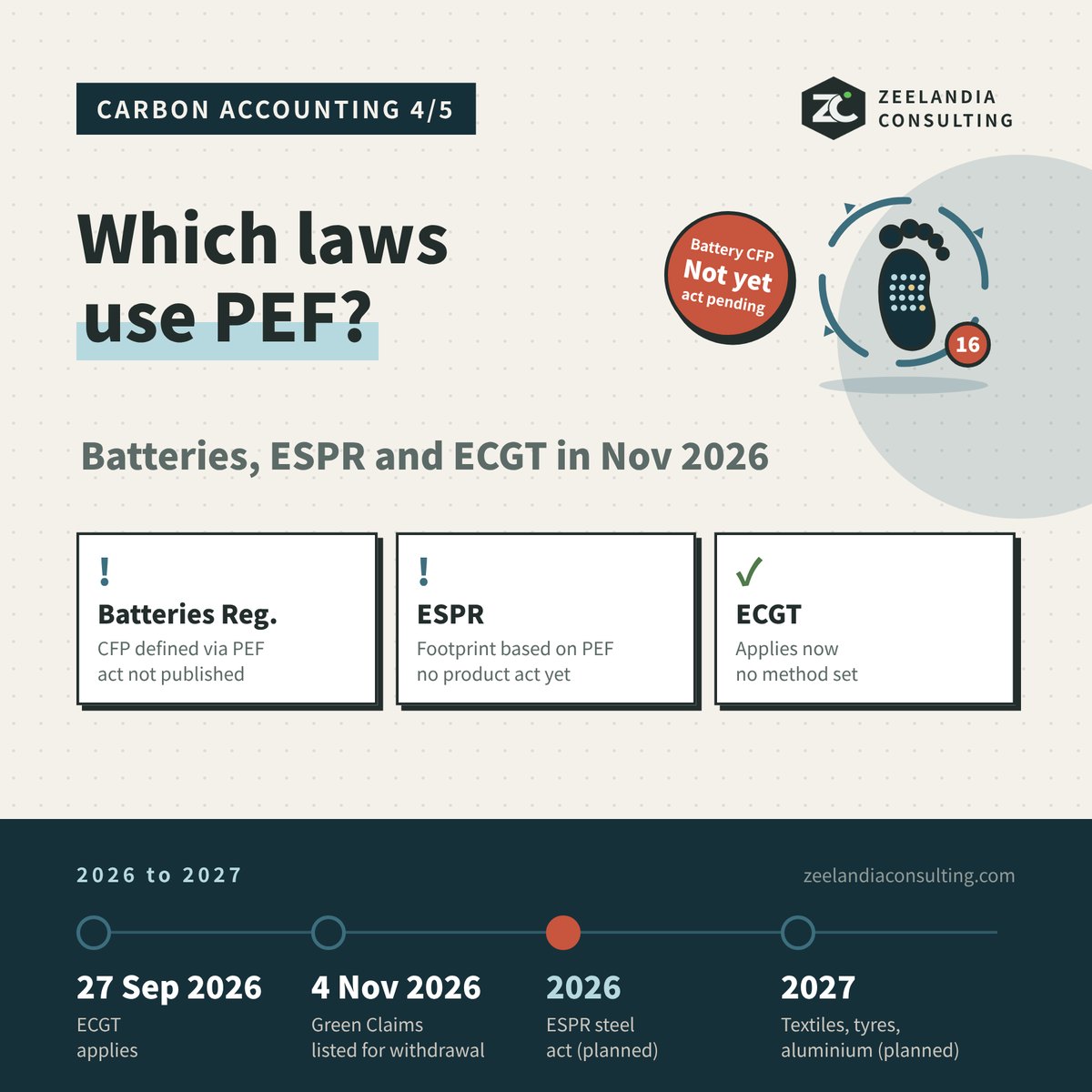
- Batteries Regulation (EU) 2023/1542: Article 3(1), point (21), defines “carbon footprint” as the sum of emissions based on a PEF study using the single impact category of climate change. The battery carbon footprint declaration in Article 7 builds on that definition.
- ESPR (EU) 2024/1781: Article 2 defines “environmental footprint” on the basis of the PEF method of Recommendation (EU) 2021/2279, or other scientific methods developed by international organisations, widely tested with different industry sectors and adopted in other Union law. Future product-specific delegated acts can set environmental footprint or carbon footprint as an information or performance requirement.
The Commission describes this as four layers: ISO 14040/14044 on LCA at the bottom, then the PEF/OEF methods (the Recommendation), then product-specific PEFCRs, and legislation (for example delegated acts) at the top. Each layer builds on the one below.
Is your product on the ESPR priority list?
The first ESPR working plan schedules iron and steel, textiles, tyres, aluminium, furniture and mattresses. Environmental footprint and carbon footprint are both parameters the delegated acts can use. As of November 2026, no product-specific delegated act has been adopted.
Once adopted, requirements apply no earlier than 18 months after entry into force.
See the ESPR timeline and secondary acts in the Regulatory Radar →
4. What is a PEFCR, and why does it matter most?
PEF is a general method. A PEFCR (Product Environmental Footprint Category Rules) sets detailed rules for one product group. According to the Commission, PEFCRs are drafted, managed and updated by a Technical Secretariat, so that calculations within a product group are consistent and results are reproducible, comparable and verifiable.
A PEFCR fixes the functional unit, the system boundary, the most relevant impact categories, the processes that must use company-specific data, and the default secondary datasets. Without this layer, two companies running PEF studies on the same kind of product still get results that are hard to compare.
The idea is similar to national product category rules for carbon footprints, such as Taiwan’s CFP-PCRs approved by its Ministry of Environment; the difference is that a PEFCR covers 16 impacts while a carbon PCR covers greenhouse gases only. The official list and the comparison are in Part 2.
5. Where does PEF stand now?
| Period | Phase |
|---|---|
| 2013 to 2018 | Pilot phase: first PEFCRs and EF datasets, Recommendation 2013/179/EU |
| From 2019 | Transition phase: Recommendation (EU) 2021/2279 replaces the 2013 version; PEFCRs updated and added |
| End of 2025 | Most EF 3.1 datasets expire |
| 2026 | Commission issues interim guidance; the Green Forum website says a new EF methods Recommendation is expected in 2026, not yet published as of our check |
| Expected 2028 | Next EF database |
In other words, PEF is changing versions. Results calculated today with EF 3.1 may not be directly comparable with results calculated later with the new database and method. Details in Part 3.
3 things to check now
- Which figure does your customer actually want? A corporate inventory, a product carbon footprint, a PEF study or a declaration required by law? Does the request mention a PEFCR, the 16 impact categories or a specific article?
- Which rules does your product fall under? Is it on the official PEFCR list, a battery under the Batteries Regulation or an ESPR priority product group?
- Can you explain where your carbon footprint figure comes from? Which standard, which product category rules, which database version, and what boundary?
A customer is asking for "PEF" or a "carbon footprint"?
Do not rush to send a single number. The requests in one email may correspond to different methods and different responsibilities, and a wrong answer causes more trouble than a slower one.
Bring the customer's email and book a 30-minute online consultation →
Common misconceptions
MythPEF is simply the EU version of a product carbon footprint.
FactPEF covers 16 impact categories, and carbon footprint is only the climate change one. Article 3(1), point (21), of the Batteries Regulation defines carbon footprint as the result of a PEF study using climate change as the single impact category, which shows exactly how the two relate.
MythAn ISO 14067 product carbon footprint already complies with PEF.
FactBoth build on ISO 14040/14044, but the PEF method (Annex I to the Recommendation) has its own rules on electricity modelling, data quality, datasets and reporting, and requires all 16 impact categories. An existing ISO 14067 study can provide some of the data but cannot be used as a PEF result as it stands.
MythThe EU already requires PEF for all products.
FactRecommendation (EU) 2021/2279 is not binding. Legal obligations arise only from individual laws that refer to PEF, such as Article 7 of the Batteries Regulation, and its methodology delegated act had still not been published in the Official Journal as of November 2026.
What the carbon accounting series covers
| Part | Topic |
|---|---|
| Part 1 | Carbon accounting explainer: what PEF is and how it differs from inventories and footprints (this article) |
| Part 2 | The official PEFCR list and products without a PEFCR |
| Part 3 | Interim guidance after EF 3.1 expired, and EF 4.0 |
| Part 4 | Which EU laws use PEF |
| Part 5 | Four kinds of carbon footprint and PEF requests from European customers |
FAQ
What is the difference between PEF and OEF?
PEF measures the life-cycle environmental impact of a product; OEF (Organisation Environmental Footprint) measures that of an organisation. Both are set out in Recommendation (EU) 2021/2279, PEF in Annex I and OEF in Annex III, with category rules called PEFCRs and OEFSRs respectively.
Can PEF results be used in consumer marketing?
They can support a claim, but claims must comply with national laws transposing the ECGT Directive (EU) 2024/825, which for example bans generic environmental claims. The PEF method also provides that comparisons and comparative assertions between products are allowed only for studies conducted in compliance with a PEFCR. Before communicating, make sure the claim matches the PEF report.
Is a national carbon label from my home country recognised in the EU?
Labels based on ISO 14067 and national product category rules can support your answers to a customer’s Scope 3 requests. They cover greenhouse gases only, and their methods and databases differ from PEF. We have not seen any EU law that accepts such labels in place of a PEF study or a battery carbon footprint declaration.
Does a PEF study need third-party verification?
The PEF method requires independent verification when study results are used for external communication. Where a specific law has its own rules, those apply; for example, the conformity assessment of a battery carbon footprint declaration involves a notified body.
Next in the series
Part 2: Which PEFCRs exist? The official list and products without a PEFCR
Need help?
ZC has offices in Amsterdam and Taipei and can help you determine which kind of environmental data a European customer is asking for and which standard or law it follows, with support on ISO 14067 product carbon footprints and ESPR and other EU regulations.
- Book a 30-minute online consultation: pick a time
- EU Regulatory Radar: ESPR page
- Follow ZC on LINE: lin.ee/QKV5RTE
Legal sources and references
- Commission Recommendation (EU) 2021/2279 of 15 December 2021, OJ L 471, 30.12.2021: EUR-Lex
- Corrigendum, OJ L 144, 23.5.2022: EUR-Lex
- Regulation (EU) 2023/1542, Article 3(1)(21) and Article 7: EUR-Lex
- Regulation (EU) 2024/1781, Article 2 and Annex I: EUR-Lex
- European Commission, Green Forum, Product Environmental Footprint method: green-forum.ec.europa.eu
This article provides general information, updated to 15 November 2026, and does not constitute legal advice. Whether a specific product is affected depends on the actual facts and the latest Official Journal texts.
Next step: have you considered these three options?
Sources · Commission Recommendation (EU) 2021/2279 on the use of the Environmental Footprint methods · Corrigendum to Recommendation (EU) 2021/2279 (OJ L 144, 23.5.2022) · European Commission, Green Forum: Product Environmental Footprint method · European Commission, Green Forum: About the Environmental Footprint methods · Regulation (EU) 2023/1542 (Batteries Regulation) · Regulation (EU) 2024/1781 (Ecodesign for Sustainable Products Regulation). This article is general information and not legal advice for any specific case. Obligations are defined by the Official Journal of the EU.
PEFProduct Environmental FootprintPEFCRproduct carbon footprintISO 14067life cycle assessmentLCARecommendation 2021/2279EU carbon accounting