
In this article (12 sections)
- 1. Overview: where PEF sits in EU law
- 2. Batteries Regulation: already in a legal definition, and the closest to mandatory
- 3. ESPR: PEF is the methodological basis, but it depends on each product act
- 4. ECGT: applies now, but does not require PEF
- 5. Green Claims Directive: listed for withdrawal
- 6. French textile “environmental cost”: PEF applied at national level
- 7. Not PEF: CSRD, CBAM and national carbon pricing
- 3 things to check now
- Common misconceptions
- FAQ
- Next in the series
- Legal sources and references
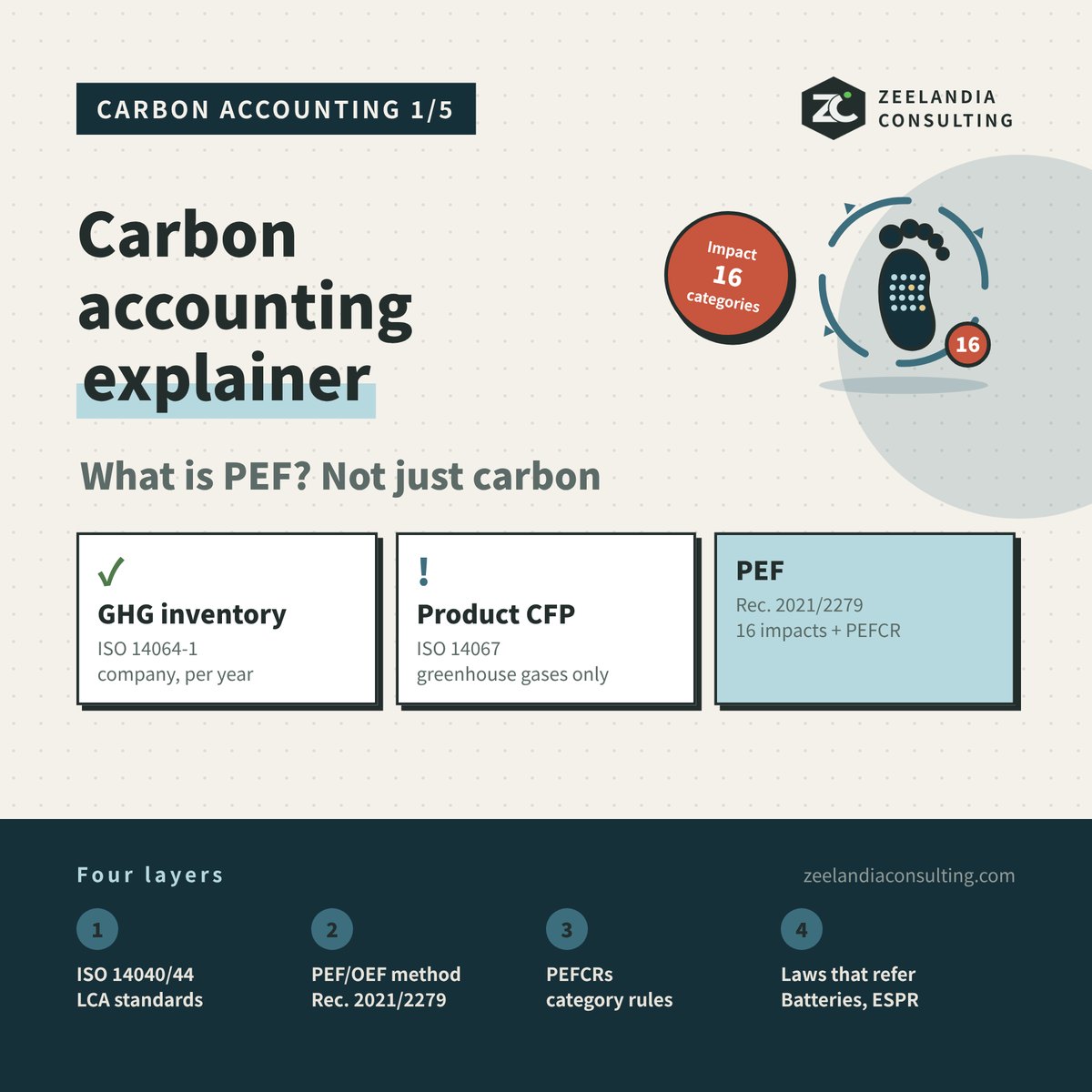
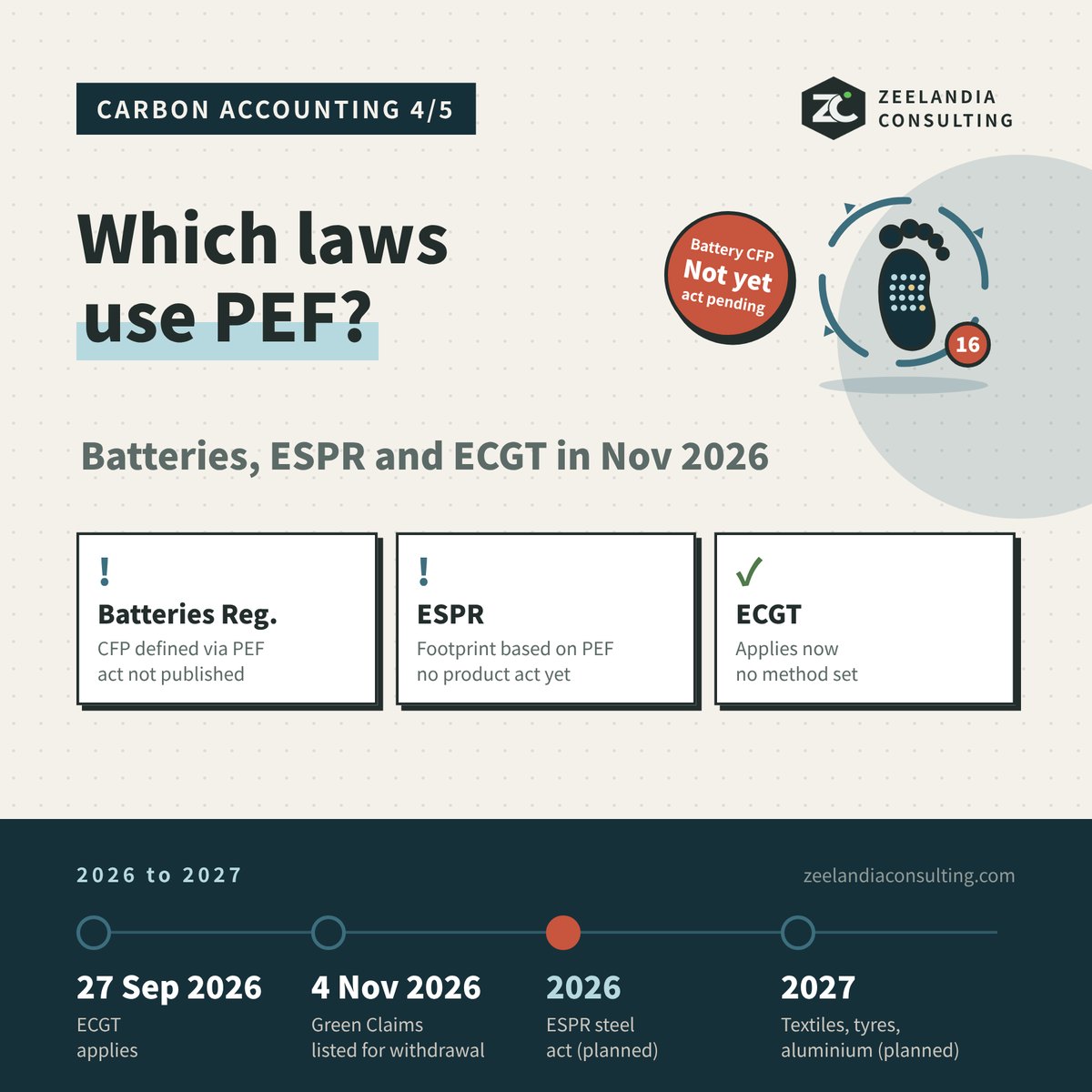
The Product Environmental Footprint (PEF) is set out in Recommendation (EU) 2021/2279 and is not binding on its own; it becomes an obligation when an individual law refers to it. As of November 2026, the laws that clearly build on PEF are the carbon footprint definition in the Batteries Regulation and the environmental footprint definition in ESPR, but the key secondary acts for both are still pending. The ECGT anti-greenwashing Directive already applies but prescribes no calculation method, and the Green Claims Directive, which would have set substantiation methods, has been listed for withdrawal.
Key points
- Batteries Regulation: Article 3 defines carbon footprint as a PEF study using climate change only; the Article 7 methodology delegated act had still not been published in the Official Journal as of November 2026, so declaration obligations have not started.
- ESPR: the “environmental footprint” definition is based on PEF; the working plan schedules iron and steel for 2026 and textiles, tyres and aluminium for 2027, but no product delegated act has been adopted yet.
- ECGT (anti-greenwashing) applies from 27 September 2026 and does not prescribe PEF, but claims must be substantiated.
- Green Claims Directive: the Commission’s 2027 work programme of 4 November 2026 lists it among proposals to be withdrawn within six months.
- Not PEF: GHG disclosures under CSRD/ESRS and embedded emissions under CBAM follow their own methods.
1. Overview: where PEF sits in EU law
| Law | Link to PEF | Status in November 2026 | Who is affected outside the EU |
|---|---|---|---|
| Batteries Regulation (EU) 2023/1542 | Carbon footprint defined on the basis of PEF (climate change only) | Methodology delegated act not yet published | EV, LMT and industrial batteries above 2 kWh, plus upstream cells and materials |
| ESPR (EU) 2024/1781 | Environmental footprint defined on the basis of PEF or other recognised scientific methods | No product delegated act yet | Exporters of steel, aluminium, textiles, tyres, furniture |
| ECGT Directive (EU) 2024/825 | No method prescribed; claims must be substantiated | Applies from 27 September 2026 | Brands selling to EU consumers; suppliers indirectly |
| Green Claims Directive proposal COM(2023) 166 | Would have set substantiation and third-party verification | Listed for withdrawal; formally pending until withdrawal is completed | No application date |
| French textile “environmental cost” | Method based on PEF, with French additions | Voluntary labelling since 1 October 2025 | Apparel brands selling in France and their suppliers |
| CSRD/ESRS E1, CBAM | Not PEF; each has its own method | Applying (scope per law) | Suppliers asked for corporate emissions or embedded emissions |
2. Batteries Regulation: already in a legal definition, and the closest to mandatory
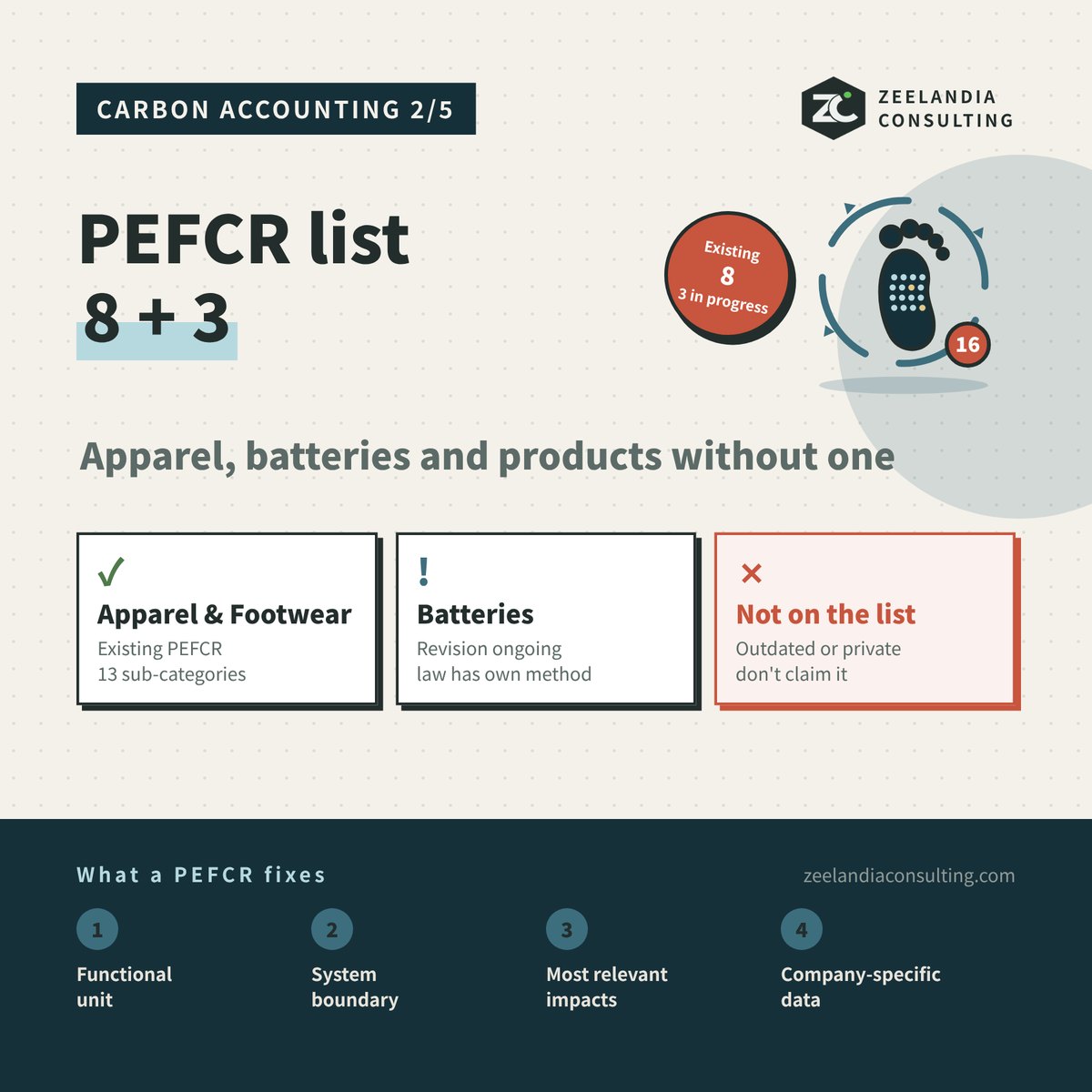
Article 3(1), point (21), of the Batteries Regulation defines “carbon footprint” as the sum of greenhouse gas emissions based on a PEF study using the single impact category of climate change; recital 27 also refers to the existing battery PEFCR. The carbon footprint requirements in Article 7 come in three stages (declaration, performance class, maximum threshold) and apply only to EV batteries, rechargeable industrial batteries above 2 kWh and light means of transport (LMT) batteries.
Each stage applies from “a fixed date or a period after the relevant delegated and implementing acts enter into force, whichever is later”:
| Battery category | Carbon footprint declaration applies from (Article 7(1)) |
|---|---|
| EV batteries | 18 February 2025 or 12 months after the delegated and implementing acts enter into force, whichever is later |
| Rechargeable industrial batteries (except exclusively external storage) | 18 February 2026 or 18 months after, whichever is later |
| LMT batteries | 18 August 2028 or 18 months after, whichever is later |
| Rechargeable industrial batteries with exclusively external storage | 18 August 2030 or 18 months after, whichever is later |
The draft delegated act on the carbon footprint methodology for EV batteries was published for feedback in April 2024 and had still not been published in the Official Journal as of November 2026, so declaration obligations have not started for any category. Portable batteries are currently outside Article 7. See EUBR series, Part 6.
Battery carbon footprint has not started yet. What now?
Once the delegated act is adopted, EV batteries have 12 months and industrial batteries 18 months to produce a declaration, with a notified body involved. Upstream cell and cathode material data take the longest to collect.
The carbon footprint will also go into the battery passport, required from 18 February 2027.
3. ESPR: PEF is the methodological basis, but it depends on each product act
Article 2 of ESPR defines “environmental footprint” as a quantification of a product’s life-cycle environmental impacts based on the PEF method of Recommendation (EU) 2021/2279, or other scientific methods developed by international organisations, widely tested with different industry sectors and adopted in other Union law. Annex I lists the product parameters that delegated acts may use, including environmental footprint and carbon footprint.
ESPR does not itself require PEF for any product; that depends on product-specific delegated acts. The first working plan, COM(2025) 187 of 16 April 2025, sets this indicative timetable:
| Product group | Delegated act expected |
|---|---|
| Iron and steel | 2026 |
| Textiles (apparel), tyres, aluminium | 2027 |
| Furniture | 2028 |
| Mattresses | 2029 |
As of November 2026, no product-specific delegated act had been adopted. Except in duly justified cases, requirements apply no earlier than 18 months after a delegated act enters into force. Whether each act requires an environmental footprint, and whether it uses PEF or its own method, depends on the drafts. The ESPR page in the Regulatory Radar tracks delegated and implementing acts.
4. ECGT: applies now, but does not require PEF
The ECGT Directive (EU) 2024/825 applies from 27 September 2026. It bans generic environmental claims, product carbon neutrality claims based on offsetting, and sustainability labels not based on a certification scheme or set up by public authorities. It does not specify which method must be used to substantiate a claim.
So PEF plays the role of “one acceptable basis”: when a brand tells consumers about a product’s environmental performance, results calculated under a PEFCR are more defensible than a home-made method, and the data often come from suppliers. See the full article on ECGT.
5. Green Claims Directive: listed for withdrawal
The Green Claims Directive proposal (COM(2023) 166) would have set prior substantiation methods and third-party verification for explicit environmental claims. Trilogue negotiations broke off in June 2025. The Commission’s 2027 work programme, published on 4 November 2026, lists it in Annex III among pending proposals it intends to withdraw within six months. Until the withdrawal procedure is completed it remains formally pending, but it has no application date.
This does not make PEF irrelevant. Claims are still governed by ECGT and national unfair commercial practices law, and the route by which product laws such as the Batteries Regulation and ESPR refer to PEF is unchanged.
6. French textile “environmental cost”: PEF applied at national level
Under Decree No 2025-957 of 6 September 2025 and an order of the same date, France has allowed apparel brands to label an “environmental cost” (coût environnemental) on a voluntary basis since 1 October 2025. The French Ministry for Ecological Transition explains that the method is based on the EU PEF and was validated by the Commission in May 2025; France added criteria that PEF does not cover. Labelling remains voluntary, but brands that choose to label must first publish their data on the official portal.
For fabric and garment suppliers, this means brands selling in France may ask for more detailed material, dyeing and origin data.
7. Not PEF: CSRD, CBAM and national carbon pricing
- CSRD/ESRS E1 requires disclosure of a company’s Scope 1, 2 and 3 greenhouse gas emissions. This is organisation-level accounting, not PEF.
- CBAM calculates embedded emissions of imported steel, aluminium, cement and other goods under its own implementing rules and default values. It is not PEF.
- National carbon fees or taxes in exporting countries follow their own inventory systems and have nothing to do with EU PEF.
These requests often appear together in one customer questionnaire; the figures and methods need to be handled separately.
3 things to check now
- Which PEF-related laws cover your products? Battery categories under Article 7 of the Batteries Regulation, or ESPR priority product groups?
- Do your customers make environmental claims to consumers? Are those claims based on data you provided?
- Which law does each “carbon” question in your customer’s questionnaire relate to? CSRD, CBAM, product carbon footprint or PEF?
One questionnaire, four methods
Corporate emissions, product carbon footprints, CBAM embedded emissions and PEF often appear in the same customer questionnaire. Separating their methods and responsibilities stops one number from answering four questions.
Book a 30-minute online consultation and bring the questionnaire →
Common misconceptions
MythWith the Green Claims Directive being withdrawn, PEF will never become mandatory.
FactThe Green Claims Directive never required PEF across the board. What turns PEF into an obligation is product law: Article 3(1), point (21), of the Batteries Regulation already defines carbon footprint on the basis of PEF, and the environmental footprint definition in Article 2 of ESPR is also based on PEF.
MythThe Batteries Regulation required carbon footprint declarations from 18 February 2025, so we are already late.
FactArticle 7(1) applies from "a fixed date or a period after the delegated and implementing acts enter into force, whichever is later". The methodology delegated act had still not been published as of November 2026, so the declaration obligation has not started.
FAQ
Will the ESPR steel delegated act require PEF?
It depends on the act. ESPR allows delegated acts to define environmental footprint using PEF or other recognised scientific methods, or to require only carbon footprint, recycled content or other parameters. As of November 2026 the steel act had not been adopted.
After ECGT, can a brand still call a product “low carbon”?
It depends on how. Writing only “low carbon” or “eco-friendly” without being able to show recognised excellent environmental performance is a generic claim; a specific claim with evidence is different. Member States enforce through their transposing laws, so check the basis and wording before making the claim.
Can CBAM emissions data be used as a product carbon footprint?
Not directly. CBAM calculates embedded emissions of specific goods at the production stage, with its own boundaries and rules; a product carbon footprint or PEF covers the whole life cycle with a different method.
Next in the series
Need help?
ZC can help you confirm which PEF-related laws cover your products, with support on the EU Batteries Regulation, ESPR and other EU regulations and ISO 14067 product carbon footprints.
- Book a 30-minute online consultation: pick a time
- EU Regulatory Radar: ESPR, Batteries Regulation, ECGT
- Follow ZC on LINE: lin.ee/QKV5RTE
Legal sources and references
- Regulation (EU) 2023/1542, Article 3(1)(21), Article 7 and recital 27: EUR-Lex
- Regulation (EU) 2024/1781, Article 2 and Annex I: EUR-Lex
- Ecodesign for Sustainable Products and Energy Labelling Working Plan 2025-2030, COM(2025) 187: EUR-Lex
- Directive (EU) 2024/825: EUR-Lex
- European Commission, Commission work programme 2027 (Annex III: withdrawals): commission.europa.eu
- Loyens & Loeff, 2027 work programme and the Green Claims Directive (5 November 2026): loyensloeff.com
- French Ministry for Ecological Transition, environmental cost of clothing: ecologie.gouv.fr
This article provides general information, updated to 15 November 2026, and does not constitute legal advice. Delegated acts and the withdrawal procedure are still in progress; rely on the latest Official Journal texts.
Next step: have you considered these three options?
Sources · Regulation (EU) 2023/1542 (Batteries Regulation) · Regulation (EU) 2024/1781 (Ecodesign for Sustainable Products Regulation) · Ecodesign for Sustainable Products and Energy Labelling Working Plan 2025-2030, COM(2025) 187 · Directive (EU) 2024/825 (Empowering Consumers for the Green Transition) · European Commission, Commission work programme 2027 (Annex III: withdrawals) · Loyens & Loeff, Green Claims Directive set to be withdrawn (5 November 2026) · Ministère de la Transition écologique, affichage du coût environnemental des vêtements · Décret n° 2025-957 du 6 septembre 2025 (coût environnemental des produits textiles). This article is general information and not legal advice for any specific case. Obligations are defined by the Official Journal of the EU.
PEFbattery carbon footprintESPRecodesignECGTGreen Claims DirectiveFrench textile environmental costProduct Environmental FootprintEU carbon accounting